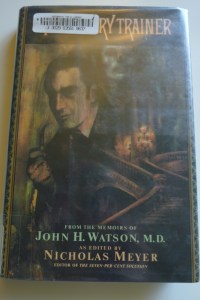
 I’ve been on a Phantom of the Opera kick lately–I mean, more so than the ongoing attachment I’ve had to the story for the last eight years. I wrote a post about different versions, and learned about a new-to-me book, The Canary Trainer by Nicholas Meyer–thank you, Swamp Adder!
Now how I could resist the Phantom of the Opera meets Sherlock Holmes, written by the director of Star Trek: The Wrath of Khan? Especially after rereading the flawed but enjoyable Angel of the Opera by Sam Siciliano, another Holmes-meets-the-Phantom story. It may not be quite fair to compare them (especially since The Canary Trainer was published a year earlier) but it’s also unavoidable. TCT was better than AotO…and worse, contradictory though that might sound.
The big problem with AotO was that it completely maligned Watson. TCT at least did better in that regard, and that does make a big difference. Watson was back in his proper place as Holmes’ closest friend. Holmes regards Watson’s writing about him with outward disdain and secret but obvious pride–as it should be. The book opens very well, with Watson visiting Holmes and discussing past cases, finally teasing a new story out of him. Here we go into a book-length flashback, told from Holmes’ point of view. I think I would have preferred a story that kept Watson’s POV, but this worked well enough–and better than bringing in a superfluous new narrator.
The story is from Holmes’ “lost years,” the time between Moriarty going off a cliff and Holmes’ return from the dead. Apparently Meyer has written other books set in this time period, including one that brings Holmes and Freud together. I haven’t read the others, and though they’re alluded to occasionally, I don’t think it’s necessary in order to read this one. The story, as you’ve probably guessed, has Holmes deciding to go to Paris. He’s incognito, since everyone presumes him dead, and has to find other, non-detective work. He chances to hear that the Paris Opera is hiring a new violinist, and applies for the job. Once at the Opera, he finds mysterious happenings involving the Phantom. He also encounters Irene Adler, who is singing at the Opera. She recognizes Holmes and asks him to help her new friend, Christine Daae–the “canary” who has a mysterious trainer.
And so it goes from there, with a falling chandelier, an inept viscount, a soprano in distress and a crazy man in a mask. Like Siciliano, Meyer doesn’t make major plot changes. Holmes is investigating the story we all know, and if nothing is greatly improved, nothing is done badly either, plot-wise.
You might say the same for Holmes. He was reasonably well-drawn, nothing extraordinary. If there’s anything reading other writers tackle Holmes has done for me, it’s made me appreciate Doyle’s ability to give Holmes clues and let him draw conclusions. No one else seems to be able to do that to any great extent, although in one scene Holmes does figure out Raoul’s entire life circumstances just by looking at him. But it was one moment, instead of a perpetual state. I won’t say that the absence of deductive reasoning was acute enough to have the character actually off-track, but he wasn’t strikingly on-track either. He also seemed to struggle a bit in his investigations. I think he was more accurate to the original and more likable than Siciliano’s Holmes, but also less capable–and not as likable or as capable as Doyle’s Holmes.
We don’t see a whole lot of Christine and Raoul, and they were pretty standard when we did see them. Raoul is immature and incompetent, Christine is hopelessly innocent and naive. They both fulfilled their roles without doing much more than that–although Christine did get to score one point on Holmes. She’s talking about her Angel of Music, and Holmes says he seems very angry for an angel. To which Christine returns, “Haven’t you ever heard of avenging angels?” Touche, Miss Daae. But on the whole, she was pretty much sweet and stupid. Looking at the basic plotline of Phantom, Christine has to be either very stupid or very clever, either a victim or the one who’s manipulating the whole thing. I’d love to see a version where Christine is manipulative (think about it–who comes out ahead quite frequently?), but so far everyone’s been choosing to make her stupid or at least confused (though I think Webber is open for interpretation).
Anyway, now we come to the key question: the portrayal of the Phantom. Usually, he’s a deeply complex character: tragic, sympathetic, terrifying, sometimes romantic, brilliant…certainly the most interesting one in the story. That’s the later versions; in Leroux, he’s much more a monster. Everyone else has been working on reforming him ever since. Except Meyer. The Canary Trainer is the first and only version I’ve found where the Phantom is actually less sympathetic than in Leroux (so…points for originality?) This is the first time he’s gone the opposite direction and felt more like a character from a monster flick, stranger, crazier, and less sympathetic. If you’ve read Leroux, you’ll know that making him crazier is really saying something.
This is the first time the body count has actually gone up. In Leroux, one person is killed by the chandelier; in The Canary Trainer, it’s almost 30. Four men who were drugged in Leroux to get them out of the Phantom’s way end up killed here. You can make the point that the Phantom is a murderer regardless of how many people he kills, but I think there’s still little doubt that Meyer was deliberately creating a more villainous Phantom. I don’t quite know what to make of that. In a way I do applaud his decision to do something different. But…there’s a reason everyone else made the Phantom more sympathetic. He’s more interesting that way.
That may kind of sum up the book. There’s nothing really wrong with it. It’s not flawed in the same ways that Angel of the Opera is flawed, nor is it flawed in other serious ways. But it didn’t do anything all that interesting either. Holmes and the Phantom were both stripped of what makes them fascinating (Holmes’ deductive ability and the Phantom’s complexity), and in the end you get a book that is not bad–better than some versions–but not great either. I don’t hate it, and I don’t love it. I think it comes out about even with Angel of the Opera, but that’s because it’s neither as good in some ways nor as bad in others. I’m glad to have read it; I’m endlessly intrigued by what people make of the Phantom story. But I do think Nicholas Meyer accomplished something much more impressive with The Wrath of Khan.
Author’s Site: http://nmeyer.pxl.net/
Other reviews:
Here, There and Everywhere
A Bluestocking’s Place
Anyone else?







 Tales of the Marvelous