Climbing Notre Dame with Quasimodo

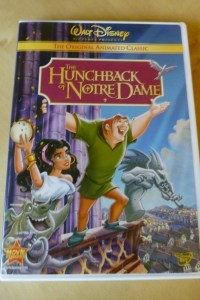
HunchbackOne of my top places to see in Paris last September was Notre Dame Cathedral–for the architecture and because I like big old churches and because it’s an icon.  But also very much because of The Hunchback of Notre Dame.  I’ve never actually read Victor Hugo’s novel (though I have put it on my list since visiting the cathedral) so when I say that Hunchback influenced my Parisian sight-seeing…I mostly mean the Disney movie.

I can’t remember being particularly attached to this one as a kid, but in recent years it’s been emerging as one of my favorite Disney cartoons.  That makes sense, because this is not at all a typical Disney cartoon, and has a much more adult feel.  I love typical Disney and I don’t mean to criticize it in the review that follows, but I do feel this one is on a different level.

I’d really like to know how the first person looked at the book and said, hey, let’s make a cartoon!  Instead of a star-crossed princess and her prince, we have Quasimodo, the hunchbacked bellringer of Notre Dame.  His only friends are three gargoyles (two of whom are named Victor and Hugo–love that) and though he dreams of entering the world he’s watched, this has always been forbidden by his master, the stern magistrate Frollo.  Quasi finds a little daring, the beautiful and bewitching gypsy Esmeralda comes on the scene, and everything changes.

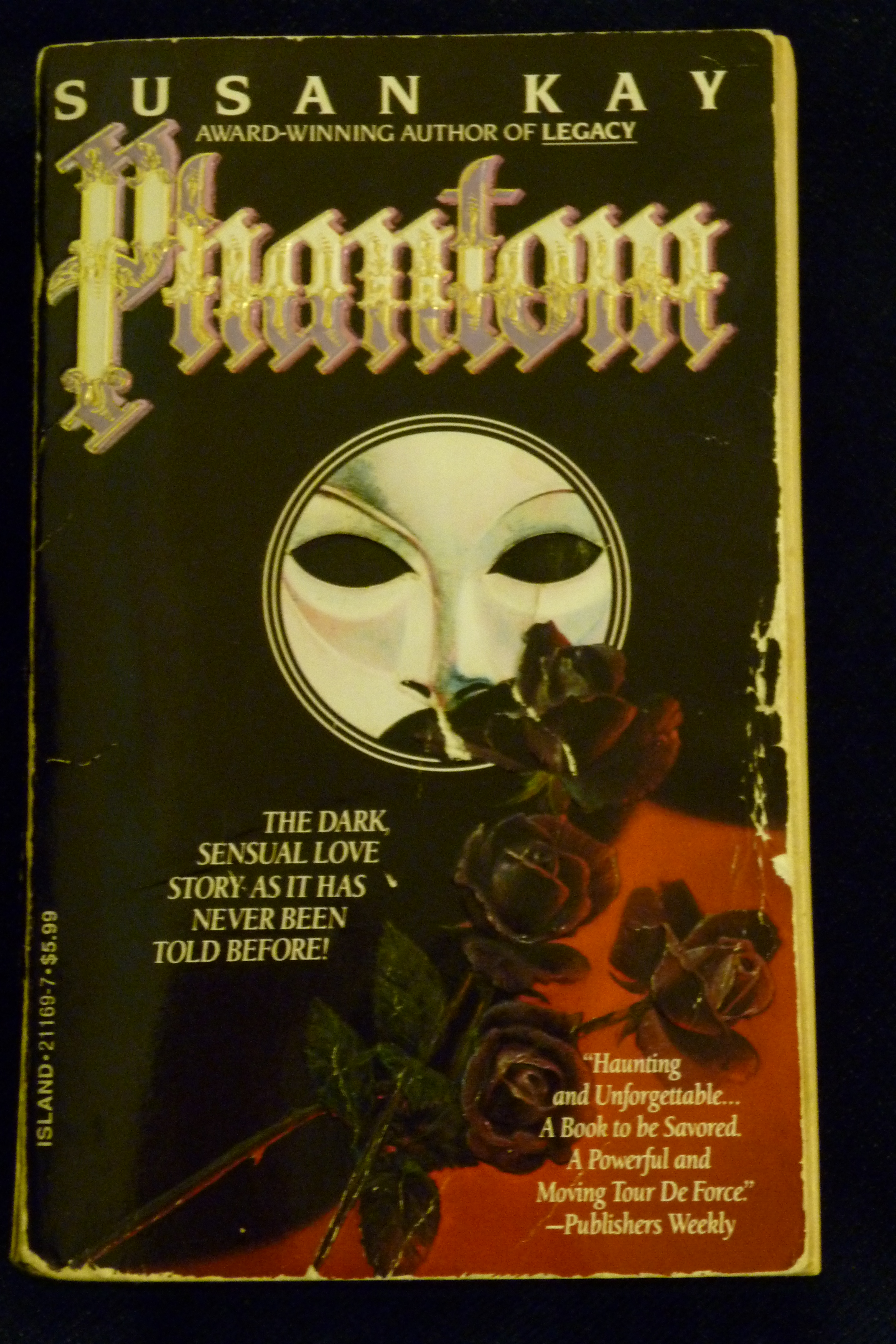
I love Quasi and his growth as a character, as he overcomes his fears and realizes his own value.  Sure, it’s not quite the complexity of Susan Kay’s Phantom, but there’s still a depth here that goes beyond perfect-princess-meets-perfect-prince.  Likewise Esmeralda is a strong, intelligent character, very aware of larger societal issues of class and prejudice.  I even like the prince figure, the handsome Phoebus, who I find more likable than, say, Raoul from Phantom.  Phoebus has his own depth, as a soldier who struggles with a new position and orders he doesn’t like–and he has a sense of humor.  Disney heroes who have funny scenes with horses to seem to work well with me…  And how do you go wrong when he says to his horse, “Achilles–heel.”

Frollo is also a villain with fascinating depth, and he’s a very mature villain for a Disney movie.  His interest in Esmeralda is on a totally different level than Jafar’s decision to marry Jasmine in Aladdin.  I really don’t know how the scene “Hellfire” got into a Disney cartoon.  Frollo is singing about lust and temptation and damnation, while there are flames and demons and hooded figures chanting “mea culpa.”  It’s fantastic and wonderful, but–in a Disney movie?  Really?

I love the songs, especially “Out There” which is one of my favorite songs ever.  It’s just so beautiful and heartfelt, and is one of the main reasons I felt I had to spend time in Paris “strolling by the Seine.”  The only time I got out my iPod while walking around was to listen to “Out There,” sitting on a wall next to the Seine.  I also love “God Help the Outcasts”–again, there’s a depth to it, and to Esmeralda’s character.  From the opening lines, “I don’t know if you can hear me, or if you’re even there–or if you would listen to a gypsy’s prayer,” she’s having a complex religious experience.  It’s deep, it’s emotional, leading up to the end, “please help my people, the poor and downtrod–I thought we all were children of God.”

My only significant reservation on the movie is the last two minutes.  After such a beautifully nuanced movie, it tied up with more of a simple Disney happy ending.  Quasi gives his blessing to Esmeralda and Phoebus, and then is embraced by the crowd.  And…I don’t buy either idea.  He may accept how Esmeralda feels about Phoebus, but I’d find it much more believable if he was less pleased about it.  A little wistfulness, maybe?  And after all the times that crowd has made an about-face, I wouldn’t trust it to stay welcoming for the span of five minutes.

I’m not sure what ending I want.  I don’t want Quasi to die, or even to retreat back into his belltowers (because then what was the point of the character growth?)  But after all the rest of the movie, I feel like they could have managed a more subtle, less conventional ending.  Maybe he retreats to the towers but it’s implied he’ll come out again in the future?  A little wistfulness on the romance question but also make it clear that Esmeralda and Phoebus will be his friends into the future, opening up the possibility that he could venture out farther someday?  There had to be some kind of bittersweet or lightly hopeful ending they could have managed.

I still love the movie–and I loved watching it shortly after visiting Notre Dame.  Someone animating this really knew what Notre Dame looked like, and when I watched it again I kept reacting to things I recognized.  If you go to Notre Dame, you can easily go into the church, which is very beautiful.  I recommend also going around the corner to the left and getting in line to visit the belltowers.  There are a lot of stairs (a LOT of stairs), but it’s worth it to see the gargoyles and the view.  You don’t really get to see Quasi’s bells (just one) or the space where he lives in the cartoon, but it’s still neat–and you can see the whole of Paris below.
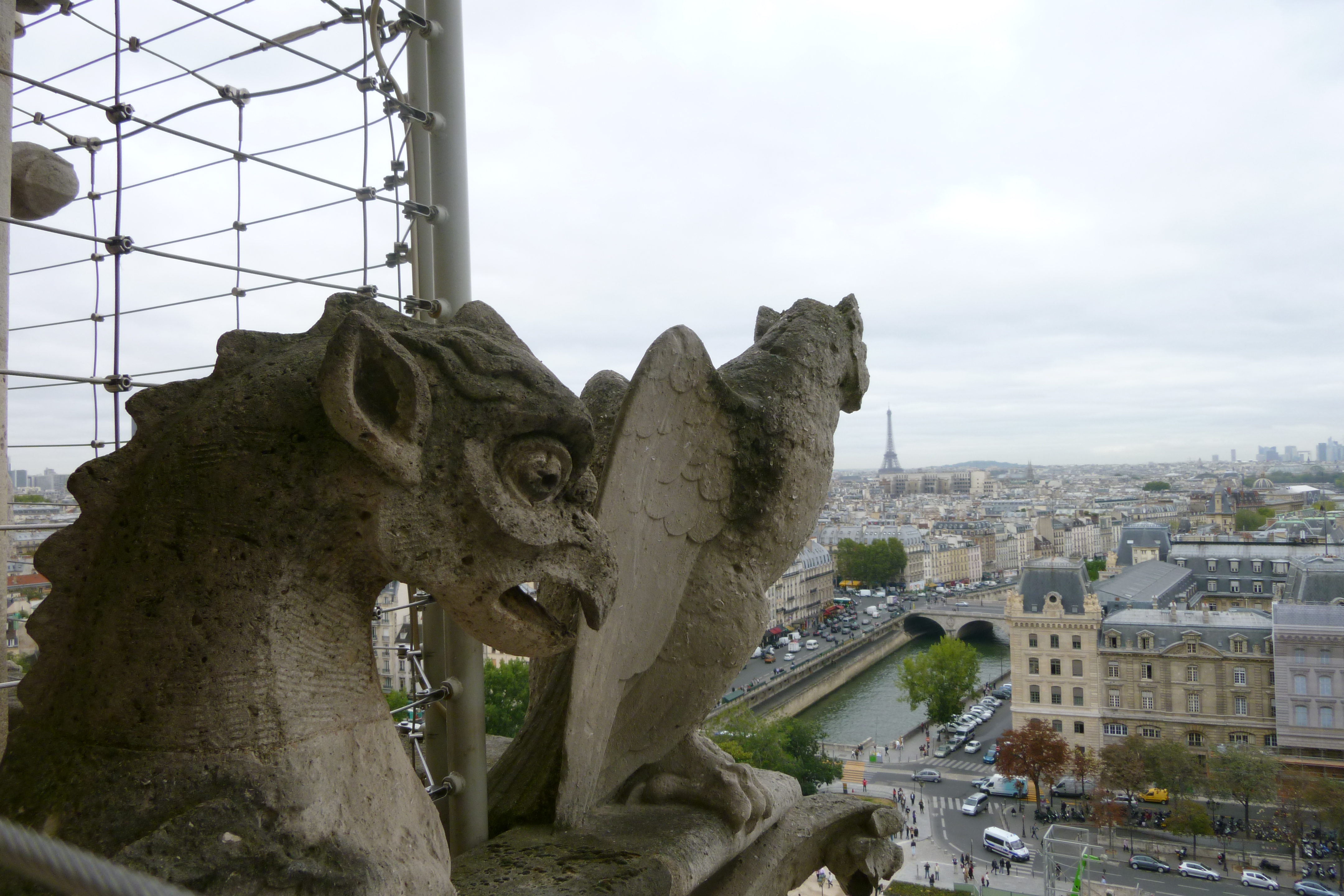
I’m planning a Notre Dame Saturday Snapshot for this weekend, so come by for more pictures then!

Saturday Snapshot: Teatime

It’s raining all this weekend.  I thought about sharing rain pictures, but found out that it’s not so easy to photograph rain.  But rain makes me want to curl up somewhere cozy and drink tea, so I thought I’d share tea pictures–particularly fun tea pictures, from my London trip.

Tea at the Orangerie (4)This is the Orangerie in Kensington Gardens.  If you’re ever there, it’s off the Broad Walk near Kensington Palace.  They’re known for their excellent afternoon teas–two different friends who had lived in London recommended them to me!

Tea at the Orangerie (5)

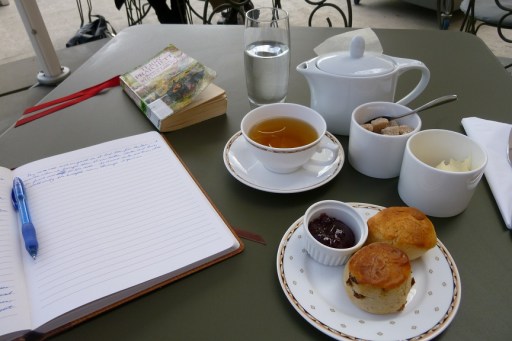
This was my experience of tea–not actually the fancy version, which they serve on a pretty tiered tray and has cakes and sandwiches and enormous amounts of food.  But I wasn’t that hungry and they kindly let me just have very tasty tea and scones, even though the option wasn’t on the menu.

Tea at the Orangerie (3)

This is the view from the Orangerie’s patio.  Somewhere beyond that path is Kensington Palace.

Tea at the Orangerie (1)I also had breakfast at the Orangerie another day–the eggs tasted better than they look in the picture!  That day I ate inside, and got this picture…

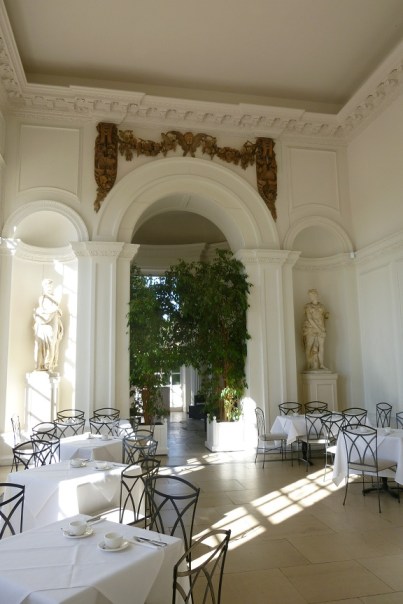
Tea at the Orangerie (2)It’s a beautiful place–and not as busy Sunday mornings as it is for afternoon tea.  If you’re in Kensington Gardens (where you MUST go if you have any interest in Peter Pan), then the Orangerie is an excellent place for a very charming breakfast or tea!

Visit At Home with Books for more Saturday Snapshots.

Saturday Snapshot: The Louvre

I still have lots of travel photos I haven’t shared yet.  Thought I’d get away from the fall colors this week and share some trip photos instead…and for some reason I’m in the mood for artwork.  Let’s tour the Louvre.

The Louvre is known for having a few very famous pieces of art.  Of the famous ones, Winged Victory was my favorite.  I took a lot of shots, but I like this one best–looking as though she’s about to take flight.

Pardon the slight fuzziness of the Venus de Milo–only shot I could get without hordes of people in the frame!

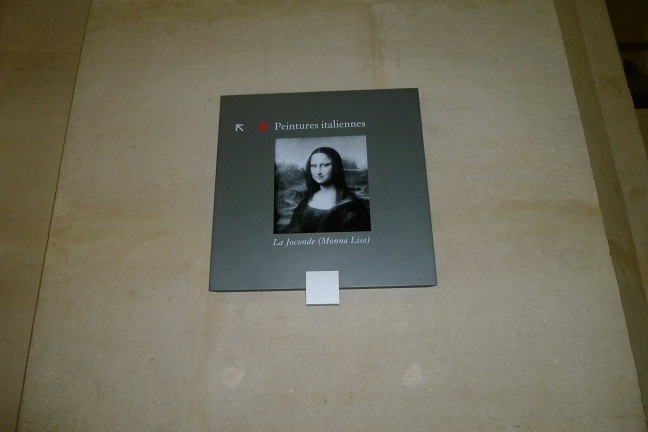
The Louvre is a complete labyrinth (I got SO lost) but they do have helpful signs pointing you to the main attractions.  I guess they know what people are looking for!

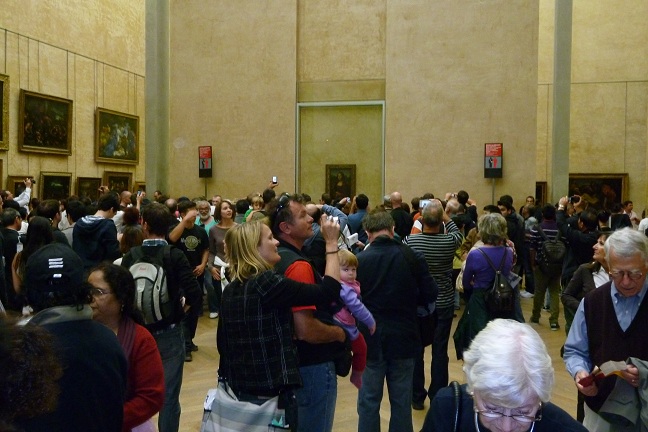
And sure enough…here’s where everyone is!  That’s the Mona Lisa way off across the crowd.  To be honest, as a painting it’s never really spoken to me.  But I was very entertained by the masses clustered around.  I wish I could have captured the forest of arms holding up camera phones–it looked like a rock concert!

I hope you enjoyed the Louvre.  🙂  Visit At Home with Books for more Saturday Snapshots.

Saturday Snapshot: Paris Opera House

This week, I reviewed one of my very favorite books, Susan Kay’s Phantom–and I promised pictures from my recent trip to Paris!

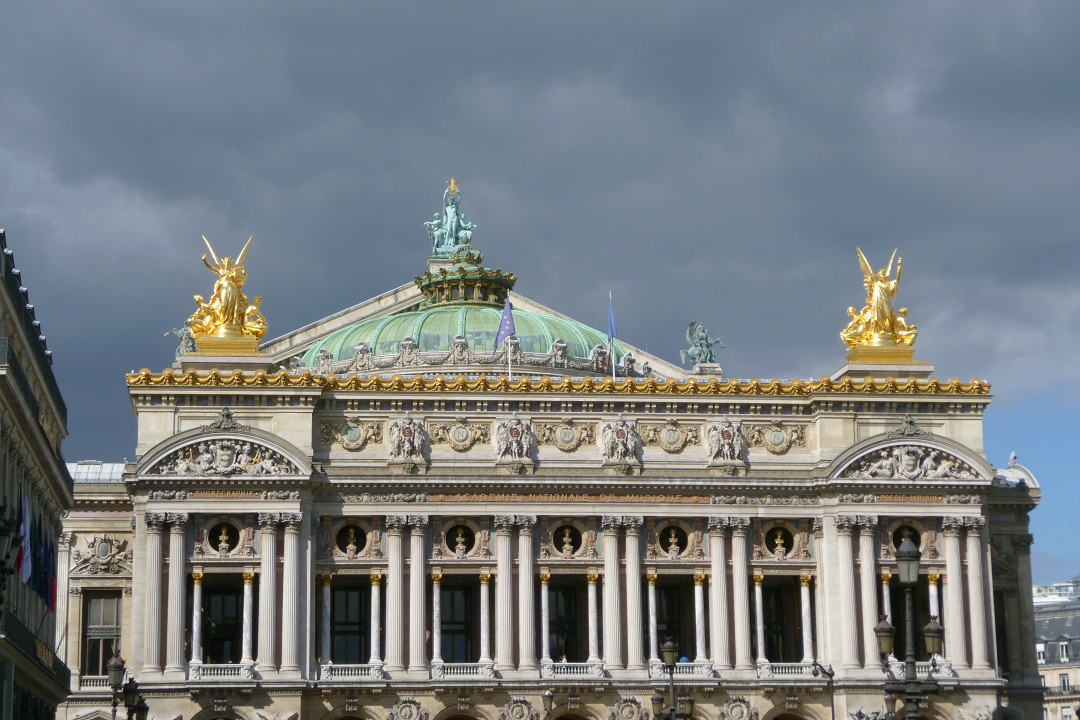
The Paris Opera House–or as the Parisians call it, the Opera Garnier.  This was taken from somewhere far enough down the Avenue de l’Opera that you can see the dome.  I love those gold statues.  They shine so bright, even on cloudy days.

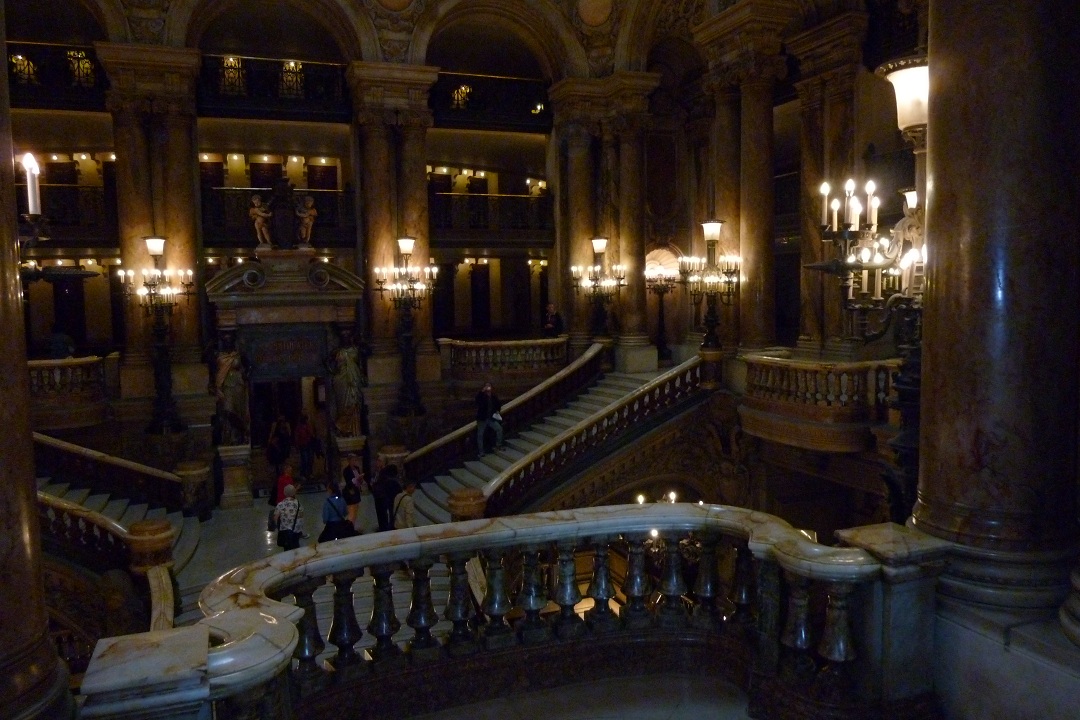
This is the famous staircase–it’s very hard to get a shot that isn’t covered in people!  Not to mention one with decent lighting…

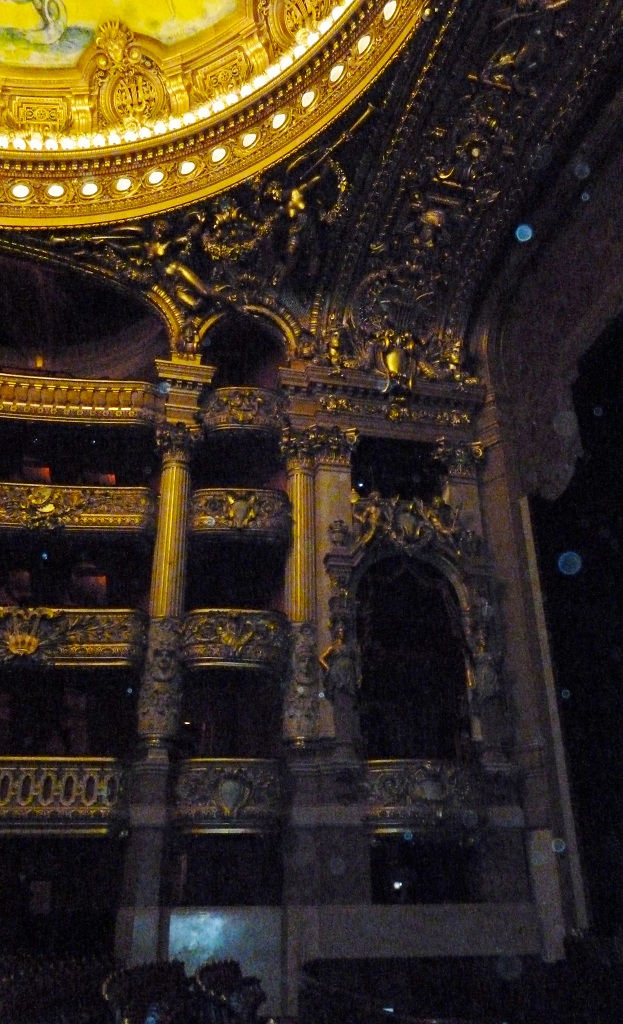
This is, I confess, what I was mostly here to see.  Phantom fans–Box Five is the bottom tier, in the middle.  The big box closest to the stage is the Imperial Box, and the boxes farther to the right are general boxes–and not nearly as secluded as Box Five.

The famous chandelier!  Unbroken. 🙂

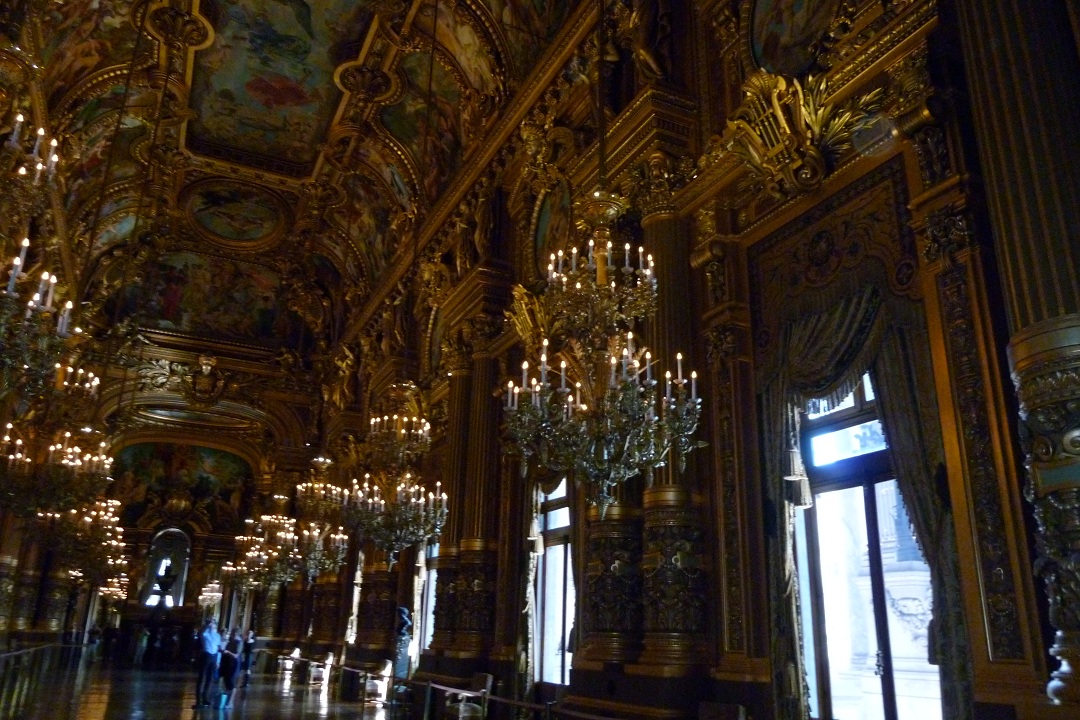
This is the grand foyer–unbelievably gorgeous.  And, as fully befits an Opera House where all is illusion…it’s mostly gold paint!

I know there wasn’t really a Phantom…but someone building this place was having fun with mirror tricks.

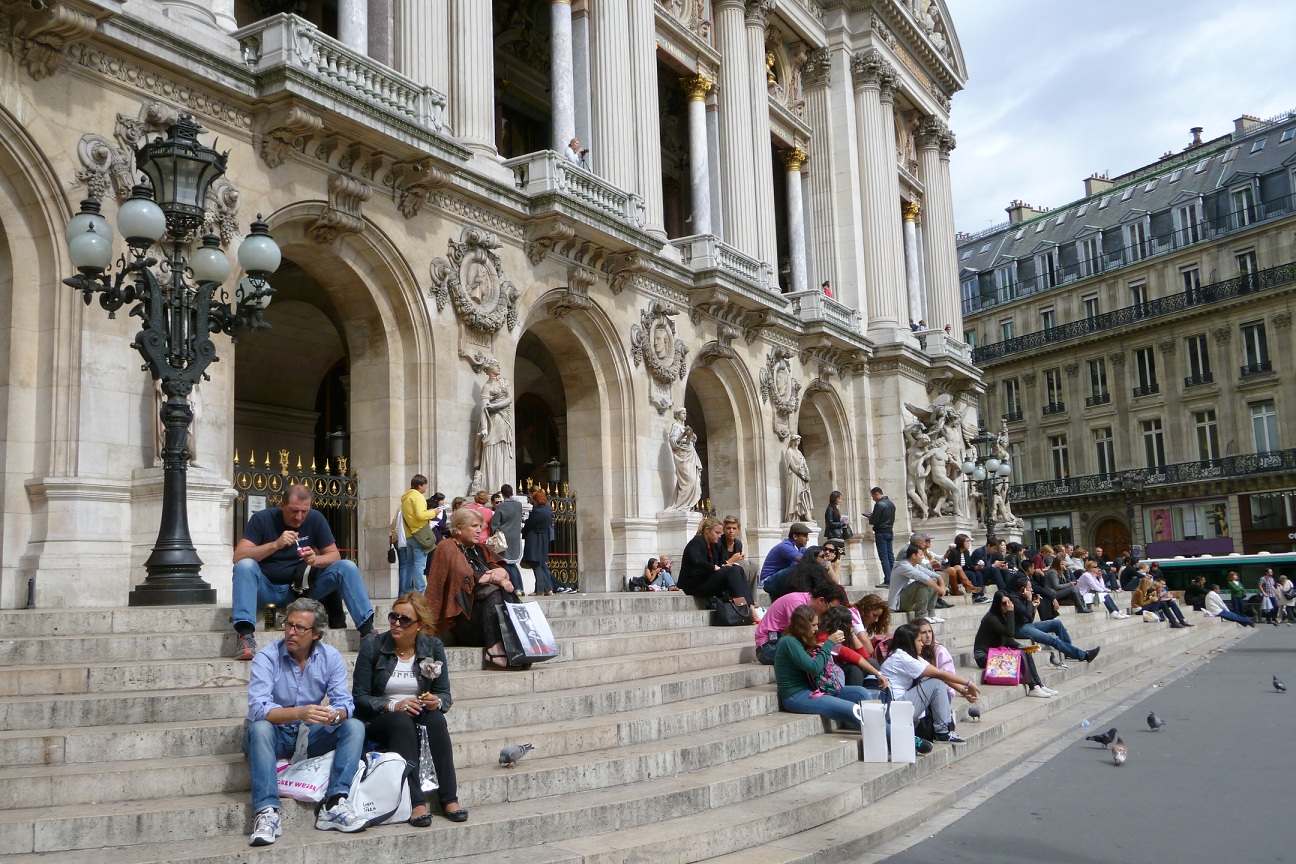
These are the front steps of the Opera House, and I feel remarkably fond of them.  You see, when you’re on a literary pilgrimage and have a hotel two blocks away, it’s a wonderful discovery to find out that you can go sit on the steps of the Paris Opera House any time you like!

Check out At Home with Books for more Saturday Snapshots!

Reading Phantom in Paris

When I went to Paris in September, I decided it was a good opportunity to finally reread Susan Kay’s Phantom.  I read it once seven years ago, it completely blew me away, and it made such an impression that I always felt like it was too soon to reread–it was still there in my mind.  And I think I was afraid that I couldn’t repeat the experience twice!

But I brought it along to Paris to read again–and it was amazing.  I’m also counting it for the R. I. P. Challenge.  I reviewed Susan Kay’s Phantom once already, but I think it’s worth doing it again.  This review is basically going to be structured as a summary, a lot of gushing, and then circle back to Paris to talk about visiting the Opera House.  You’ve been warned if you want to skip some of the gushing!

My copy of the book doesn’t have a sub-title, but I’ve also seen this called Phantom: The Story of His Life, and that’s really what it is.  The story begins with the Phantom’s mother, goes on through his entire life and on past his death.  Kay brilliantly grounds us in each period, telling the story in sections with different first-person narrators.

First there’s Erik’s mother, Madeleine, telling her own story and taking us through his very troubled childhood.  Erik takes over the narration when he runs away from home at nine, falling in with a band of gypsies.  Later we see him as a teenager in Rome; this section is told by Signor Giovanni, the master architect who saw a spark of genius in this strange masked boy, and took him under his wing–for a time.  The Daroga tells us about Erik’s time in Persia, and a very sad and bloody time it is.  Erik picks up the thread again when he returns to France, meets Charles Garnier, and becomes obsessed with work on the building of the new Paris Opera House–which he ultimately decides will be his escape from the world.  And then Christine comes on the scene, and she and Erik tell the most familiar part of the story in alternating scenes, until the final section is narrated by–but perhaps I won’t give that away!

Kay does something truly masterful here.  Every narrator has his or her own story, with their own passions and tragedies, while at the same time the book never loses its focus on Erik.  It’s a brilliant balance that gives us the Phantom through so many eyes, and tells so many stories, without feeling fragmented or like we ever get lost on some side-plot. Every character is brought to life and I care deeply about all of them–even Madeleine.  I hate her, so caring might not be quite the right word, but I do feel deeply about her.  Although on a second read, I felt more sorry for her than I did the first time around.

The most significant character, of course, is the Phantom.  As on my first read, I fluctuate between finding him scary, and wanting to hug him.  He is so dark, and so unstable, and SO SAD.  And brilliant–completely, unbelievably brilliant.  Unlike other books I could name, Kay doesn’t pin all of Erik’s problems on the facial deformity.  That’s a huge part of the book, of course, but there’s so much more.  Erik is rarely shown kindness, so he doesn’t trust it when he sees it.  His biggest problem is not that he’s so ugly no one could love him; it’s that he believes he’s so ugly no one could love him.  It’s a fantastic, vital distinction that makes him so much more complex.  And something that’s not going to be solved by a moonless night.

The scope of the book is magnificent.  Without feeling long, it still feels like it crosses continents and covers decades.  When an adult Erik remembers his childhood dog, I don’t feel like I just read about her a hundred pages ago–it was years in the past!  Despite the huge scope, it doesn’t feel like an overview.  Everything is immediate and present as it happens.

There are so many very small, very wonderfully told moments.  The first to come to mind is Erik’s fifth birthday, when his mother insists that he tell her what he wants, and all he really wants is a kiss (one now, and one to save for later) and…it doesn’t end well.  And I hate Madeleine.  There are some nice moments of friendship with the Daroga, and later with Charles Garnier, the Opera House’s architect.  There’s a very funny exchange when Erik makes a joke to Garnier about how the then-under-construction Opera House really ought to have a ghost, and perhaps they should advertise.  Services of one ghost needed, tenor voice preferred.

And then near the end–just before everything goes horribly, horribly awry with Christine–Erik goes up to the roof of the Opera to pray.  And he doesn’t know how, because he hasn’t since he was a little boy, and the only prayer he can come up with is Please God, let her love me, and I’ll be good forever.  It just makes me want to cry and cry.

The book is so beautiful, emotional, moving–and so deeply tragic.  Phantom descends to the depths and aspires to the heights of human emotion, and does it beautifully and believably.  In 500-odd pages of dealing with that level of complexity, I felt like Kay hit a false note only once.  There’s a near-miss, where Erik might have been able to have a better relationship with his mother and the opportunity is lost; that was the only moment that didn’t feel real.  I didn’t believe Madeleine could make the leap, and it felt dragged in for tragedy’s sake.  However, I make that observation mostly to say how amazing the rest of the book is–because every other moment I completely believed and was swept along with.

It may also be worth saying that I’m completely invested in my own concept of the Phantom, who he is and how his life post-Leroux (if he wasn’t dead) ought to turn out–and this isn’t that at all.  But it’s so good, that doesn’t even bother me.

If I haven’t been clear enough yet, Susan Kay’s Phantom is easily among my top five favorite books I have ever read.  Maybe my absolute favorite.  I wouldn’t recommend reading this without either reading Leroux or knowing the Webber musical; there is an assumption of some knowledge, particularly once Christine comes in.  But if you have a little grounding and you’re intrigued by the Phantom–read this.  It’s mind-blowing.

Well, now that I’ve gushed plenty, let’s talk about Paris.  This is also a great book to read if you’re visiting the city, particularly the Opera House.  Most of it is actually not in Paris, but key sections are.  When I visited the Opera House, the guide was telling us about the history and I kept thinking, “I know, that was in Susan Kay’s Phantom!”  The book is set at the same time they were redesigning Paris, so it talks about the broad boulevards and the large-scale apartments, and they’re what you’re seeing as you walk around the city.  It gave me a nice grounding, and of course, it populated the Opera House for me.  There’s a monument to Charles Garnier near the visitors’ entrance, but Susan Kay’s Phantom brought him to life for me.  And it made me happy that, even though we call it the Paris Opera House here, in Paris it seems like they mostly call it the Opera Garnier.

If you’re interested in Paris history, architecture, music, or of course the Phantom of the Opera, the Opera House is great to visit.  It’s very beautiful on the inside–Garnier went way over budget!  I recommend the tour–they do one in English, and you get to see the theatre, the grand staircase, and the foyer, along with a few other rooms.  You don’t get to go into Box Five–but I did get the guide to point it out while we were in the theatre (Erik has good taste, it’s one of the best boxes), and I saw the door from the hall too.  And there’s the famous chandelier.

The foyer is gorgeous, all gold decorations and mirrors and yes, chandeliers.  But you know my favorite thing about the foyer?  It’s mostly gold paint.  Garnier was struggling with his budget!  Gold paint was cheaper!  But I LOVE that.  It’s an Opera House–everything’s illusion.  Stay tuned for pictures for Saturday Snapshot!

Final word on the subject: read Susan Kay’s Phantom.  It’s just the most beautiful of books, the most heart-rending of stories…and if you’re anything like me, you will be haunted by the Phantom of the Opera.

Other reviews:
The Written World
A Fair Substitute for Heaven
A Night’s Dream of Books
Anyone else?