Rambling Philosophy About Coming of Age

As another companion piece to The Graveyard Book read-along, this week we’re writing about coming of age stories.

I have to admit, I had some initial tripping-up with this topic.  But I think I’ve got my train of thought sorted out–we’ll see as I type!

When I first heard “coming of age stories” as a topic, my brain perversely went to Peter Pan–who is the complete opposite.  He’s the character who flatly refuses to come of age, ever.  However, I do think that’s one part of the story, as it leads me to the question: why does Peter choose not to grow up?

So I turn the pages to the section of the book when Wendy tries to coax Peter to stay in London with her, and I find that he balks because she would send him to school and then to an office and soon he’d be a man, to paraphrase slightly.  Well, if being a grown-up just means going to an office, by all means, fly back to Neverland, Peter!  That’s what it seems to mean for the other boys; we hear about them as adults, and the saddest is John, the bearded man who doesn’t know any stories to tell his children.  It all rather makes me wonder about J. M. Barrie’s life.

To turn this back around again, I think a key part of growing up is realizing that there’s more to being a grown-up than going to an office!  Peter wants to “always be a little boy and to have fun,” but grown-ups can have fun too.  Different fun.  It’s worth remembering, because when life does seem to revolve around going to an office (or any other humdrum parts of grown-up life, like washing dishes and paying bills), it’s easy to start thinking Peter was right.

But he wasn’t.  And he was also wrong that grown-ups can’t go to Neverland–in a metaphorical sense, of course.

To move along in that direction, let’s look at another classic children’s writer, who seemed to have a healthier view on things.  First, I quote St. Paul, who said something to the effect of, “When I became a man, I set aside the things of childhood.”  C. S. Lewis followed that up with, “And one of the things of childhood I set aside was the fear of being thought childish.”

I remember that there was a point in my life when I came to a revelation that I didn’t have to stop reading children’s books.  And that I can still go to Disneyland and ride the Peter Pan ride.  Of course, now I also have a quite different appreciation for the Pirates of the Caribbean ride, and I read books from the grown-ups section too.  But I don’t have to let go of all those children’s things if they still appeal to me.  Neverland might look different to us, but we can still get there.

Or to put it another way, growing up means a bigger library to choose from.
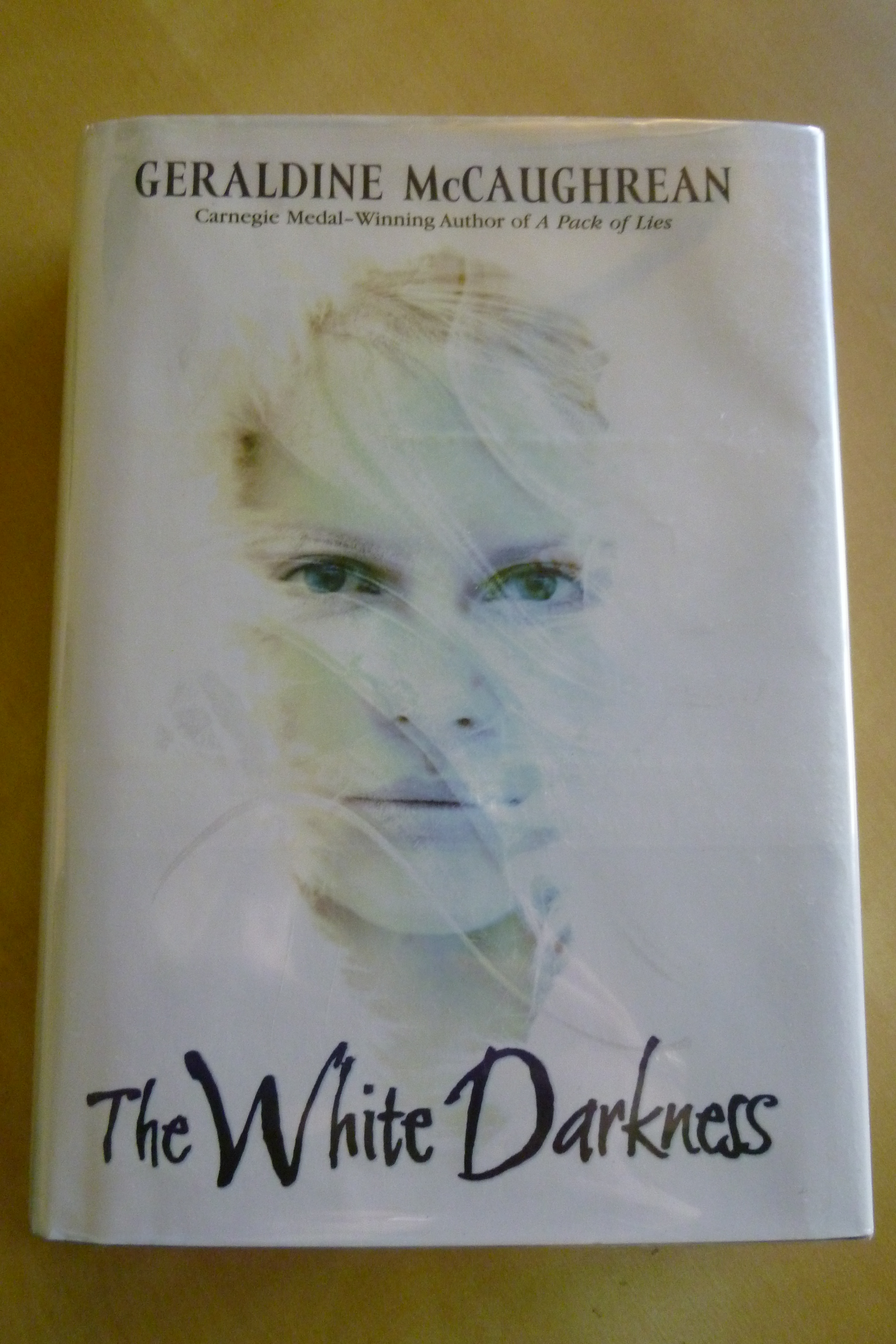
This puts me in mind of what actually is an example of a coming-of-age story, my much-beloved and frequently-referenced The White Darkness by Geraldine McCaughrean.  Spoilers here, so you may want to drop down a paragraph.  For new readers, The White Darkness is about Sym, a fourteen-year-old girl who creates an imaginary friend out of Lawrence “Titus” Oates, the Antarctic explorer.  She gains confidence and self-understanding through a really awful experience in Antarctica.  You could say she grows up.  In the course of that, a couple of times I was afraid she was going to have to give up Titus, as part of growing up–but she never does.  And that makes me immensely happy, possibly because of all those things I was discussing above.

On a side-note, since I brought up the book–I also have to say that I was very sad recently to hear about the death of Richard Morant, the inspiration and audiobook-voice of Titus.  I don’t actually believe in ghosts and I certainly don’t want to confuse the actor and the character…but all the same, I like musing over the idea that maybe he’s off being a supportive shoulder to some girl in great need of a friend.

Back to the topic: another coming-of-age story that comes to mind is, oddly enough, The Mischief of the Mistletoe by Lauren Willig, who would probably be taken-aback to hear her story described that way.  It deals with two adults, Arabella and Turnip (don’t ask about the name), who fall in love while trying to untangle a spy ring.  And you ask how this relates.  But it does, more obviously for Arabella, but really both of them.  Arabella starts out as a shy, mousy wallflower, who finds herself as a strong, capable woman.  Turnip shows up in earlier books in the series, always as the buffoon everyone treats as comical and then disregards.  He stays comical, but he also emerges as having much more worth than it previously appeared.

Which brings me to what I think will be my final point–that coming-of-age stories don’t necessarily have all that much to do with age.  Or if they absolutely must, then I seem to be talking about a different sort of story, though a related one.  I think what it’s really about is figuring out who you want to be.  Not who the world says you are, or who you are when you’re afraid to be something else, but who you want to be.  Often that happens at a certain age–but not necessarily–and to some extent it never really stops happening.

To circle back around to the beginning (because he wouldn’t like dropping out of the post), perhaps that’s another reason there could never be a coming-of-age story about Peter Pan.  He is who he wants to be.  He’s the little boy endlessly having fun.

For the rest of us, who follow Sym and Arabella and Turnip to “come of age,” I think it’s worth listening to C. S. Lewis, and to keep in touch with the Peter Pan and the Titus Oates in us all.
Riding the Orient Express with Hercule Poirot

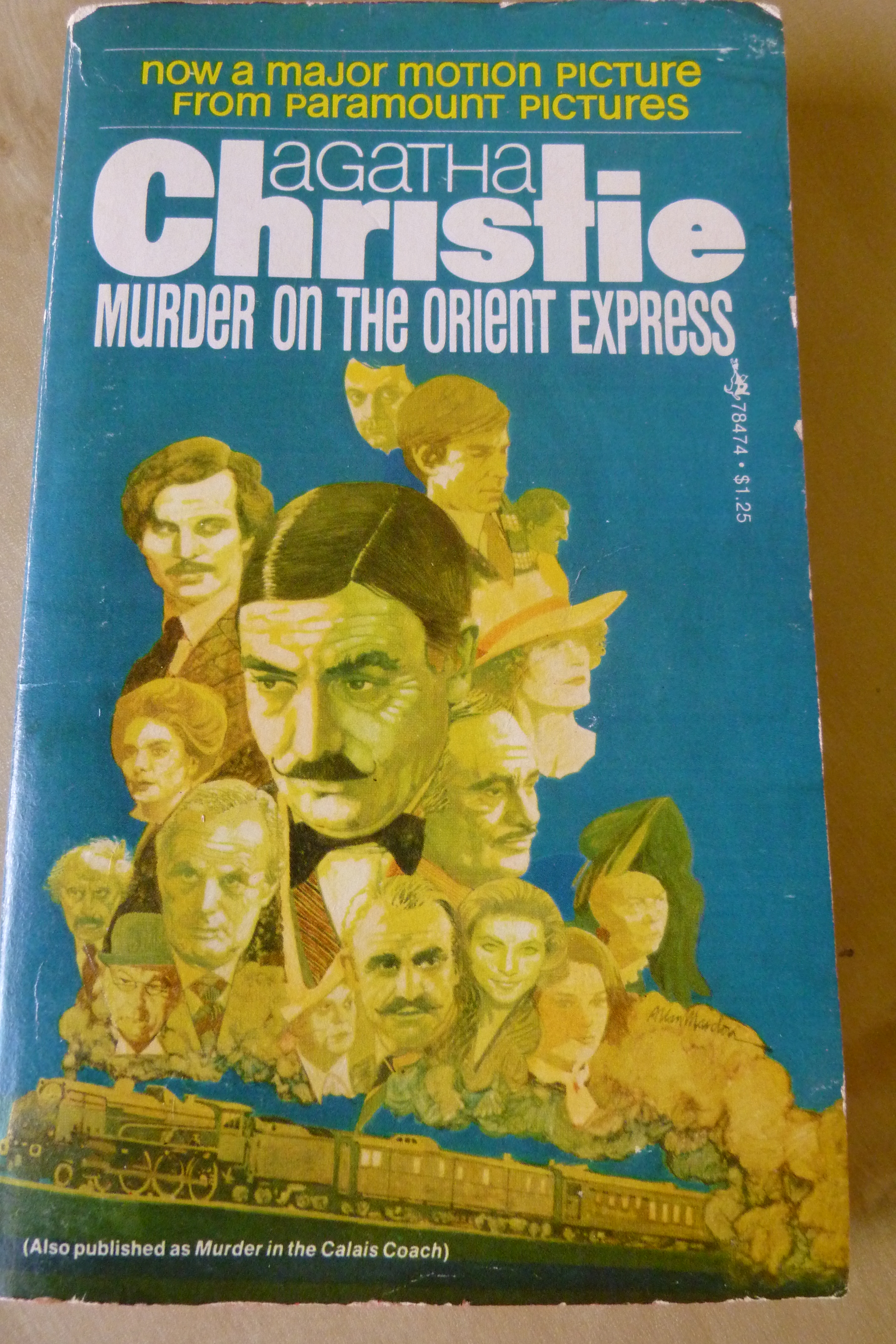
I’ve been meaning to read Agatha Christie for ages.  She’s one of those authors you hear about–and L. M. Montgomery enjoyed her–and she showed up on an episode of Doctor Who!  So I decided to bring a mystery along to London with me.  I asked readers for suggestions and found out I know a lot of Christie fans.  🙂  I ended up reading Murder on the Orient Express, which I’m counting as another book for the R. I. P. Challenge.

Reading Christie was similar, I think, to reading many classics, in that there’s a frequent feeling of–oh, this is where that comes from!  It wasn’t a particular reference, but rather a set of circumstances and a way of unraveling them.

Murder on the Orient Express is, as the title suggests, the story of a murder committed on the Orient Express, while the train is stranded in a snow bank.  No one could come in, no one could go out, and detective genius Hercule Poirot must examine the evidence to determine which of the passengers commited the crime.

It feels like such a classic mystery situation–a group of people trapped together, and one of them is a murderer–but which?  A gloomy manor house would be a little more classic, but no matter.  The book is laid out very neatly, with a long middle section examining each point of evidence and each passenger’s story, and then it all comes together for the classic reveal at the end.  Poirot brings everyone together and expounds upon his thought process and his conclusion.

The mystery is engaging, especially as it develops and more oddities and connections are revealed.  The conclusion is clever–and I certainly won’t give it away!

I know Poirot appears in a number of novels, and I’d like to read more of him.  He was a decent character, though I don’t really have strong feelings about him.  I do think (in this novel at least) as a character he was of secondary interest to the puzzle itself–which is not necessarily a bad thing in a mystery.

Sherlock Holmes tends to be my benchmark by which I compare all other detectives, and Poirot was intriguingly different in a comparison.  He focuses on the psychology of the people involved, rather than the clues.  Holmes, of course, is all about the clues, and isn’t  that interested in individuals.  I haven’t read enough of Christie to form a definite opinion on whether I like Poirot’s method of exploring a mystery, but if looking at psychology means exploring characters more fully, that does appeal to me.  But then, I love Holmes stories too…

All in all, I think it was a good opening foray into Christie’s novels.  Anyone want to give me their top suggestion for what I should read next? 🙂

Other reviews:
Unfinished Person
Harry’s Desk
The Yellow-Haired Reviewer
Anyone else?

The Graveyard Book Read-Along, Week Two

This month, I’m participating in a read-along of Neil Gaiman’s The Graveyard Book, as part of R.I.P.  We’re looking at a few chapters a week, with no specific questions for each post.  This week’s discussion is on chapters 4-6.  See my first post here.

I want to start by saying I’ve really enjoyed reading everyone else’s thoughts on the book; it’s definitely made me think about new aspects of the story, or consider some angle I hadn’t thought of.

For instance, I’ve seen some comparisons to Tim Burton–and I can completely see that!  There’s a very Burtonesque aspect to the depiction of the ghosts and the supernatural beings, who come across in some ways as more “alive” and engaging than the living characters.  That’s the entire focus of Corpse-Bride, and we see it here too.  Bod’s friends and loved ones are all dead or supernatural.  In this section of the book particularly, we see Bod venture out among living people–who are far less friendly and much more threatening.

This line of thought has also led me to very much want an animated movie (or maybe miniseries, it’s so episodic) of the book–screenplay by Neil Gaiman and directed by Tim Burton.  Obviously that would mean Johnny Depp as the voice of Silas, Helena Bonham Carter as the voice of the Lady on the Grey, and possibly Christopher Lee as the voice of the man Jack.  So if it ever happens, remember–you saw it predicted here!

Anyway, on to this section of the book…

I think Chapter 4 is one of my favorite chapters.  Bod meets the ghost of Liza, who was drowned and burned (both) as a witch and buried without a marker.  He decides that he wants to buy her a headstone, and ventures out of the graveyard to find a place that sells them.  I love Liza, who is so up and down and friendly and spooky all together.  I love that Bod wants to get her a headstone just because it’s right for her to have one.  It would be so easy to make her really nice or a perfectly innocent victim.  Then it would still be admirable, but somehow I think it would make his action less.  It would become an act of charity, or simpler in some way.  As-is, I think he’s doing it just because it’s right.

Chapter 5 is about “the dance Macabray,” the rare night when the dead and the living gather in the old town and dance together.  I love the eeriness of that concept, and I love the descriptions of the unearthly music and the magical dance.  I do have to say that as someone who normally pronounces macabre as “ma-cob,” the constant use of “Macabray” made me wince…but I looked it up and apparently there are multiple correct pronunciations.  Maybe it’s a British/American thing.

After Chapter 5, we have a brief interlude that shows us the man Jack again, though it doesn’t tell us much except that he’s still after Bod.  He’s a convocation, and even though the speaker is talking about philanthropic work, the mere fact of the man Jack’s presence makes me deeply suspicious about this group.  And I am reminded of a group in The Sandman Chronicles.  There was a kind of murderers convention, especially for really twisted murderers.  That was aroundwhen I stopped reading those graphic novels, so it’s just as well we don’t get more specifics here about the man Jack’s group…

Chapter 6 sees Bod attempting again to venture out of the graveyard, this time to go to school.  There are some fantastic things in here–I mean, he uses graveyard powers to fight bullies!  Love that!  Though I do think Silas could have been a little more proud of him, even if it was a bit stupid.

As touched on above, Bod meets far more frightening people among the living than he does in the graveyard, and I love that inversion of expectations.  It’s also interesting that Bod doesn’t decide to hide among the ghosts–he still feels drawn towards the living.  There’s a lovely bit (which of course I can’t find right now!) when Silas talks about how, for the living, there are always possibilities, always the potential for growth and change and making an impact on the world.

That’s my philosophical thought for this section. 🙂  I believe the next (final) section will be tying up some of the background threads from the beginning of the book, and I’m looking forward to seeing it all come together.

And, of course, to seeing everyone else’s thoughts on this part of the book!

Saturday Snapshot: Paris Opera House

This week, I reviewed one of my very favorite books, Susan Kay’s Phantom–and I promised pictures from my recent trip to Paris!

The Paris Opera House–or as the Parisians call it, the Opera Garnier.  This was taken from somewhere far enough down the Avenue de l’Opera that you can see the dome.  I love those gold statues.  They shine so bright, even on cloudy days.

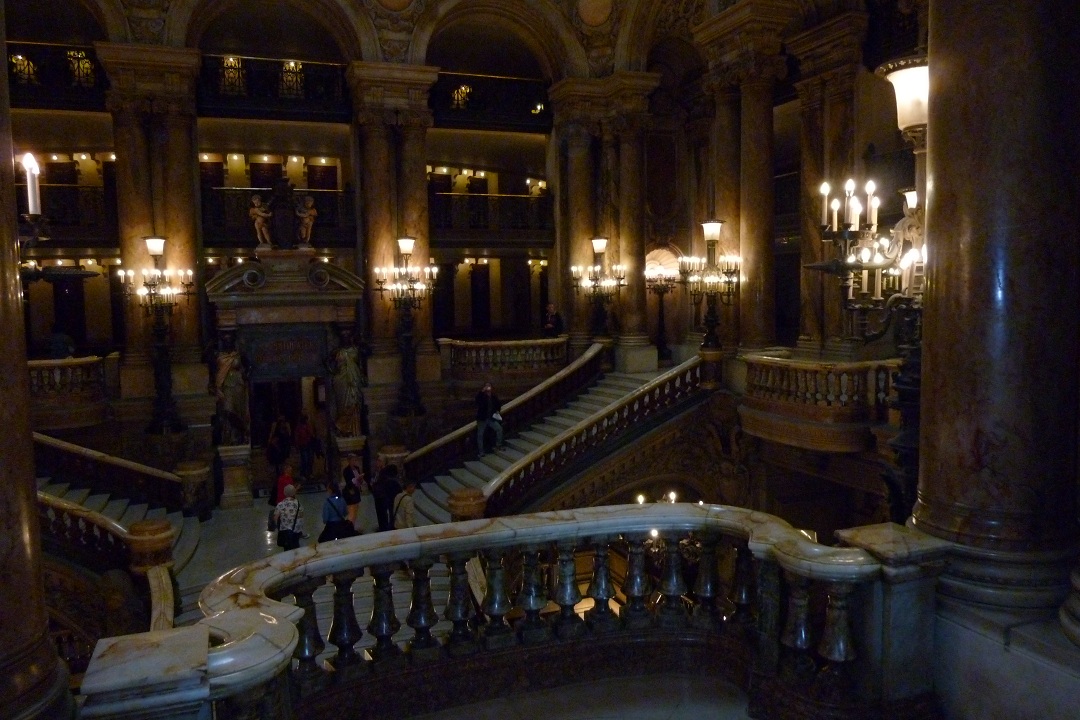
This is the famous staircase–it’s very hard to get a shot that isn’t covered in people!  Not to mention one with decent lighting…

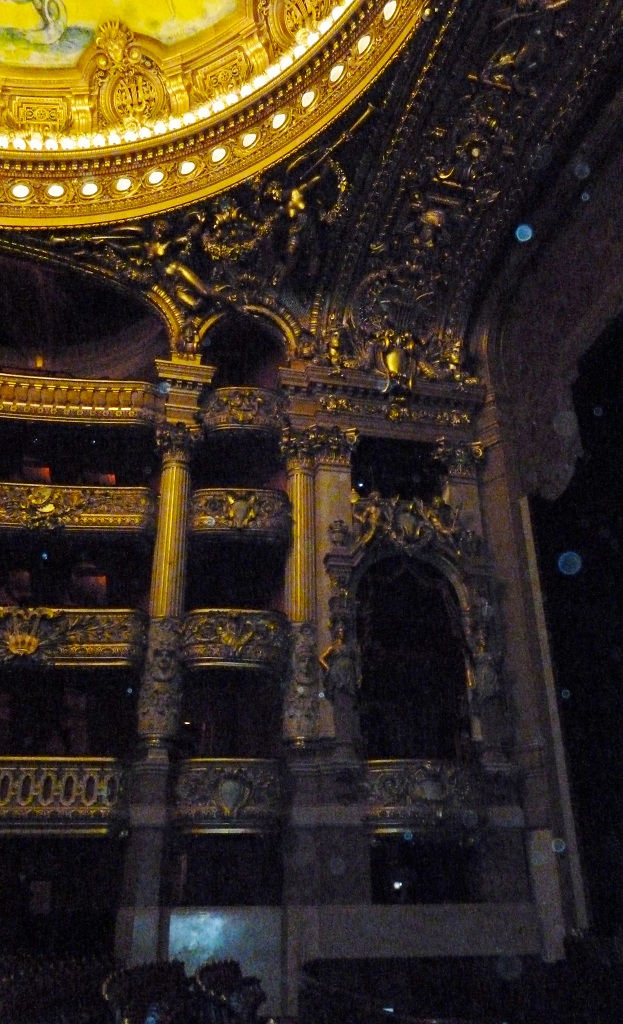
This is, I confess, what I was mostly here to see.  Phantom fans–Box Five is the bottom tier, in the middle.  The big box closest to the stage is the Imperial Box, and the boxes farther to the right are general boxes–and not nearly as secluded as Box Five.

The famous chandelier!  Unbroken. 🙂

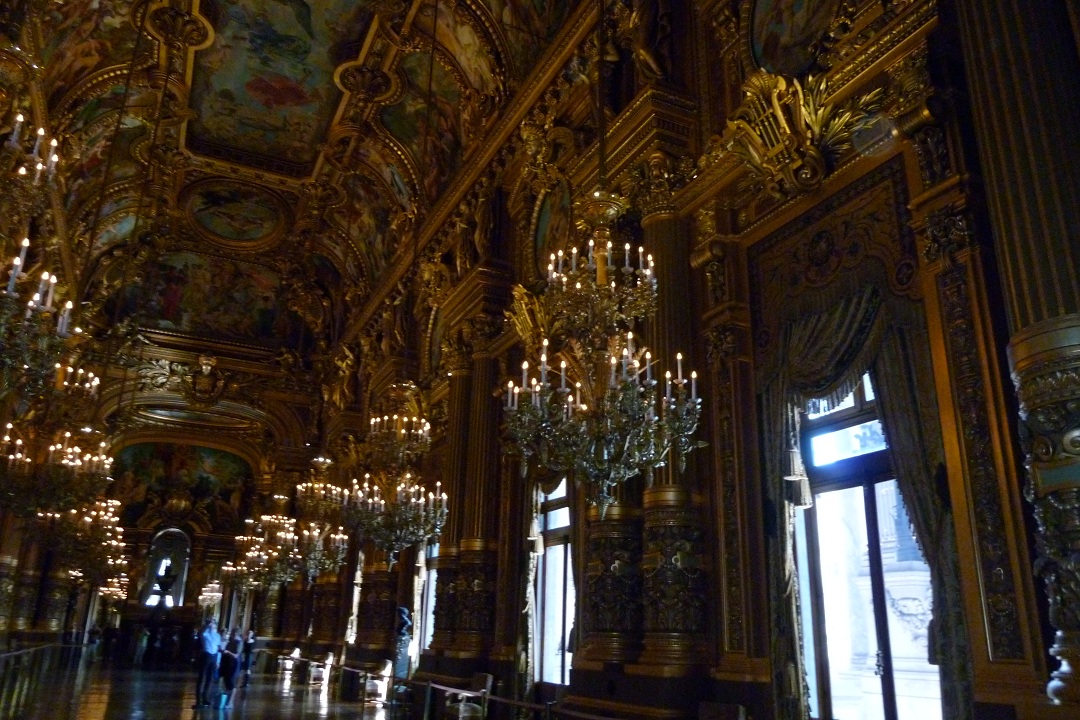
This is the grand foyer–unbelievably gorgeous.  And, as fully befits an Opera House where all is illusion…it’s mostly gold paint!

I know there wasn’t really a Phantom…but someone building this place was having fun with mirror tricks.

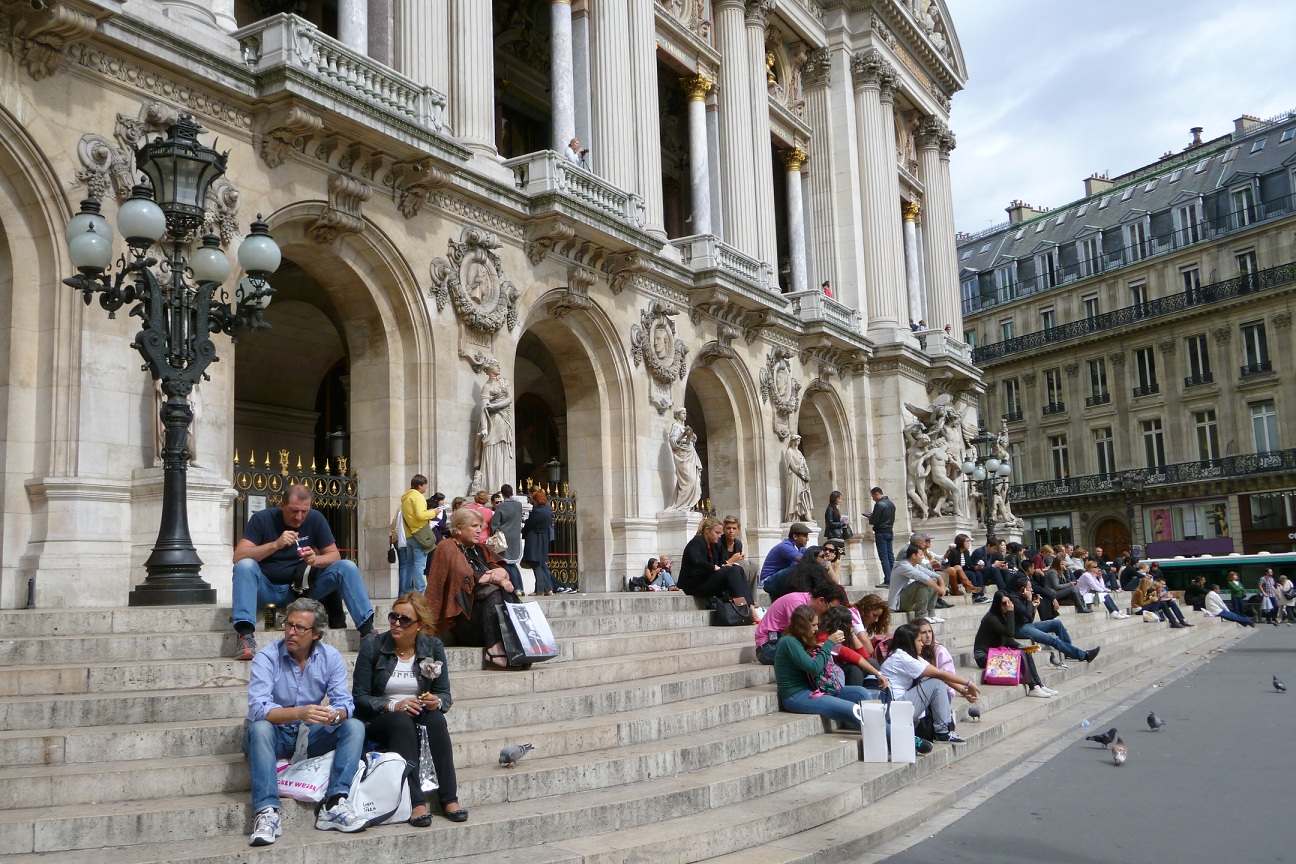
These are the front steps of the Opera House, and I feel remarkably fond of them.  You see, when you’re on a literary pilgrimage and have a hotel two blocks away, it’s a wonderful discovery to find out that you can go sit on the steps of the Paris Opera House any time you like!

Check out At Home with Books for more Saturday Snapshots!

Blog Hop: Autumn Books

I’m participating in the Book Blogger Hop again this week, which invites book bloggers to answer a bookish question and visit each other’s blogs.  Hosted at Soon Remembered Tales this week, here’s today’s question:

With Autumn upon us and Halloween drawing near, what books remind you of fall? What ones do you enjoy reading that are about autumn?

My first thought was that Autumn doesn’t seem to get that much play in fiction.  Summer and winter, with their more dramatic temperatures, seem to be more usual choices–and then of course, spring is the traditional setting for love stories.  (Also for L. M. Montgomery books, which while not all in the spring, all have that feel.)

But perhaps I don’t think of Autumn as a frequent setting because I don’t read the right books.  Perhaps Autumn comes up all the time in ghost stories and horror novels.  I wouldn’t know.

Anyway, I thought a bit more, and I did hit on two favorite books where Autumn plays a role.  First, The Girl Who Circumnavigated Fairyland by Catherynne M. Valente features a heroine named September.  While not entirely set in Autumn, there is a scene where September turns into a tree–and begins to dry and crumble as Autumn comes in.  It’s truly frightening, and one of the most striking moments of the book.

Second, I thought of Peter Pan in Scarlet, Geraldine McCaughrean’s sequel to J. M. Barrie’s Peter Pan.  I imagine there are all seasons in Neverland (probably delightfully crammed together), but in a metaphorical sense, Neverland exists in a perpetual summer time.  This book explores what happens when the magic begins to crumble, and Autumn comes to the island.

I was in Kensington Gardens this September, where Peter Pan lived before going to Neverland.  True to the magic of the Gardens, Autumn seemed to arrive over night.  My hotel was nearby so I was visiting daily–and one day it was warm summer, the next it turned cold and drifts of leaves covered the ground.  It’s not hard to imagine that the fairies decided it was time for a season change, and went to work!

Autumn in Kensington Gardens