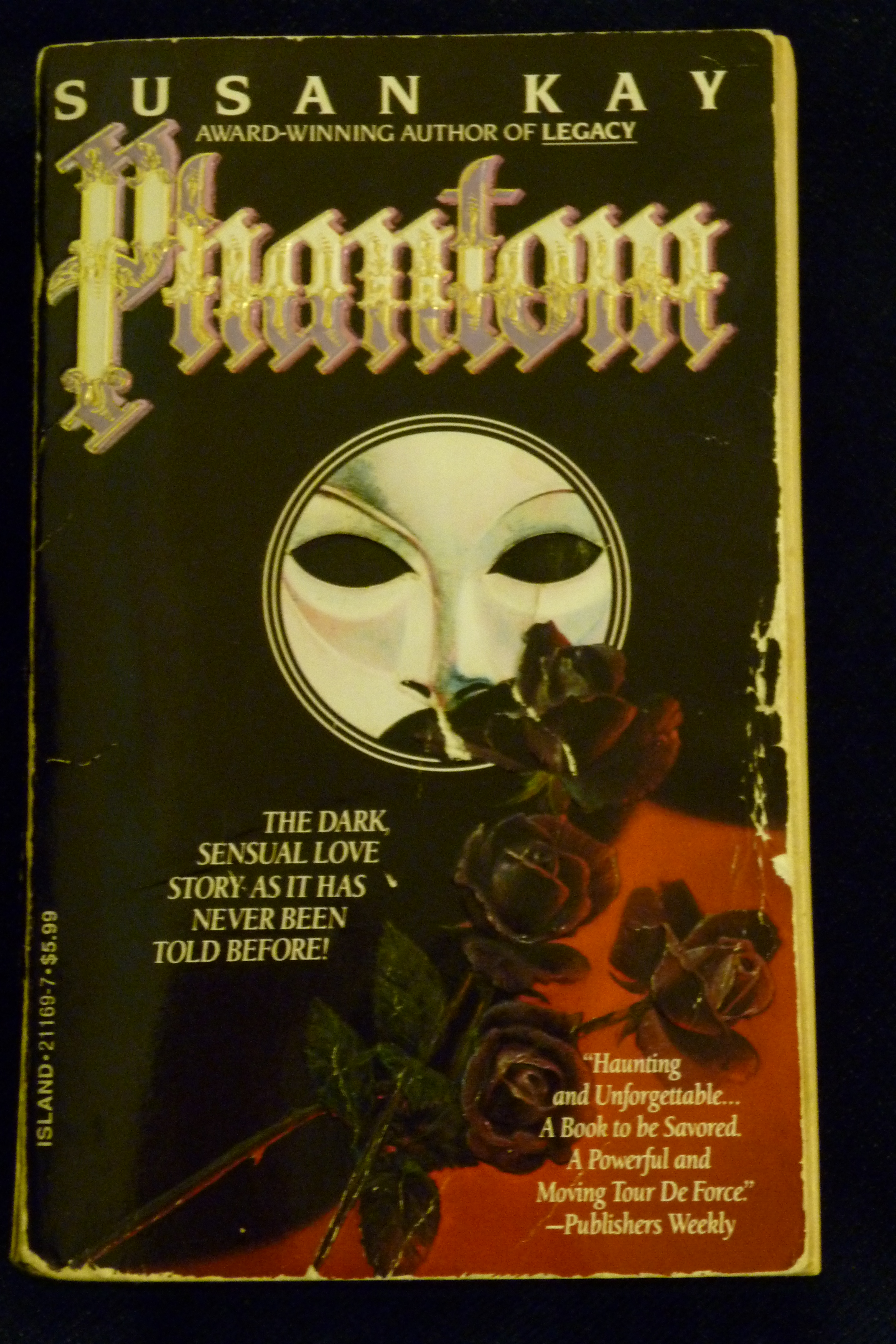
Reading Phantom in Paris

When I went to Paris in September, I decided it was a good opportunity to finally reread Susan Kay’s Phantom.  I read it once seven years ago, it completely blew me away, and it made such an impression that I always felt like it was too soon to reread–it was still there in my mind.  And I think I was afraid that I couldn’t repeat the experience twice!

But I brought it along to Paris to read again–and it was amazing.  I’m also counting it for the R. I. P. Challenge.  I reviewed Susan Kay’s Phantom once already, but I think it’s worth doing it again.  This review is basically going to be structured as a summary, a lot of gushing, and then circle back to Paris to talk about visiting the Opera House.  You’ve been warned if you want to skip some of the gushing!

My copy of the book doesn’t have a sub-title, but I’ve also seen this called Phantom: The Story of His Life, and that’s really what it is.  The story begins with the Phantom’s mother, goes on through his entire life and on past his death.  Kay brilliantly grounds us in each period, telling the story in sections with different first-person narrators.

First there’s Erik’s mother, Madeleine, telling her own story and taking us through his very troubled childhood.  Erik takes over the narration when he runs away from home at nine, falling in with a band of gypsies.  Later we see him as a teenager in Rome; this section is told by Signor Giovanni, the master architect who saw a spark of genius in this strange masked boy, and took him under his wing–for a time.  The Daroga tells us about Erik’s time in Persia, and a very sad and bloody time it is.  Erik picks up the thread again when he returns to France, meets Charles Garnier, and becomes obsessed with work on the building of the new Paris Opera House–which he ultimately decides will be his escape from the world.  And then Christine comes on the scene, and she and Erik tell the most familiar part of the story in alternating scenes, until the final section is narrated by–but perhaps I won’t give that away!

Kay does something truly masterful here.  Every narrator has his or her own story, with their own passions and tragedies, while at the same time the book never loses its focus on Erik.  It’s a brilliant balance that gives us the Phantom through so many eyes, and tells so many stories, without feeling fragmented or like we ever get lost on some side-plot. Every character is brought to life and I care deeply about all of them–even Madeleine.  I hate her, so caring might not be quite the right word, but I do feel deeply about her.  Although on a second read, I felt more sorry for her than I did the first time around.

The most significant character, of course, is the Phantom.  As on my first read, I fluctuate between finding him scary, and wanting to hug him.  He is so dark, and so unstable, and SO SAD.  And brilliant–completely, unbelievably brilliant.  Unlike other books I could name, Kay doesn’t pin all of Erik’s problems on the facial deformity.  That’s a huge part of the book, of course, but there’s so much more.  Erik is rarely shown kindness, so he doesn’t trust it when he sees it.  His biggest problem is not that he’s so ugly no one could love him; it’s that he believes he’s so ugly no one could love him.  It’s a fantastic, vital distinction that makes him so much more complex.  And something that’s not going to be solved by a moonless night.

The scope of the book is magnificent.  Without feeling long, it still feels like it crosses continents and covers decades.  When an adult Erik remembers his childhood dog, I don’t feel like I just read about her a hundred pages ago–it was years in the past!  Despite the huge scope, it doesn’t feel like an overview.  Everything is immediate and present as it happens.

There are so many very small, very wonderfully told moments.  The first to come to mind is Erik’s fifth birthday, when his mother insists that he tell her what he wants, and all he really wants is a kiss (one now, and one to save for later) and…it doesn’t end well.  And I hate Madeleine.  There are some nice moments of friendship with the Daroga, and later with Charles Garnier, the Opera House’s architect.  There’s a very funny exchange when Erik makes a joke to Garnier about how the then-under-construction Opera House really ought to have a ghost, and perhaps they should advertise.  Services of one ghost needed, tenor voice preferred.

And then near the end–just before everything goes horribly, horribly awry with Christine–Erik goes up to the roof of the Opera to pray.  And he doesn’t know how, because he hasn’t since he was a little boy, and the only prayer he can come up with is Please God, let her love me, and I’ll be good forever.  It just makes me want to cry and cry.

The book is so beautiful, emotional, moving–and so deeply tragic.  Phantom descends to the depths and aspires to the heights of human emotion, and does it beautifully and believably.  In 500-odd pages of dealing with that level of complexity, I felt like Kay hit a false note only once.  There’s a near-miss, where Erik might have been able to have a better relationship with his mother and the opportunity is lost; that was the only moment that didn’t feel real.  I didn’t believe Madeleine could make the leap, and it felt dragged in for tragedy’s sake.  However, I make that observation mostly to say how amazing the rest of the book is–because every other moment I completely believed and was swept along with.

It may also be worth saying that I’m completely invested in my own concept of the Phantom, who he is and how his life post-Leroux (if he wasn’t dead) ought to turn out–and this isn’t that at all.  But it’s so good, that doesn’t even bother me.

If I haven’t been clear enough yet, Susan Kay’s Phantom is easily among my top five favorite books I have ever read.  Maybe my absolute favorite.  I wouldn’t recommend reading this without either reading Leroux or knowing the Webber musical; there is an assumption of some knowledge, particularly once Christine comes in.  But if you have a little grounding and you’re intrigued by the Phantom–read this.  It’s mind-blowing.

Well, now that I’ve gushed plenty, let’s talk about Paris.  This is also a great book to read if you’re visiting the city, particularly the Opera House.  Most of it is actually not in Paris, but key sections are.  When I visited the Opera House, the guide was telling us about the history and I kept thinking, “I know, that was in Susan Kay’s Phantom!”  The book is set at the same time they were redesigning Paris, so it talks about the broad boulevards and the large-scale apartments, and they’re what you’re seeing as you walk around the city.  It gave me a nice grounding, and of course, it populated the Opera House for me.  There’s a monument to Charles Garnier near the visitors’ entrance, but Susan Kay’s Phantom brought him to life for me.  And it made me happy that, even though we call it the Paris Opera House here, in Paris it seems like they mostly call it the Opera Garnier.

If you’re interested in Paris history, architecture, music, or of course the Phantom of the Opera, the Opera House is great to visit.  It’s very beautiful on the inside–Garnier went way over budget!  I recommend the tour–they do one in English, and you get to see the theatre, the grand staircase, and the foyer, along with a few other rooms.  You don’t get to go into Box Five–but I did get the guide to point it out while we were in the theatre (Erik has good taste, it’s one of the best boxes), and I saw the door from the hall too.  And there’s the famous chandelier.

The foyer is gorgeous, all gold decorations and mirrors and yes, chandeliers.  But you know my favorite thing about the foyer?  It’s mostly gold paint.  Garnier was struggling with his budget!  Gold paint was cheaper!  But I LOVE that.  It’s an Opera House–everything’s illusion.  Stay tuned for pictures for Saturday Snapshot!

Final word on the subject: read Susan Kay’s Phantom.  It’s just the most beautiful of books, the most heart-rending of stories…and if you’re anything like me, you will be haunted by the Phantom of the Opera.

Other reviews:
The Written World
A Fair Substitute for Heaven
A Night’s Dream of Books
Anyone else?

Sunlit Graveyards

As another group activity for R. I. P., Carl has invited people to write this week about graveyards–no particular focus, just whatever strikes you.  Technically it’s supposed to be tomorrow, but I’m posting a day early so I can keep with my regular Wednesday-book-review schedule.

I’m probably going to have a bit of a different post than most on this subject, because I tend not to think of the creepy side of graveyards.  I think this is a product of not reading horror books, and of reading L. M. Montgomery instead.  I don’t read about scary ghosts and Things From the Crypt and skeleton hands reaching out of graves–and I don’t watch those movies either.  But I do read L. M. Montgomery books, where families and towns have their local graveyards and it’s quite a personal thing where everyone’s ancestors are buried.  Funerals are social occasions and graveyards are a pleasant place to spend a sunny afternoon.

In the Emily of New Moon books, the Murrays have their own graveyard on New Moon property, and Emily loves going to sit on the slabs and write, and to think about all the family stories about the ancestral Murrays.  In the TV show, Emily sees the ghosts of the Murrays in the graveyard–not unlike The Graveyard Book, actually.  And it was either Anne (of Green Gables) or Montgomery herself who liked walking around a graveyard across from where she was lodging while at school.  I can’t remember if it was in a novel or her journal–maybe both.

I love that attitude toward graveyards.  Unless you’re trying to tell a ghost story, why should they be creepy anyway?  Often they’re very park-like, and the old ones especially are so beautiful and full of history.

I suppose my favorite graveyard is Westminster Abbey, if that qualifies.  You can’t walk without stepping on the memorial of someone whose name you recognize–from Charles Darwin to Oliver Cromwell to Henry V to Elizabeth I to Charles Dickens.  The list is staggering.  What a community of ghosts that would make!

Ooooh…I may need to write a story!

I once had the best time rambling around a graveyard with a friend one afternoon.  There was nothing creepy or morbid about it, we were just looking at the stones and the history.  And we did manage to stumble on a funny story.

In one area, there was a section of graves of Jesuit priests.  All the headstones had their names in Latin, which seemed to mean they were recognizable names with “us” at the end–Edwardus and so on.  Well, the very last one in the row must have been named Hilary (it can be a man’s name) which means what his stone actually read was…Hilarius!  I sincerely hope he had a sense of humor.

I think I’ll leave it on that funny note about graveyards.  🙂  Do you have any good graveyard stories or experiences, creepy or sunlit?

Visiting Madrid with Bloody Jack

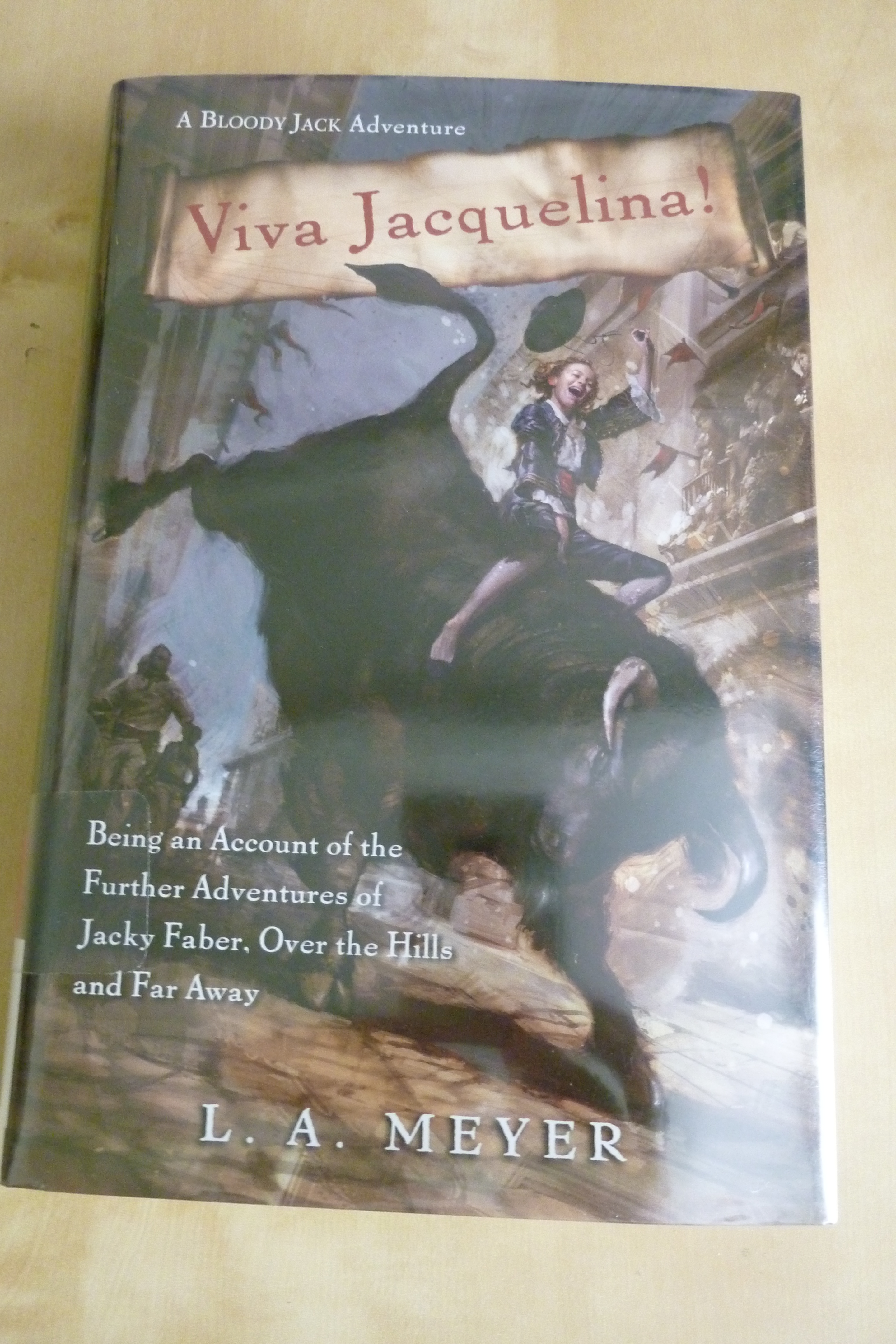
Every fall I look forward to the latest installment of the adventures of Bloody Jack.  This year, it was Viva Jacquelina!, L. A. Meyer’s tenth book about the irrepressible Jacky Faber.

Jacky has, in her various adventures, been a British Navy sailor, a merchant captain, a pirate, a member of the British intelligence, and sometimes even a fine lady.  As you might guess, this installment takes Jacky to Spain.  It begins on the battlefields of the Napoleonic wars, before Jacky is sent on a spy mission to Madrid.  Separated from her friends, she finds work at an artist’s studio, learning painting, posing as a model, and flirting with the local boys.  Jacky’s adventures go on to involve bull-riding, the Spanish Inquisition, and a band of gypsies.  In other words, it’s the usual Jacky Faber fare.

Jacky is still the charming, undaunted, ever-cheerful and ever-resourceful girl we’ve met in nine previous books.  She’s grown more confident but no more cautious or sensible.  The adventures come fast and furious here, which is good and bad.  The book keeps moving along at a quick clip and there’s never a dull moment–but sometimes I did wish it would slow down and give us more depth and more detail.

It strikes me that we’ve entered an interesting place with these later books in the series–they’re still enormous fun, I still love the characters, and I still can’t resist reading on to find out what happens next.  At the same time, the books are starting to lose the depth and the originality of the early ones in the series.  In some ways this book reminded me a bit of the second one, Under the Blue Tattoo, in that Jacky spends some months settling (relatively) quietly into a town and a household.  But this book racketed along at a much faster pace than the second book, and we never delved as deep into the characters or developed a plot that was as complex.

Jacky is also beginning to seriously grate on my nerves when it comes to her constant flirtations.  In the span of this one (relatively slim) book, she gets into pretty serious sparking with five men–all while her heart belongs to her one true love Jaimy, of course.  Jacky’s always been a bit free with her affections, but I feel like in this book she went farther faster and with greater numbers, and never seems to grasp that any of these men might take her seriously.  When her attitude starts to become, “ho-hum, another one swearing undying love,” it gets just a little annoying.

But I do still love Jacky–only I’m starting to feel like her best friend, Amy Trevelyne, who is frequently apt to sigh and wish Jacky would learn some restraint.  On the other hand, it is kind of fun that Jacky turns on its head the cliche of the roving man with a girl in every port.

All in all, I’d say this book isn’t up to the brilliance of the earliest ones in the series…but it’s still a very enjoyable read.  I wouldn’t suggest starting the series here, but if you haven’t read Bloody Jack, I do recommend picking it up!  This is a wonderful series to explore.

Author’s Site: http://www.jackyfaber.com

Other reviews:
Fyrefly’s Book Blog
In Bed with Books
Bookyurt
Anyone else?

The Graveyard Book Read-Along, Week One

This month, I’m participating in a read-along of Neil Gaiman’s The Graveyard Book, as part of R.I.P.  We’re looking at a few chapters a week, with no specific questions for each post.  This week, a discussion on the first three chapters.

I’ve read The Graveyard Book before, but it’s been a few years and some of the details have gone fuzzy.  I do remember the shadowy feel of the book, and that I enjoyed it!  So I’m looking forward to digging into in greater depth.  (I suspect there’s a pun somewhere in that “digging in” phrase…but we’ll just move along…)

For those not familiar with the book, it tells the story of Bod, a living orphan who is being raised by a community of ghosts.  The first chapter describes how this situation came about, and the next two share a couple of Bod’s childhood adventures.

The first thing that struck me on picking this up again was the pictures.  The first few pages of each chapter are illustrated with wonderful black and white drawings that set the shadowy tone of the book so well.

Gaiman makes a very interesting choice by starting us out in the point of view of a murderer, the man Jack who killed Bod’s family.  What’s particularly remarkable is that he manages such a deft balance of starting us in an unbelievably horrible situation–but I don’t feel inclined to slam the book and walk away.  It is horrible, and it’s certainly dark and creepy (just the phrase “the man Jack” is so creepy), but it never quite becomes grotesque or too twisted.  And if you’ve read the Sandman graphic novels, you know Gaiman is capable of going there!  As it is, this sets up a wonderful darkness without scaring squeamish me off of the book.

I also love that it’s the living man who’s frightening–the ghosts are quite homey and pleasant.  They have a close community in the graveyard, with each ghost living in his or her respective crypt, all going about much the same community relations that they had in life.  And why not?

In Chapter Two, Bod makes a human friend, a little girl named Scarlett whose mother thought it made sense to bring her to play in a graveyard (a nature reserve, technically).  The two of them venture into a dark depth of the graveyard and encounter very strange and sinister creatures.  I enjoyed some of the contrast between Bod and Scarlett, but wish Gaiman had done more with that.  Ultimately they both end up not being afraid of what appears to be a monster–and I totally get that Bod is used to the strange and the supernatural, but I don’t understand why Scarlett, as a normal little girl, calms down remarkably quickly.  Perhaps I’m just meant to take her as being special too.

My favorite thing about Scarlett, though, is probably that she thinks Bod is an imaginary friend.  What a wonderfully fuzzy margin between reality and imagination!

In Chapter Three, Bod gets a new tutor, Miss Lupescu (whose name makes her secret fairly obvious), and ends up captured by ghouls.  The best thing about the ghouls is their names.  They all receive new names when they become ghouls, names which properly reflect the high esteem ghouls hold themselves in: names like “the famous writer Victor Hugo” or “the Bishop of Bath and Wells” or “the 33rd President of the United States.”  And they’re never shortened.

So far, the book is quite episodic, with each chapter almost a self-contained short story.  I do seem to recall, however, that threads begun in one place will come back in another, and it’s going to be fun to watch that weaving.  And the short story nature makes this good for a read-along!

Saturday Snapshot: Fish and Chips

This may sound strange, but I love British food.  It gets a bad reputation–but what’s not to love about fish and chips, meat pies, yorkshire pudding and jammie dodgers?  I made a particular effort (and it wasn’t that hard) to find British food while I was in London.  After I got home, I started thinking about where I could find British food here–and what I could try making myself.

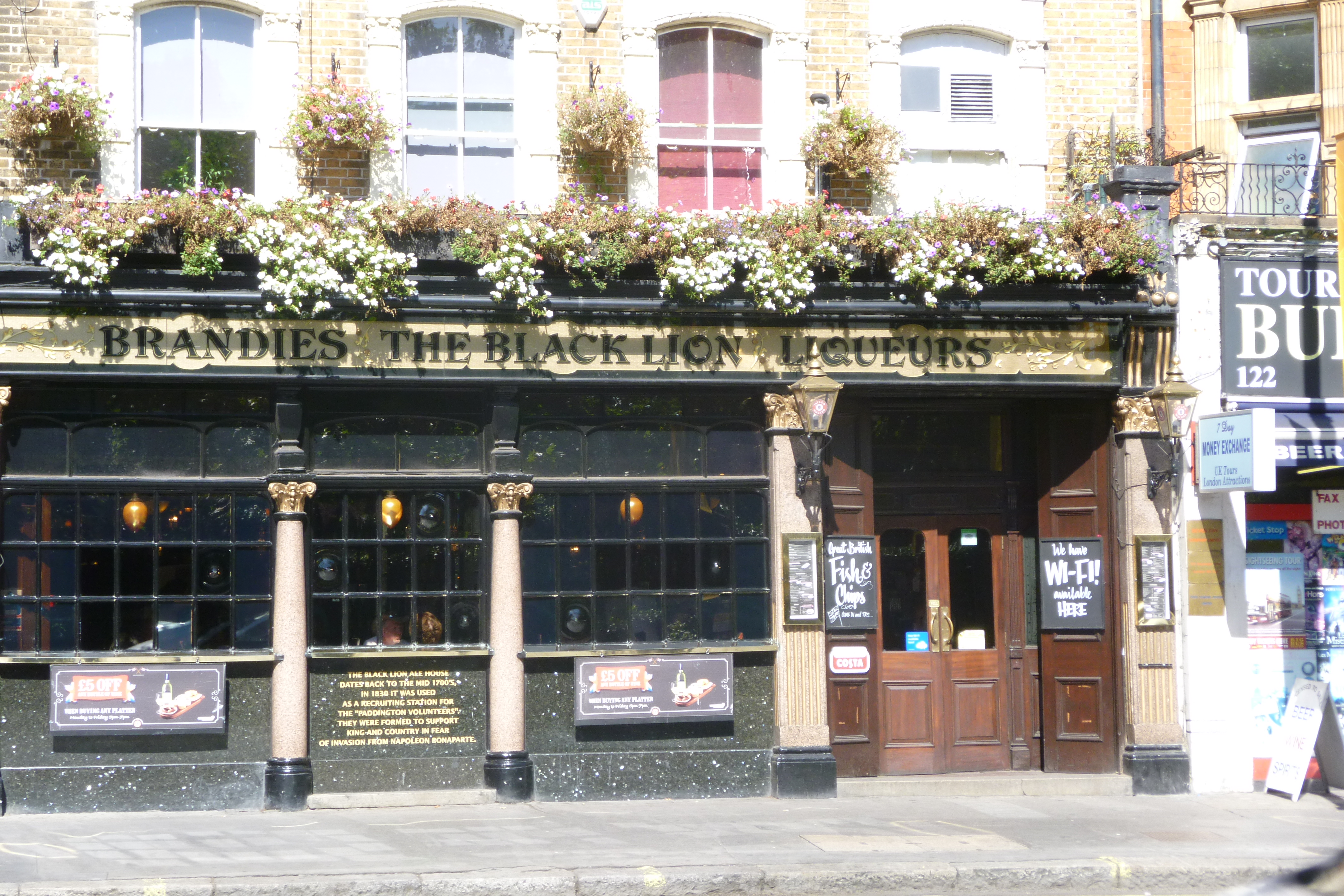
Meat pies seem complicated, but I thought I could handle fish and chips.  On my trip, I had fish and chips for lunch one day at The Black Lion.  First picture, here’s the pub:

It’s a great old place that dates back to the 1700s.  It’s on Bayswater Road, across the street from the Black Lion Gate, which opens onto the Broad Walk in Kensington Gardens.  I like to think J. M. Barrie may have eaten here, considering he lived just a few blocks away.

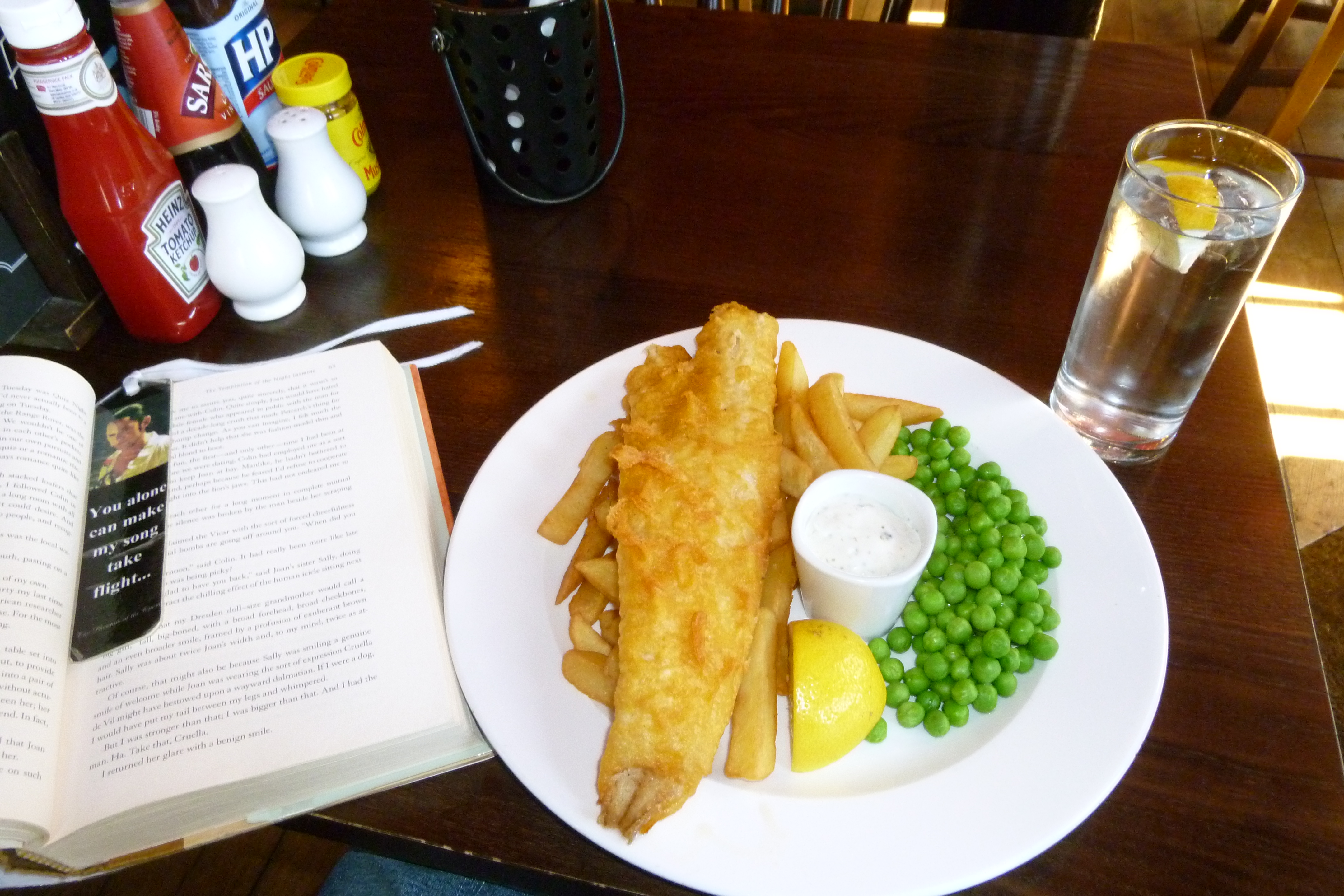
Here’s The Black Lion’s fish and chips:

The book, incidentally, is Temptation of the Night Jasmine by Lauren Willig, and very good.  So was the food!

And here’s my version of fish and chips–which also turned out tasty. 🙂

Check out At Home with Books for more Saturday Snapshots!