Federation: Star Trek Across Eras

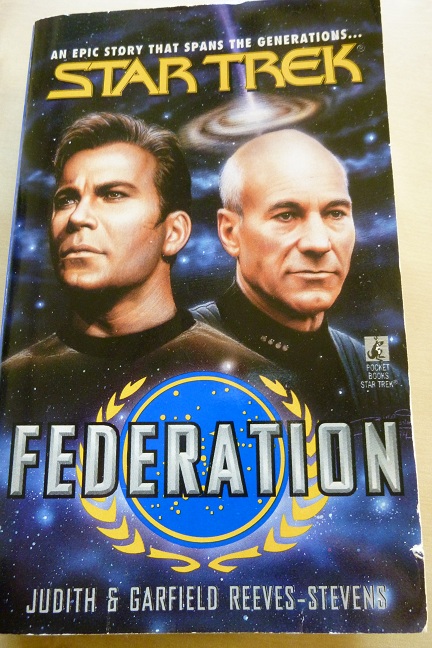
FederationOne of the nearly-last books on my Sci Fi Experience reading stack was Federation by Judith & Garfield Reeves-Stevens.  This was a re-read, but it had been years and I’d forgotten most of the details…but I did remember it was a good one.  The Reeves-Stevens also wrote one of my favorite Trek books, Prime Directive, and are absolutely brilliant at capturing characters.

Federation takes a broad scope, with three storylines across times, which ultimately intertwine.  We follow Zefram Cochrane, inventor of warp drive, through the early days of warp technology and into World War Three.  In the 23rd century, Kirk is facing fire from Starfleet over a recent mission–the one in which they met a much older Cochrane (“Metamorphosis”), who asked to be kept secret.  In the 24th century, Picard is hoping to obtain a piece of Borg technology that could be vital to the defense of the Federation.

There’s a lot to juggle here, and this is a case where, as a writer, I can very much appreciate how well the Reeves-Stevens handled it.  The divergent plots feel like they should be confusing, but aren’t; they ground us very well in each storyline, and a tight point of view helps a great deal too.  We’re only ever in the points of view of Cochrane, Kirk or Picard, and move in regular sequence between the three.

The Cochrane plotline provides a very interesting window into an earlier era of Trek history–even if it turns out not to be canon.  This was written before First Contact, and there’s a very prescient author’s note remarking that later films might invalidate the ideas set out in the book.

With all due appreciation for First Contact, I like the Reeves-Stevens’ version better.  It feels more like possible history and less like an action film.  Cochrane develops warp flight with financial backing from an idealistic billionaire (who I’m pretty sure is the long-lived Flint from “Requiem for Methuselah”), and is instrumental in founding early colonies.  He gets tangled up with World War Three because one military leader believes that Cochrane holds the secret to the ultimate weapon, a so-called “warp bomb.”  It’s exciting, while blending in philosophy, economics and galactic politics in a way that’s remarkably believable.

Kirk’s plotline draws very closely from original series episodes.  The plot points are mostly from “Metamorphosis,” but the timing is directly after “Journey to Babel,” with Ambassador Sarek still aboard at the beginning of the book.  There’s a wonderful scene with Kirk, Spock and Sarek playing poker in Sickbay.  I really enjoyed how much this was grounded in particular episodes.  Most Trek books seem to take place vaguely “on the five-year mission” (maybe in the last year after the final episode).  That’s fine as a rule, but tying it in so closely made me feel oddly nostalgic.

The best thing about Trek are the characters, and I think I love the Reeves-Stevens so much because they know how to tell Kirk, Spock and McCoy.  Trek books live and die for me based on whether Spock and McCoy snipe at each other–and they do here!  It’s understated, but perfect.  They go back and forth a few times, with Spock giving very precise estimates, McCoy rolling his eyes, and at least once Spock is deliberately vague, just to bait him.  It’s excellent.

The Picard plotline had its own mysteries and tensions, which is good since for most of the book it felt completely unrelated to the other two plots.  It comes together in the end, and the authors try to tie it closer together with an Ambassador Sarek connection…but mostly I think the reader has to just take it on faith that the plotline is relevant and enjoy it for itself in the meantime.  The way it ties together is ultimately a bit far-fetched…but personally I’m willing to just go with it.

If I have any major criticism, it’s that the frame-story felt unnecessary.  I see what they’re doing–it’s a thematic thing–but it didn’t work for me.  The book starts with a prologue about a very depressed Kirk coming to the Guardian of Forever.  The timing is right before Generations (which I’d prefer to IGNORE, if you don’t mind) and Kirk is having a premonition that his life is over and there’s no purpose anymore and etc. etc.  The Reeves-Stevens are so good at portraying the characters, but this was odd…and just depressing.  There’s a thematic point about the purpose of it all, and humanity’s journey and the exploration of that idea within the book is inspiring–but it doesn’t need the prologue to draw that out.  So if you pick this up and the first few pages aren’t working for you…skip ’em.

And after the first few pages, this is absolutely worth picking up.  Watch “Journey to Babel” and “Metamorphosis” in preparation, and then I think you’ll thoroughly enjoy Federation!

Authors’ Site: http://www.reeves-stevens.com

Other reviews:
Pareidolia Book Blog
That’s all I found!  Anyone else?  Tell me about yours!

Buy it here: Federation by Judith & Garfield Reeves-Stevens
Pucker Up…and Wake a Dead Guy?

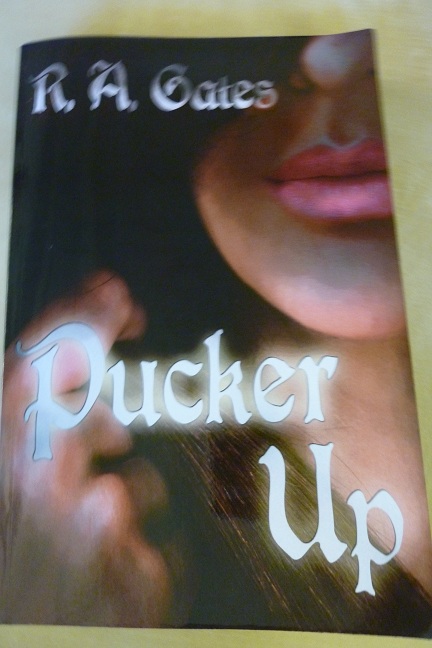
Pucker UpI think anyone who’s around this blog even occasionally knows that I love retold fairy tales.  There are so many fascinating and strange elements to fairy tales that modern authors can play around with.  So what’s not to love in an urban fantasy about a girl who needs to wake a sleeping prince with a kiss?  Pucker Up by R. A. Gates is a YA Fantasy that takes a fun spin on some old fairy tale tropes.  Disclosure–the author is a friend and member of my writing group, but I promise an honest review anyway!

Pucker Up centers on Ivy, a reluctant witch who finds herself on a quest to wake up sleeping Prince Sebastian.  Ivy lives in Salmagundi, the place of refuge for anyone with magic, hiding from the witch-hunting Eradicators.  Unfortunately, the spells hiding the town are breaking down.  Ivy’s cousin Thane believes the answer is to wake up Prince Sebastian, who created the spells to begin with.  Ivy needs the reward money to pay a debt to a very angry werewolf.  As a descendant of Sebastian’s true love, she should be able to wake him up with True Love’s kiss…except that she really doesn’t want to kiss a dead guy!

I always approve of heroines who set off to do things rather than waiting for a man to save the day, and I love the twist of a girl needing to wake up a prince instead of the other way around. Ivy is a fun, somewhat-reluctant heroine, with good mysteries in her past that kept me curious as I read.  The book also keeps moving with a series of adventures on the journey to find the prince.  We get a whole host of magical creatures, including vampires and werewolves and even dragons–like a cute baby dragon nicknamed Sparky.

There are serious moments, but overall there’s a light tone to the book.  It’s frequently funny in a tongue-in-cheek way…as with the ongoing series of necrophilia jokes.  I love retellings that are aware of the absurdities in their inspiration material.

When Ivy and Thane set off on their quest, they’re accompanied by Thane’s friend Garren, who Ivy finds immensely irritating.  Don’t expect too many surprises in the romance department…but even if it’s a bit predictable, it’s fun to read.  And there are more surprises in the plot.

This is the first book in a series, and with some twists in the ending, I’m excited to see where it goes in the next book!  Alas, not published yet…

I think I’ll finish up by borrowing a line from Ivy’s dialogue on the last page–it’s not a spoiler, and I think it sums up the book nicely.

“Don’t even think you’re rescuing me.  I’m no damsel in distress.”

Author’s Site: http://ragates.com/

Buy it here: Pucker Up in paperback or ebook

Saturday Snapshot: Paris Revisited

In reading, I am still making my way through Les Miserables.  Considering it’s a 900-page behemoth with small print, this may not surprise you!  As a result, I still have Paris on the brain…and since Marius and Cosette just fell in love, let’s run with that theme.

P1010904

I’d like to say I forgot the name of this bridge, but I don’t think I ever actually knew it.  However, I did hear the tradition somewhere–couples put a lock on the bridge and throw the key into the Seine, as a sign of commitment…because the only way to open the lock and end the relationship is (theoretically) to jump into the river and find the key again.  Obviously this is an immensely popular tradition.

P1010905

I wanted a close-up, so I fiddled around with the locks to get a good angle on a couple with fun names…kind of makes me wonder who Pierre and Juliette are.

P1010900

If you don’t like the lock option, people have carved up all the poor trees along the Seine too.  The sheer number of hearts and initials is staggering…my environmental instincts freak out a bit, while the hopeless romantic in me just goes AWW!

Have a wonderful weekend!  I’ll be forging along through Les Mis…

Visit At Home with Books for more Saturday Snapshots!

Sci Fi Experience on Screen: Superheroes and Extra-Terrestrials

The Sci Fi Experience seemed like the perfect time to watch a few sci fi movies I’ve been meaning to get to…old and new.  This Friday, here’s a survey on the sci fi movies I’ve watched in the last couple of months.

The Amazing Spider-Man (2012): I have to admit, I didn’t quite see why we needed another origin story movie for Spiderman (Toby Maguire just wasn’t that long ago…) and while I still kind of feel that way, this was a fun movie.  I’ve been a fan of Andrew Garfield ever since he was the adorable Antoine in The Imaginarium of Doctor Parnassus, and he’s the main reason I saw this.  He plays a wonderfully awkward Peter Parker, who also manages to have a lot of fun with his new powers.  My favorite thing about the movie, though, may be Gwen Stacy (Emma Stone).  I mostly remember Kirsten Dunst’s Mary Jane screaming a lot when things got tense.  Gwen is far tougher, keeping her head and actually being useful in a crisis.  That’s an awesome quality in a superhero’s girlfriend.

E. T. the Extra-Terrestrial (1982): I haven’t seen this one in years, so I was curious to rewatch some classic sci fi.  All the iconic moments are great, and it was so much fun seeing an incredibly young Drew Barrymore (talented even then).  One thing that struck me was how little explanation this movie has.  It’s not incomprehensible like 2001, but we never find out who E.T.’s people are, why they were on Earth, how the government knew to look for them, whether there was any communication after E. T. is picked up…  I was also struck by the moment when E. T. asks Elliot to go with him.  Yes, 10-year-old boys probably shouldn’t go off with aliens–but what a missed opportunity!

The Dark Knight Rises (2012): I kept having near-misses with this movie.  It never quite worked out to see it in local theaters…then I almost saw it while I was in Paris, at a theater a few blocks from the Paris Opera House.  But I couldn’t tell from the posters whether it was subtitled or dubbed, so I gave it up and went back to my hotel room to spend the evening writing fragments of stories involving the Phantom of the Opera, which was probably just as well.

So I finally saw this in January from Netflix.  While quite grim in spots, overall I enjoyed it–especially Catwoman.  Anne Hathaway impressed me this year as both Catwoman and Fantine…and impresses me all over again when I compare those characters side-by-side.  The villain here wasn’t nearly as much fun as the Joker in The Dark Knight, but this was still an exciting ride, and I enjoyed Joseph Gordon-Levitt (who’s been adorable ever since 10 Things I Hate About You) as the new cop trying to make good.

Batman Begins (2005): I knew I’d seen The Dark Knight, but I couldn’t remember if I’d seen this one.  After watching the final installment, I was pretty sure I hadn’t seen the first one, and felt like I ought to do something about that.  The origin story was interesting, some parts of the later movies make a good deal more sense now, and…mostly, I really liked Alfred.  And I have a nice completed feeling now.

I think that covers Sci Fi On Screen…although I may re-watch The Dark Knight soon!  Which will thoroughly complete the out-of-order-ness of it all.

The Callista Trilogy: Planet of Twilight

File:Planet of twilight.jpgIn my continuing exploration of the Star Wars universe, I wound up the Callistra Trilogy with Planet of Twilight by Barbara Hambly.  I thoroughly enjoyed Hambly’s first book, Children of the Jedi, and was disappointed by the second in the trilogy, Darksaber, authored by Kevin J. Anderson.  Book three brought us back to Hambly, and it showed–and I was quite pleased by that fact.

The book opens eight months after the previous one, as Luke searches for his lost love, Callista, who has gone off on her own quest in search of her lost Jedi powers.  Luke’s search and Leia’s political responsibilities bring both of them to Nam Chorios, a former prison planet where the religious-cult majority insists on isolationism, over the objections of the minority of more recent colonists.  The minority political leader captures Leia, while Luke explores very strange operations of the Force on the planet, and hunts for clues to Callista’s trail.

It was such a relief after Darksaber to come back to Hambly’s characterization.  The characters had depth again.  You can feel Luke’s pain at losing Callista, and it feels both real and appropriate–not vaguely self-indulgent, the way the focus on their relationship felt in the last book.  I have a feeling there are those who would object to his focus on Callista when he has larger responsibilities (like an Academy to run), but really, I think it’s just human to balance something personally important against something that’s logically important.  And at the risk of a slight spoiler, ultimately the novel is about how Luke accepts his path going forward.

There’s also some good delving into Leia’s character.  Children of the Jedi had a lot about her past on Alderaan.  This one has more about some of her plans and her fears, and delves into the rarely-addressed fact that she’s the child of Darth Vader as much as Luke is.

Most of the book is in either Leia’s or Luke’s point of view, and between their differing experiences we get to explore some very strange mysteries and very strange characters–including a Hutt with Force-ability, and some truly creepy bug creatures.  It gets pretty gross in spots, and I likely would have been ill with a movie, but it wasn’t too bad in text.  I enjoyed the reveal of the mystery and weird aliens are among the hallmarks of Star Wars.

Han, Lando and Chewie all have small roles here, trying to figure out what happened to Leia, and though they don’t have a big part, it’s enough that they don’t become conspicious by their absence, if that makes sense.  Threepio and Artoo, meanwhile, manage to get lost and provide some excellent comic relief as they try to sort themselves out.  Artoo, of course, is calm throughout; Threepio, not so much!

I got a little muddled in here with politics on various planets, and some arching plotlines involving plague and multiple revolutions.  But the main focus was on the primary characters, so I didn’t worry too much about the larger politics, and that seemed to go all right.

I found this a satisfying end to the trilogy.  I won’t claim it was brilliant, but it was put together well, has good portrayals of the characters, some clever twists, and all in all, an enjoyable read.  And somehow it’s making me want to rewatch Return of the Jedi

Author’s Site: http://www.barbarahambly.com/

Buy it here: Planet of Twilight