A Mother’s Quest

Lowry SonLast week, I reviewed the first three books in Lois Lowry’s Giver quartet.  Today, I’m turning to book four, the recently-released Son.  Lowry does a wonderful job bringing together threads from all three of the previous books, and giving us a final conclusion.

This last book takes us back to the beginning of The Giver, and we see familiar events play out from a new point of view.  Jonas’ story in The Giver also involves Gabe, a baby boy whose future is in grave danger due to his “failure to thrive.”  In Jonas’ restrictive community, there’s no place for anyone who doesn’t perfectly fit the standards.

Son shifts the point of view to Claire, a girl who has been selected to be a Birthmother.  This is an assigned job like any other, and not an honored one.  Girls who are selected as Birthmothers spend a few years in the role, giving birth to three Products, and then going on to low-level labor for the rest of their lives.  Something goes wrong with Claire’s delivery, and she is shunted into a new role at the fish hatchery.  But she can’t stop thinking about her Product–her son.  Claire finds her way to the Nurturing center, and there she meets Jonas’ father, who is caring for her son, Gabe.

I’ve been trying to avoid spoilers, but I don’t think I can at this point–at the end of The Giver, Jonas escapes the community and takes Gabe with him.  In Son, Claire is devastated by this, and sets out on a desperate search to find her son.  She ends up in a shipwreck, washing ashore in a small, isolated village with no memories.  When her memories return, she resumes her quest, sacrificing everything to find Gabe.

It’s fascinating to go back to Jonas’ community, and to see it through Claire’s eyes.  I did spot a few inconsistencies, but considering the books were written 18 years apart, I’m impressed by how well Lowry did with the return.  The Giver showed us the community through the eyes of a twelve-year-oldwhile Son is from the perspective of independent young adults.  We learn more about life in the community, and there are extra details that add to what was already a brilliantly-painted picture.  There were comforting notes–I was relieved to see Jonas’ father expressing more concern over Gabe.  There were horrifying notes–we find out even more just how little bond there is between family members.

In some ways, Claire seemed a little too aware.  Part of the brilliance of Jonas’ character was that he simply didn’t know anything different, down to the level of not having the vocabulary to explain things he’s feeling.  Claire at times thinks about things that I don’t feel like she should even be aware of.  There’s some explanation for why Claire is different from the others around her, so mostly I believe it…but it was just a tiny bit off at times.

Son gives us a fourth community when Claire washes ashore.  This one felt like a medieval fishing village, maybe in Scotland or Ireland.  The community is close-knit and kind, for the most part.  They do turn judgmental when it becomes known that unmarried-Claire had given birth to a son.  Which is rather ironic, considering.  It didn’t occur to me reading The Giver, but the community has basically made an institution out of virgin birth–all the Birthmothers are impregnated using science.

One of my favorite characters in the book is in the fishing village–and it’s annoying me to no end that I can’t remember his name!  I already sent the book back to the library, and Google is not helping me here.  I’m bad at character names, so anyone out there want to help me out?  He has his own horrible past, and his attempt to climb out of the cliffs surrounding the village has left him crippled–but given him the knowledge to become Claire’s mentor as she continues her own quest.  I’m a big fan of gruff, antisocial characters who turn out to have unexpected depth and hearts of gold.  That part of the story is ultimately very bittersweet.

I don’t want to give too much away, but the story does take us eventually to the village from Messenger, where we get to see Jonas, Kira and Gabe, as well as the return of an old villain.  The one thing in this book that makes me happiest may be a relatively small plot thread that confirms happy endings for Jonas and Kira.  Messenger gives us some hints, and it’s so nice to have a definite conclusion!  I usually hate ambiguous endings in books.

I won’t tell you the end of Claire’s story, of course, but I just want to comment that she does undergo incredible struggles.  As heartbreaking as it often is, it feels right somehow too–the world is so thoroughly messed up, I wouldn’t have believed that it could be easily solved.

The first three books have a definite theme around the things that can dehumanize us.  I think Son is about keeping your humanity in the face of those threats.  Claire loves her son despite living in a society that barely understands the word; the people in the fishing village care for one another despite their relative poverty; and certain characters manage to resist greed in favor of things that are more important.

Thematically and plotwise, Son is an immensely satisfying conclusion.  Before I read it, I wondered if it would really be the end–after all, Messenger was supposed to be the end too.  But Son feels much more like The End.  The one plot thread that didn’t feel resolved relates back to Jonas’ community.  There are hints that things changed drastically after Jonas (and Claire) left, but we don’t find out details.  I could imagine a fifth book relating to those event, but it would be much more removed from the others in the series.

Barring that, I think we can pretty safely put the end onto the story.  So if I find a nice set of four, I’m buying it!

Author’s Site: http://loislowry.com/

Other reviews:
Literary Treats
Waking Brain Cells
Slatebreakers
And many more.  Tell me about yours!

Buy it here: Son by Lois Lowry

Saturday Snapshot: Knick-Knacks

I like everything I own to have a story.  That doesn’t extend to, say, my shampoo or silverware, but it does include my knick-knacks.

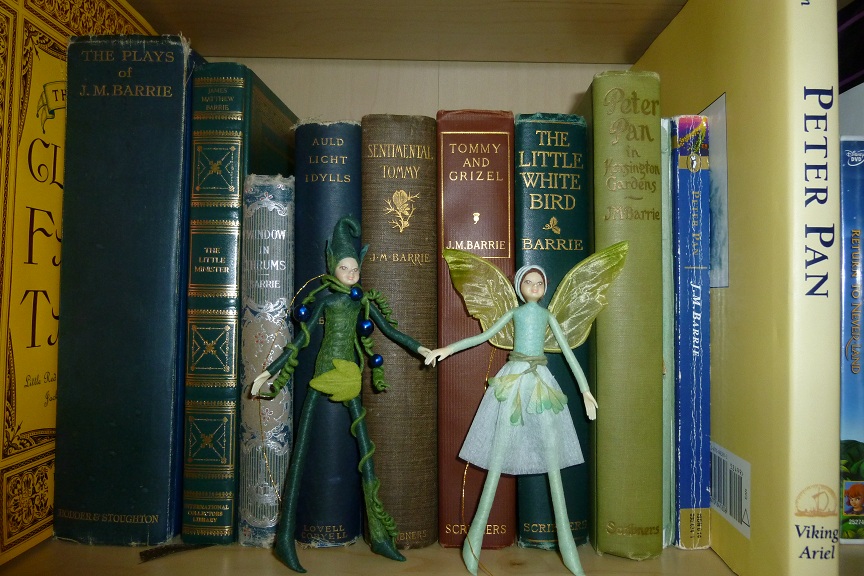
Shelf - Barrie Fairies

I saw these adorable fairies for sale in Covent Gardens.  Having just spent a week wandering around Kensington Gardens with fairies on my mind, I couldn’t resist.  Naturally I keep them in front of my J. M. Barrie collection.

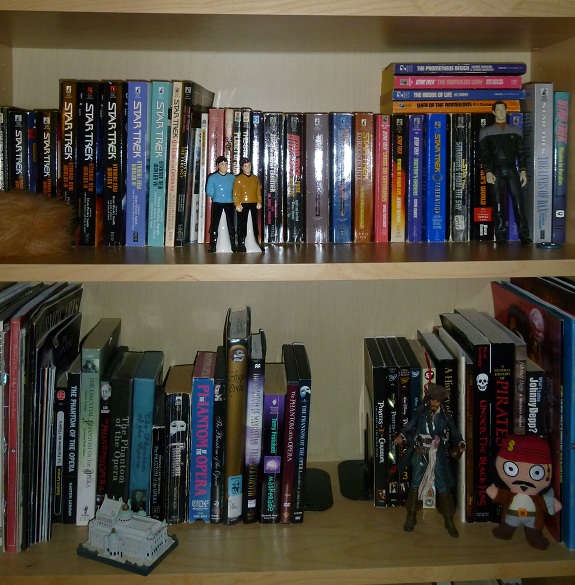
Shelf - Fandom

Here you see the result of some of my fandoms…my shelf of Star Trek books also houses Trevor the Tribble, Kirk and Spock salt-and-pepper shakers, and a Data action figure that I bought at my first ever job, at KayBee Toys (for the record, I don’t recommend working in a toy store for the Christmas season).

On the next shelf, my Phantom collection, with a model of the Paris Opera House, and then my Pirate collection.  I bought the “solemn” Captain Jack action figure because the grinning one was terrifying (really), and I managed to get a Captain Jack Happy Meal toy without actually buying any food at McDonalds.

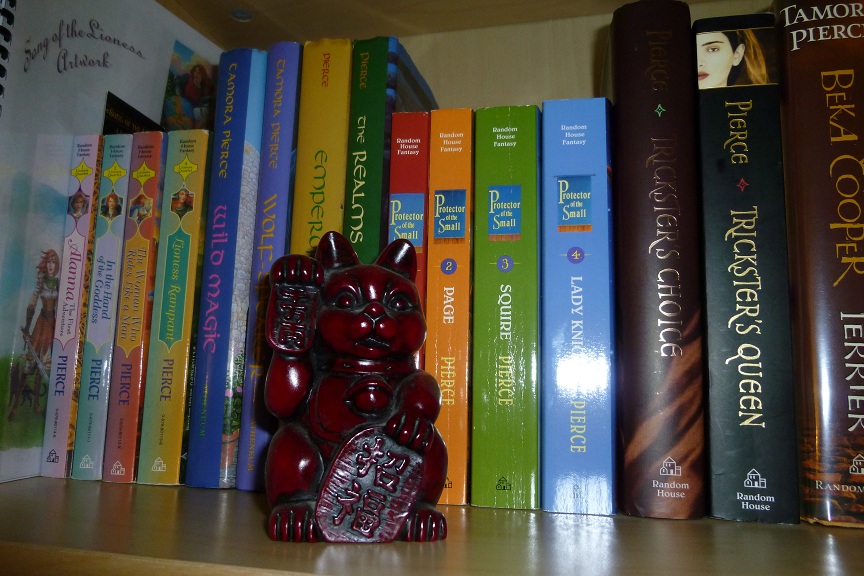
Shelf - Lucky Cat

A less obvious connection here…but I have a Lucky Cat figurine that I bought in Chinatown in San Francisco, and it’s on this shelf because Keladry, heroine of the Protector of the Small quartet, has a collection of Lucky Cat figures.

Those are my cleverest book-and-knick-knack combinations…but perhaps I’ll share other knick-knacks another day! 🙂  Do you have any with fun stories?

Visit At Home with Books for more Saturday Snapshots!

January in Prince Edward Island

L. M. Montgomery Reading ChallengeI am racing about in a flurry of science fiction this month, but in between the aliens and the dinosaurs and the superheroes, I’m also visiting beautiful Prince Edward Island for the L. M. Montgomery Reading Challenge.  So far I’ve been wandering through short stories and a bit of poetry, so this Friday I thought I’d remark on a few of the ones I’ve visited.

I have a funny relationship with L. M. Montgomery.  More than any other, she’s the writer I feel like I’m always reading.  Not literally, but with two books of poetry, 199 short stories, and five enormous journals, it’s always easy to pick up a bit of Montgomery.  And that’s not even counting more concentrated reading in a novel.  But I dip in and out of her short stories on a fairly regular basis.  I own every available collection, so rather than reading any one straight through, I’m spending this month bouncing to whatever story strikes my fancy.  And whichever poem I have a hankering for.

“Old Man Shaw’s Girl” in The Chronicles of Avonlea is a lovely story, quite sentimental but very sweet.  Old Man Shaw’s neighbors think he’s a bit shiftless and lazy and has never made much of his farm, and maybe that’s true–but he also knows how to enjoy life and value what’s really important.  His only family is his beloved daughter, who has been away for three years at school.  He is eagerly anticipating her return–until a meddling neighbor points out how much the girl may have changed.

“A Dinner of Herbs” in At the Altar is one of my very favorites of LMM’s short stories.  Very little happens but it’s delightful and romantic.  Old maid Robin must choose between marrying a widower she doesn’t much like, or continuing to put up with her domineering sister-in-law and chattering niece.  And she’s terribly fascinated by Michael, the shell-shocked war veteran next door, with his two cats (First Peter and Second Peter) and love of natural beauty.  This story is rich in its simplicity, and the dialogue between Robin and Michael brings them to life as much as any characters I’ve met.  It occurred to me rereading this that there are definite echoes of this story in The Blue Castle–or the other way around, I don’t know which came first.  And I LOVE The Blue Castle.

This story also provides one of my favorite quotes from anywhere: “They had laughed together the first time they had talked, and when two people have laughed–really laughed–together, they are good friends for life.”

I keep Montgomery’s poetry collections by my bed and occasionally read a poem or two.  I’m not even a fan of poetry, but I love her poems for some of the same reasons I love her books–she makes the world so much more beautiful than anything my eyes can see.

So I thought I’d end by sharing one of my favorites.  I’ve no idea if it’s great poetry, and I do know occasionally the rhyme or the meter jangles.  But the concept–and the images!  Lovely.

And having read her journals, well…even though she wrote this before her beloved friend Frede died, it’s still about Frede.  It just is.  If Montgomery ever looked at this one again later, I KNOW she was thinking of Frede.

As the Heart Hopes

It is a year, dear one, since you afar
Went out beyond my yearning mortal sight­
A wondrous year! perchance in many a star
You have sojourned, or basked within the light
Of mightier suns; it may be you have trod
The glittering pathways of the Pleiades,
And through the Milky Way’s white mysteries
Have walked at will, fire-shod.

You may have gazed in the immortal eyes
Of prophets and of martyrs; talked with seers
Learned in all the lore of Paradise,
The infinite wisdom of eternal years;
To you the Sons of Morning may have sung,
The impassioned strophes of their matin hymn,
For you the choirs of the seraphim
Their harpings wild out-flung.

But still I think at eve you come to me
For old, delightsome speech of eye and lip,
Deeming our mutual converse thus to be
Fairer than archangelic comradeship;
Dearer our close communings fondly given
Than all the rainbow dreams a spirit knows,
Sweeter my gathered violets than the rose
Upon the hills of heaven.

Can any exquisite, unearthly morn,
Silverly breaking o’er a starry plain,
Give to your soul the poignant pleasure born
Of virgin moon and sunset’s lustrous stain
When we together watch them ? Oh, apart
A hundred universes you may roam,
But still I know–­I know­–your only home
Is here within my heart!

DragonFlight Group-Read, Week One

As part of the fun for the Sci Fi Experience, I’m participating in the group-read of DragonFlight by Anne McCaffrey.  This was just the push I needed to revisit Pern…which I’ve been meaning to do for far too long.

First, a little context for those not reading along: DragonFlight is set on the planet Pern, where society is centered around small holds, traditionally guarded by the Weyrs, where the dragonriders live.  The dragonriders are a race apart, each one bound for life to his or her dragon.  The dragons’ mission is to protect Pern from deadly Threads, parasites which fall from the neighboring planet of the Red Star and burn everything in their path.  They’ve fallen at regular intervals for millenia, but 400 years ago the last pass of the Red Star ended, leading to a Long Interval; five Weyrs of dragonriders mysteriously disappeared, leaving only Benden Weyr to survive to the present.  Now the Red Star is looming in the sky again, and F’lar of Benden is looking for a woman to Impress the new queen dragon about to hatch.  Meanwhile, Lessa of Ruatha has been hiding in her ancestral hold, the only one of her family to survive slaughter ten years before when Fax invaded and took control–and her long quest for revenge is coming to a head.

DragonFlight is one of those books that I read several times as a kid or young teenager, but somehow haven’t touched in the last ten years.  It was very interesting coming back to it again.  Like my experience with The Giver, there’s a lot more to be disturbed by than I remember…  There are some undertones and details that are more worrying than my younger self perceived.  On the other hand, it’s still an exciting adventure on a fascinating world, with deeply engaging characters.

But perhaps I ought to get into Carl’s questions for the discussion…

1.   What are your thoughts on McCaffrey’s handling of the male and female characters in Dragonflight?

2.  F’Lar and Lessa are an interesting pair of protagonists.  What do you like and/or dislike about their interactions thus far?  What things stand out for you as particularly engaging about each character (if anything)?

I want to take these first two questions together, because they feel very interrelated–and related to my complex feelings mentioned above.  It’s an odd thing about women in this book.  There’s a definite feeling that women don’t have much power in society, that there’s a clear delineation between the genders, and that women cook and have babies.

In the Weyrs, the Weyrleader is the man whose dragon mates with the queen dragon.  First, that is a strange way to choose a leader for society.  Second, it is a far more disturbing prospect to consider that the queen rider’s mate is based on which dragon flies the fastest.  I’ve read many other Pern books and I know others end up suggesting that the rider’s preference has a lot to do with which dragon has a successful flight.  But that’s not in this book, so I’m not sure it’s a valid defense…

So all in all…not really liking the treatment of women.

But on the other hand–Lessa is amazing!  The one major female character is certainly as smart as any of the men, and stronger and more determined too.  But–she also spends a lot of the book trapped in a role, and when she breaks out there’s some sense that she’s declaring her independence…but there’s also a sense that she’s an impetuous child who’s rebelling.

In some ways F’lar acknowledges Lessa’s intellect and strength–he certainly sees it.  But he doesn’t treat her as an equal, and there are some very troubling aspects to their relationship.  I feel like if I really wrap my head around some of it, I’m going to end up hating F’lar and I don’t want to do that–so I am very curious to see how other people respond to this question!

3.  How do you feel about Pern to this point in the story?  What are your thoughts on McCaffrey’s world-building?

I already covered some disturbing aspects of Pernese society, but really I’m fascinated by it.  I actually don’t feel like this is a very good book to analyze Pern and McCaffrey’s world-building, because in large ways Pern here is in a crisis of society.  They’re going to figure things out in subsequent books.  I find Pern a more interesting place when it’s thriving, because then you get to find out more about different craft halls, how the Holds interrelate, how dragons fit into the mix…and women don’t seem quite as marginalized in other books.  All in all, a picture emerges of a society that is quite different from our own, marvelously intricate, and just seems to work and fit together in a wonderful fashion.

4.  For those who have already read Dragonflight how do you feel about  your return to Pern?  What stands out in your revisit?

I felt SO nostalgic when I opened to the Introduction and found “Rukbat, in the Sagittarian sector, was a golden G-type star.”  I think every Pern book has the paragraph that follows, and at the height of my Pern-fandom, I could have recited it.

It’s true that sometimes we can go back to books and find them different–although we’re the ones who changed.  I already touched on some of the parts that disturb me, that went right past me before.

But on the other hand, some parts are still the same.  Lessa is such a strong figure.  Dragons–I mean, they’re awesome.  That goes without saying.  I’m fascinated by…I guess I have to call it the shape of the world.  Pern is just an interesting place.

I think that wraps up a discussion of the first half of the book.  More to come next week!  In the meantime, read everyone else’s thoughts.

The Gift of The Giver Series

When I found out that Lois Lowry had released a fourth and final book in her Giver series, I had it on reserve at the library within five minutes.  Apparently everyone felt the same way, as I was about #25 in line.  That actually worked out perfectly, because it gave me time to reread the first three books!  Which also seemed to be in high demand…so perhaps other people felt the same on that too.  Today I want to talk about those three–and then discuss Son in its own review next week.

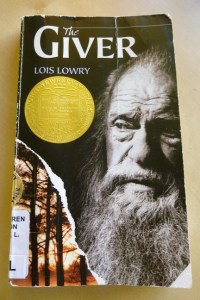
Lowry Giver The most famous, I believe, is the first book, The Giver.  I remember a teacher read it to us in sixth grade, which is the same age Jonas is in the book (probably not a coincidence).  Until I picked it up again, I would have guessed that I had reread it more recently–but I don’t think so anymore, because it felt so different reading it as an adult.

Jonas lives in a very carefully regulated community, where a council of elders decide how each person’s life will be lived.  Everyone is assigned a career at age twelve.  Later on they’re assigned a spouse, and then given children.  When Jonas turns twelve, he is assigned the mysterious role of Receiver, the keeper of the community’s memories from a time before.  As he gradually receives memories from the old Receiver, now called the Giver, Jonas begins to question the world around him.

As far as I can remember when I was twelve, I didn’t find this book disturbing until most of the way through, when I found out what it really means to be “released” from the community.  Reading it as an adult, I was disturbed by page one, when a plane flies over the community unexpectedly and everyone, children and adults alike, stop in their tracks, paralyzed by uncertainty and fear in the face of anything different.  There is something really wrong with this society.

The more you read and the more you find out, the worse it gets.  Lowry has created an incredibly chilling book that is deceptive in its simplicity.  The language is simple, the book is short (I read it in a day) and it’s very much about a child–but it is so powerful.  Part of the chilling nature is Jonas’ easy acceptance of the world as it’s been presented to him.  I think when I was twelve I accepted it right along with him.  As an adult, I’m horrified immediately, while the narrator goes along without seeing a problem for most of the book.

This is not a flashy dystopia–no one’s bleeding, no one’s starving or forced to fight to the death in an arena.  The community is designed to prevent pain.  But it is nevertheless a terrifying vision of a future with no independence, where the individual is completely subjugated to the “good” of the community, and the goal of eliminating pain has eliminated all positive emotions too.

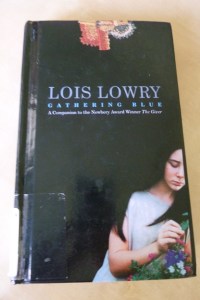
Lowry Gathering BlueNow how do you follow that book?  Book two is Gathering Blue, which does not really seem to have any connection to The Giver (more on that in a bit).  This is set in a different future community.  Kira’s community is not neat and ordered like Jonas’.  Her village lives a subsistence life with no room for warmer emotions in the fight merely to survive.  Anyone who can’t contribute is killed.  Kira, born with one bad foot, was saved in childhood by her caring mother.  Now that her mother has died, Kira saves her own life through her talent for embroidery; the village elders choose her to repair the Robe that records the history of their world.

Kira’s people are as much dehumanized as Jonas’, albeit in a different way, and the governing body has no more concern for people.  It’s fascinating to watch more and more be revealed about her community.  Kira is a particularly good character, and there are good mysteries to unravel in her world.  I remember the first time I read this, I was so frustrated by where it ended!

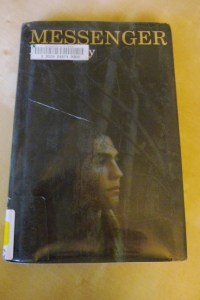
Lowry MessengerSo it’s a good thing there’s book three, Messenger, which ties the first two books together and gives us answers to their inconclusive endings–if not a final ending yet.  This book focuses on Matty, a young friend of Kira’s.  He’s living in a new village, a warm and welcoming place founded by outcasts from other, harsher communities.  But something is changing.  A mysterious figure known as the Trademaster has been inviting people to trade away parts of themselves–honor, kindness, strength–for whatever they most want, and the attitude of the whole community is hardening.

This is the first directly fantastical book.  There are fantasy elements in the first two, but they don’t feel like fantasy.  Jonas’ receiving of memories feels like a kind of hypnosis, and Kira’s embroidery abilities seem like they could be magic, or could be only inspiration.  This book features the Trademaster and his abilities, as well as a sentient, hostile forest, and a special ability Matty is learning to use.  Kira and Jonas both return, so we find out more about the next few years of their lives, and about their clearly magical abilities too.

We again see a theme of dehumanizing.  Jonas’ people lost their humanity trying to escape their pain.  Kira’s people are ground down by poverty and self-interest.  Matty’s people are sacrificing the best of themselves in the interest of greed.

Messenger is in some ways the weakest book, with its primary value bridging the two stronger ones.  I don’t feel like Matty is as effective a character as Jonas and Kira, and while Trademaster is terrifying, he’s also flashier–and we lose the subtle horror of the first two books that was so much more chilling.

However–I also think Messenger gets some criticism because it’s been perceived as the final book of the series.  It does part of that job, tying some things up, but it doesn’t give a strong finish.  Seeing it only as a bridge book leading to book four, I think it lives up to that role very well.

And book four, Son, gave me that stronger finish I was looking for.  But that will be the next review…

Author’s Site: http://loislowry.com/

Other reviews:
Annette’s Book Spot
Stephanie Early Green
Becky’s Book Reviews
Anyone else?

Buy it here:
The Giver
Gathering Blue
Messenger