I'm a book review blogger and writer. I have published four novels, The Wanderers; The Storyteller and Her Sisters; and The People the Fairies Forget; and The Lioness and the Spellspinners. All can be found on Amazon as an ebook and paperback. In my day job, I'm a Marketing Specialist. Find me on Twitter (@MarvelousTales) and GoodReads (MarvelousTales).
I have noticed myself having frequent conversations which involve the sentence, “Oh, you have to watch Doctor Who!” So I thought I’d do a blog post on that subject. I already did one review of the first couple of seasons of the current incarnation. For something a bit different, rather than giving you the sweeping commentary, I decided to zero in on some absolute favorite episodes–giving due attention to each Doctor and companion.
“The Empty Child” and “The Doctor Dances” – This two-parter is my favorite Christopher Eccleston (Ninth Doctor) episode, possibly my absolute favorite of the series. Rose and the Doctor arrive in 1940s London during the Blitz, looking for a crashed alien spacecraft. They find a strange little boy in a gas mask stalking London’s street children, plaintively asking for his mummy. It sounds odd–it is SO creepy. This episode also introduces the delightful Captain Jack Harkness. The first time I saw this, I was absolutely riveted. It’s scary and suspenseful, woven through with wonderful bits of humor, and the last ten minutes are so feel-good that they make me incredibly happy–even when I re-watched it on a nine-hour plane flight.
“The Girl in the Fireplace” – I think this is my favorite Rose and David Tennant (Tenth Doctor) episode. They’re my favorite pairing so it’s hard to choose–but this one has the Doctor crashing through a mirror on the back of horse. That was the moment I decided David Tennant was an awesome Doctor. With regards to this pairing, due honorable mention given as well to the episode when Rose leaves. So unbelievably heart-breaking.
“The Shakespeare Code” – Unquestionably my favorite Martha episode. I mean–they visit Shakespeare! At the Globe! And there are witches, and a mystery involving Love’s Labor’s Won! Probably my favorite destination the TARDIS ever went to. It’s where I’d want to go (after Cavendish, Prince Edward Island, circa 1907. Then Shakespeare’s Globe).
“Turn Left,” “The Stolen Earth” and “Journey’s End” – Lots to love about the Donna and David Tennant episodes, but this multi-part set is fairly mind-blowing. I don’t feel like I really appreciated Donna until “Turn Left,” and then the last two episodes…there are Daleks, and everyone unites to fight them. We get to have so many amazing characters in an incredibly epic confrontation. Love it.
Honorable mention also to David Tennant’s last episode. I really think the writers did everything they could to NOT help me deal with him leaving. I’m still not over it. But on we go to Matt Smith…
“Vincent and the Doctor” – I have more mixed feelings about the seasons with the Eleventh Doctor, Matt Smith (something for another post), but I do madly love this episode. The Doctor and Amy visit Vincent Van Gogh. I’m pretty familiar with his paintings, and it is SO MUCH FUN to see iconic paintings scattered all over Van Gogh’s living room (he apologizes for the mess). There are little bits and pieces referencing his paintings all over the episode. It’s also a beautiful, moving story about the pains and the joys of life.
If anything–anything at all–in here is catching your attention…you have to watch Doctor Who! And if you already have, I’d love to hear about your favorite episodes.
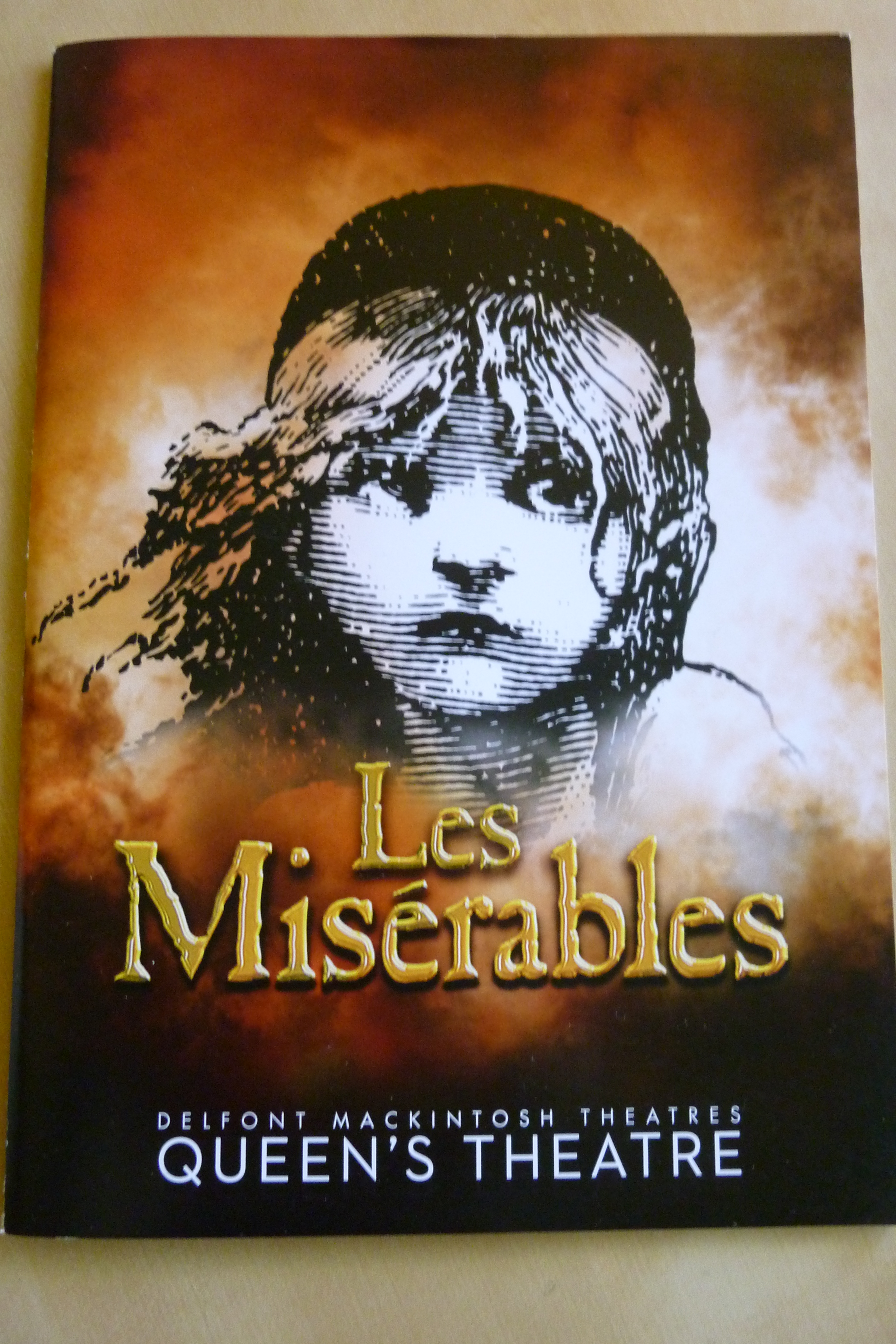
One of the most exciting things I did while I was in London in September was go to the theatre. I got to see Les Miserables for the first time after listening to the soundtrack many, many times. I thought I’d do a theatre review and share the experience! And, because this is me, make some comparisons to Phantom too–another theatre review that’s coming soon! Spoiler warning for Les Mis (mostly who dies), as it’s hard to discuss without spoilers…but I’m guessing most people have some knowledge anyway.
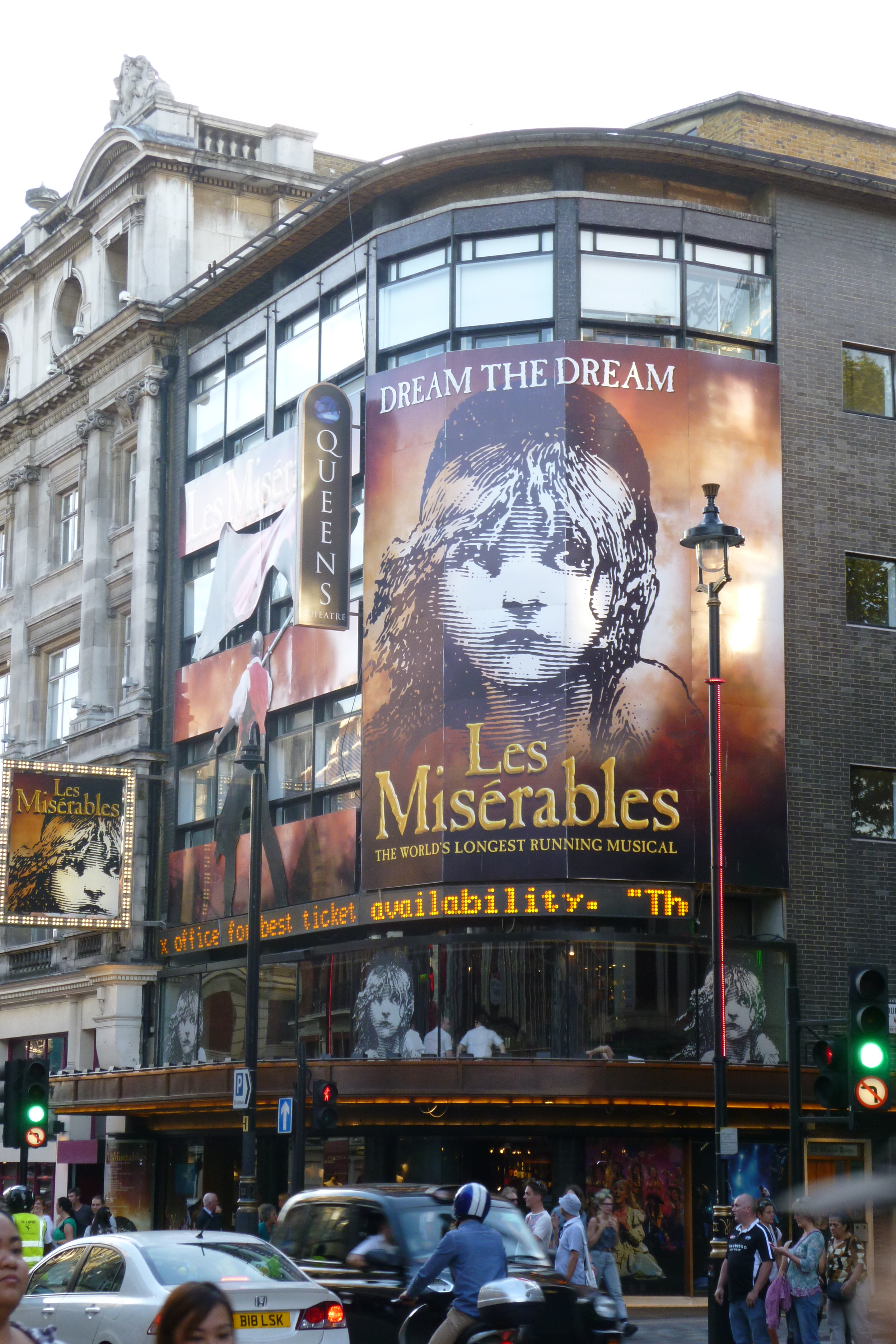
Les Mis in London is playing at the Queen’s Theatre, near Leceister Square. I set off there in the late afternoon, because I have theatre paranoia. I always have this dreadful fear that I’m going to be late to a play–fueled, I think, by the fact that some theatres won’t let you in for entire acts if the curtain is already up, and because I’m frequently seeing plays while traveling, and if I don’t see it then…I won’t see it. So I got there early, and ended up having a quick, order-at-the-counter dinner, at a place directly across the street from the theatre. And then of course I got there almost an hour early anyway!
I bought my ticket for Les Mis last May, so I was able to get a really good seat–front row and center. I decided to splurge a little, since I’d never seen the play. And once you decide you’re buying a ticket, the nice seats are not really that much higher than the so-so seats. I think almost any seat in the house would be good, though, as the theatre just isn’t that big.
The very short reaction–it was amazing. There’s so much more than is on the soundtrack. You can get most of Phantom on the soundtrack, but there are huge pieces of Les Mis that aren’t on the CD. They put all the dramatic songs on, of course, but there’s so much more dialogue, and scenes that reveal character or explain plot points. There were some bits that never made sense to me–and they do now!
The plot is complex, but basically we’re following Jean Valjean, a former convict (for stealing a loaf of bread) who broke parole to try to remake his life, but is still being sought by Inspector Javert. Valjean’s path intersects with Fantine, a woman who’s driven to prostitution in order to provide for her daughter. Valjean ends up raising Fantine’s daughter, Cosette–whose path in turn intersects with Marius, a student who is in with a group of young revolutionaries, determined to rise up on behalf of the poor and downtrodden of France. That’s as brief as I can make it, and doesn’t even mention my favorite characters–who I’ll get to in a bit.
Valjean and Javert were both excellent. They have such powerful songs, and are such complex characters. As I was leaving the play, I heard someone say, “I really like that even the villain isn’t really a villain.” It’s possible he meant Thenardier, the comic relief villain, but I think it’s more likely he meant Javert. And it’s true–Javert wants to hunt down Valjean, who the audience can see is unequivocably a good man, yet Javert is coming from a place where he’s convinced that he’s the one in the right.
There’s a very nice handling of religion in the play, because both men are motivated by a belief that they’re doing what God would want of them. Perhaps part of Javert’s trouble is that he’s sure he’s right, while Valjean realizes it’s a struggle. Anyway, they both performed wonderful songs that blew me away. Geronimo Rauch (Valjean) has also played Jesus in Jesus Christ Superstar, and I could hear it a bit. I’m guessing he did an amazing “Gethsemane.” It’s that kind of powerful drama.
The Queen’s Theatre – you can kind of guess what’s playing.
After the major characters, I should talk about my favorite. I love Eponine. She’s a girl from the streets who loves Marius, but he just never sees her. In the production I saw, Eponine was played by Danielle Hope, who’s exciting by association; she played Dorothy to Crawford’s Wizard of Oz. I thought she was excellent as Eponine–emotional, heartfelt, so powerful in her major song, “On My Own” (which you can find on YouTube, by the way…though of course it was better live).
You don’t get a lot of context on Eponine just listening to the soundtrack, so seeing the play, I realized she is so much braver and more complicated than I knew. It’s not just that Marius is oblivious, it’s also that he’s a higher social class, making her unrequited love even more poignant. Especially since he’s so oblivious, he wants Eponine to help him woo Cosette–which she does, at considerable sacrifice. Loved, loved Eponine.
Fantine was very good too, with this wonderful personal quality to her “I Dreamed a Dream.” She seemed to be appealing directly to the listener; Eponine had a bit of that too. I saw Sierra Boggess as Fantine, which was interesting because she’s Christine in the filmed, 25th anniversary production of Phantom.
The Thenardiers are much funnier in the play than on the soundtrack. They’re also more awful, so that’s a nice mix there.
I was surprisingly impressed by young Cosette. I’ve never been that fond of her song, “Castle on a Cloud,” but it becomes more remarkable when you can see how small the girl singing it is! I wasn’t all that impressed by grown-up Cosette. It wasn’t the actress’ fault. It’s just that they give Cosette SO little to do.
Which brings me around to Marius. He’s on stage more than Cosette, and is sort of more involved…but he is such a passive character. I didn’t think of this until I saw the play, but he reminds me a lot of Raoul from Phantom. Some of that may have been casting–he looked like Raouls I’ve seen–but I also think they’re the same archetype. They’re the very innocent, pure, utterly non-threatening romantic lead, uncomplicated and ultimately shallow as characters. And they can end up coming across as rather dull wimps.
To give fair due, at least Raoul tried to rescue Christine. He failed, but he tried. Marius accomplishes nothing, and attempts nothing. He needs Eponine to find Cosette for him, and to deliver his letters to her. He fights on the barricade with the revolutionaries, but that feels like he’s just being carried along by his friends–and then he’s literally carried away from the barricade by Valjean. Marius actually does…well, nothing.
Interestingly, there’s no romantic alternative for Cosette. Often the innocent romantic lead is paired with a darker, more complex and seductive figure (that would be the Phantom). Les Mis, on the other hand, gives Marius a romantic alternative in the darker, more complex Eponine. She’s had a harder life than Cosette (after age five or so), she’s smarter and more capable, and she’s not as innocent. She’s also the socially-challenging choice.
That in turn makes me question Marius’ revolutionary fervor. The revolutionaries are all about equality and raising up the lower class, yet when Marius falls in love, it’s with someone from his class (or who at least appears that way). He barely seems to realize ragged Eponine is a girl, but he falls madly in love with prim and proper Cosette, literally at a glance. Marius may come across better in the book, but I was not impressed by him in the play.
I did believe in the revolutionary fervor of the others, especially the leader, Enjolras. He was my favorite of the students. And I loved Gavroche, the little boy from the streets with an eye on everything. He’s so sweet and so clever. After the barricade is taken, there’s this moment where they turn it around and you can see the front. Gavroche is lying dead among the soldiers, and Enjolras is spread out hanging off the wall with his flag…SO SAD!
I was also (differently) sad that Gavroche didn’t get to sing “Little People.” He reprised it a couple of times with a verse or two, but he never sang the full song from the soundtrack. I’m sure that made the reprises less moving. Anybody know if that’s normal, to leave out that song?
Other thoughts…almost every song was excellent. I didn’t think they got quite enough power into “Do You Hear the People Sing?” but on the other hand, “One More Day” was breath-taking. That was the first act closer, and it was brilliant. I basically believe in the revolutionaries’ cause, but in some ways it almost doesn’t matter. The songs are so inspiring, they make you want to join the cause without worrying about the details (which is probably a dangerous commentary, actually…)
Javert’s death was a little oddly handled. He’s supposed to be jumping off a bridge into the Seine, but instead of having him literally fall, they raised the bridge behind him. And…it looked like a bridge rising, not a person falling. I would say that’s fine, maybe you can’t have someone jump down into water on stage–but Raoul does it, so I know it’s possible. Although Raoul wasn’t singing at the time.
The end of the play is SO sad. It’s like a Shakespearean tragedy, with almost everyone dead. There’s a moment with the spirits of Fantine, Valjean and Eponine smiling down on Cosette and Marius. I guess we’re supposed to be consoled by the couple’s happy ending–but it just highlights the fact that all the complex, interesting, deserving characters died. On the other hand, they died so movingly, and it was all such beautiful music, and intertwined with great ideals and complex examinations of life and class and human emotions…
It was such a good night at the theatre. Now I can’t wait for the movie version.
And on one last happy note, after the last bow, there was a cast group hug. Valjean grabbed Madame Thenardier in a bearhug, and then everyone piled in. So cute!
Considering how much I love Terry Pratchett’s Discworld books, I have been impatiently awaiting his latest book–even if it isn’t Discworld. Dodger is not quite on the level of the best Discworld, but it was a fun read of its own.
To clarify one thing at the beginning, the book is not really about the Artful Dodger from Oliver Twist–at least, not exactly. Say rather it’s a young man who could be the inspiration for the Artful Dodger–considering his connections to Charlie Dickens, and all.
Dodger is a tosher by trade, a seventeen year old boy who makes his living searching through the sewers of Victorian London in search of lost coins, jewelry and other treasure. And if occasionally things happen to fall out of their owner’s possession and into Dodger’s hands, well, who is he to dispute with a bit of good fortune? Everyone knows Dodger, and everyone knows Dodger never gets caught.
There’s no Fagin, but there is Solomon, a wise old Jewish watchmaker who gives Dodger a place to sleep and helps him stay on the straightish and somewhat narrow path. There’s no Oliver Twist, but there is Simplicity, a young woman Dodger rescues from a couple of thugs–a young woman who turns out to have crowned heads of Europe intensely interested in her. His efforts to help her will take Dodger into a whole new part of society and bring big changes into his life.
All in all, I didn’t love the book, but there is a great deal here to like very much. There’s enormous fun in the various historical figures Dodger’s path crosses–from Fleet Street journalist Charlie Dickens to up-and-coming politican Benjamin Disraeli, and a host of others I didn’t have enough historical grounding to recognize (but there’s a helpful afterword). We also wander into fictional territory when Dodger meets Sweeney Todd, more sad than demonic and a powerful lesson about the tendency of the world to create the story they want to hear.
Dodger’s character growth throughout the book is excellent. At first, he seems a little too noble (in the character sense) for a boy on the streets, but as the book develops and his character does too, it fits more easily. It’s not an easy growth, and Dodger finds a certain loss of identity (or at least uncertainty) in his sudden rise in standing and character.
My favorite things are a couple of character quirks. First, especially near the beginning, Dickens has a tendency to make a remark, get a look in his eye, and hastily jot something down–as when he made a reference to “our mutual friend.” I would have loved even more Dickens quotes sprinkled throughout–though there may have been more that I just missed. Second, I love Solomon’s religious life. He frequently explains situations to God, perhaps when someone is doing something a bit, well, dodgy. But Solomon will make matters clear to Him, in a lightly humorous and never offensive way. It has much the same feel as the beginning of the song “If I Were a Rich Man” in Fiddler on the Roof.
My least favorite thing…well, I found out a bit more than I really needed to know about Victorian sewers, and I could have lived with far fewer references to, shall we say, Victorian waste, human and animal, in and out of sewers. The most recent Discworld book featured an interest in bathroom humor, and I sincerely hope this is a short-lived trend in Pratchett’s writing. It’s more often nasty than funny, and frankly, I know he’s more clever than to need to resort to that.
Still, this is a fun trip through Victorian London with solid characters and a plot with a few good twists. Don’t come here expecting the high hilarity of Discworld, but it is an enjoyable historical novel.
This month, I’m participating in a read-along of Neil Gaiman’s The Graveyard Book, as part of R.I.P. We’re looking at a few chapters a week, with no specific questions for each post. This week’s discussion is on the last two chapters. See my first post here.
So much to love in these last two chapters–and so much to be desperately sad about! Since we’re talking about the end, there will be spoilers… Warning duly noted, let’s jump in!
Chapter seven is practically a novella, and right from the title, “Every Man Jack,” it promises us resolutions to the arching plot of the book. I love how this chapter ties bits and pieces together from almost every earlier, disparate chapter. A teenage Scarlett (chapter two) comes back to town, and finds her way to the graveyard and to Bod. She also meets Mr. Frost, a soft-spoken academic…who in a brilliant twist turns out to be the man Jack. I love that too–and you’d think I’d remember it! But I didn’t, so I got to be surprised again. This is why I enjoy rereading.
Meanwhile, Silas has disappeared from the graveyard on mysterious business. We find out that he’s with Miss Lupescu (chapter three) and other comrades in a desperate fight against a group of enemies. And I love that we have a last stand featuring a mummy, a werewolf and (though it’s never said, it’s pretty obvious) a vampire. I love that we get all the classic horror monsters, and in this case they get to band together and be the heroes. Love that. I do have to admit, though, that parts of this confused me. It eventually becomes clear they’re fighting the Jacks, but exactly where and how…I found that muddled.
Back at the graveyard, Bod finally has to confront not only the man Jack but several of his associates, the creepy men from that rather creepy convention we saw in the Interlude. I love their names: Jack Dandy, Jack Nimble, Jack Tar. I don’t get Jack Ketch–is that a reference I don’t know? I love that Bod has to use all his knowledge and friendships from growing up in the graveyard to protect himself and Scarlett–he makes use of the ghoul gate (chapter three), gets help from Liza the witch (chapter four) and ultimately uses his experience of the Sleer (chapter two) to defeat the man Jack.
I love that Bod has to really embrace who he is as a child of the graveyard–realizing that he doesn’t need to “learn” his name. He is Nobody Owens. He uses all that he’s learned to protect himself and his friend. And I love that Gaiman manages to handle all the men Jack without Bod actually killing any of them. As a writer, I know that requires much more creativity than just killing the villain.
I am desperately, desperately sad about Scarlett. Bod felt so drawn to her, and she was his only human friend…and then she becomes afraid of him…! It’s such a tragic twist, that in the process of embracing his own identity and vanquishing his enemy, Bod ends up losing his friend. He protected her, and then she rejects him for it. I love the emotional tug of it–brilliant storytelling–while being so sad for him, and so disappointed that Scarlett couldn’t make the leap to accept him.
Chapter eight is very bittersweet as well. Almost an epilogue chapter, Bod is growing up and that means leaving the graveyard. It’s so sad that he can no longer see this community that he’s grown up in, while at the same time it’s exciting that he’s going to go explore the world beyond the graveyard. The ghosts and the graveyard become a metaphor for childhood as he has to leave it behind to become an adult.
I get the metaphor, and it’s effective. But I do wish the graveyard could still be there for him to go back to, the way some of the joys and wonder of childhood can still be found by adults. And also, the idea of a sixteen year old boy with scarcely any experience of the world going out into the world alone–it sets off all kinds of screaming alarms in my head. Silas, this is not responsible guardianship! At least take him on a Grand Tour before sending him off by himself!
Though on the other hand…Bod set off into the world alone as a toddler, and made his way to the graveyard. Now, at sixteen, he’s continuing that journey.
And I love his last exchange with Silas. Love.
And I love to think that someday, after a long life full of lots of adventures and meeting people who won’t run away, I love to think that Bod comes back to the graveyard.
I’d also love to see a sequel about Bod’s adventures in the world. Such potential for so much more.
In the meantime, I have thoroughly enjoyed taking a leisurely trip through this book again, and loved all the thought-provoking discussion on everyone’s blogs. Big thank you to Carl for hosting, and to everyone for all your wonderful thoughts!
I am SO ready for fall and winter. That may partially be because of R. I. P., but mostly it’s the fault of the weather–we had a tantalizing few days of cold and clouds, before going back to upper-80s this past week. I am trying to savor the cold mornings and pretend not to notice the hot afternoons. I can’t wait until it’s actually cold enough for all my favorite fall and winter things–like sweaters and heavy quilts and scented candles.
In the meantime, I’m amusing myself for Saturday Snapshot this week with a sort of Fall Tableau.
What could be better on a dark and chilly evening than a cozy afghan, hot tea and warm cookies, candlelight and Hitchcock?
I’m just impatient. I suppose it’ll get chilly soon enough…and I watched Rebecca this week anyway.

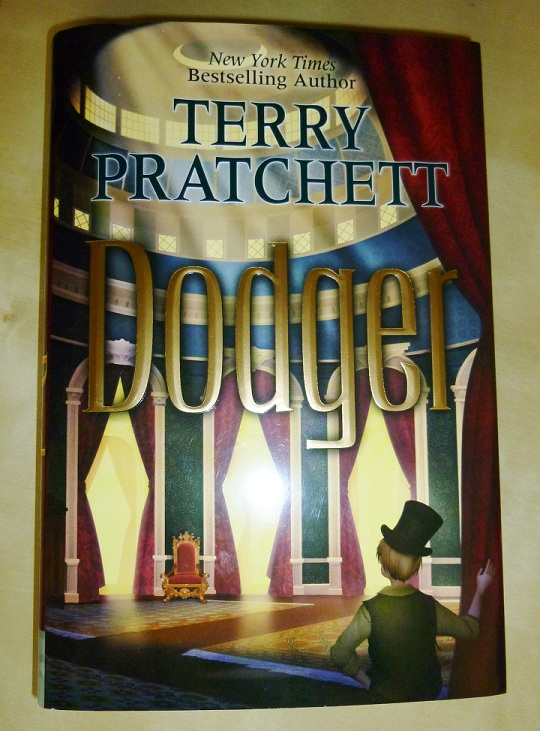
 is not quite on the level of the best Discworld, but it was a fun read of its own.
 , as part of