
Author: cherylmahoney
I'm a book review blogger and writer. I have published four novels, The Wanderers; The Storyteller and Her Sisters; and The People the Fairies Forget; and The Lioness and the Spellspinners. All can be found on Amazon as an ebook and paperback. In my day job, I'm a Marketing Specialist. Find me on Twitter (@MarvelousTales) and GoodReads (MarvelousTales).
Gender Equality in Discworld
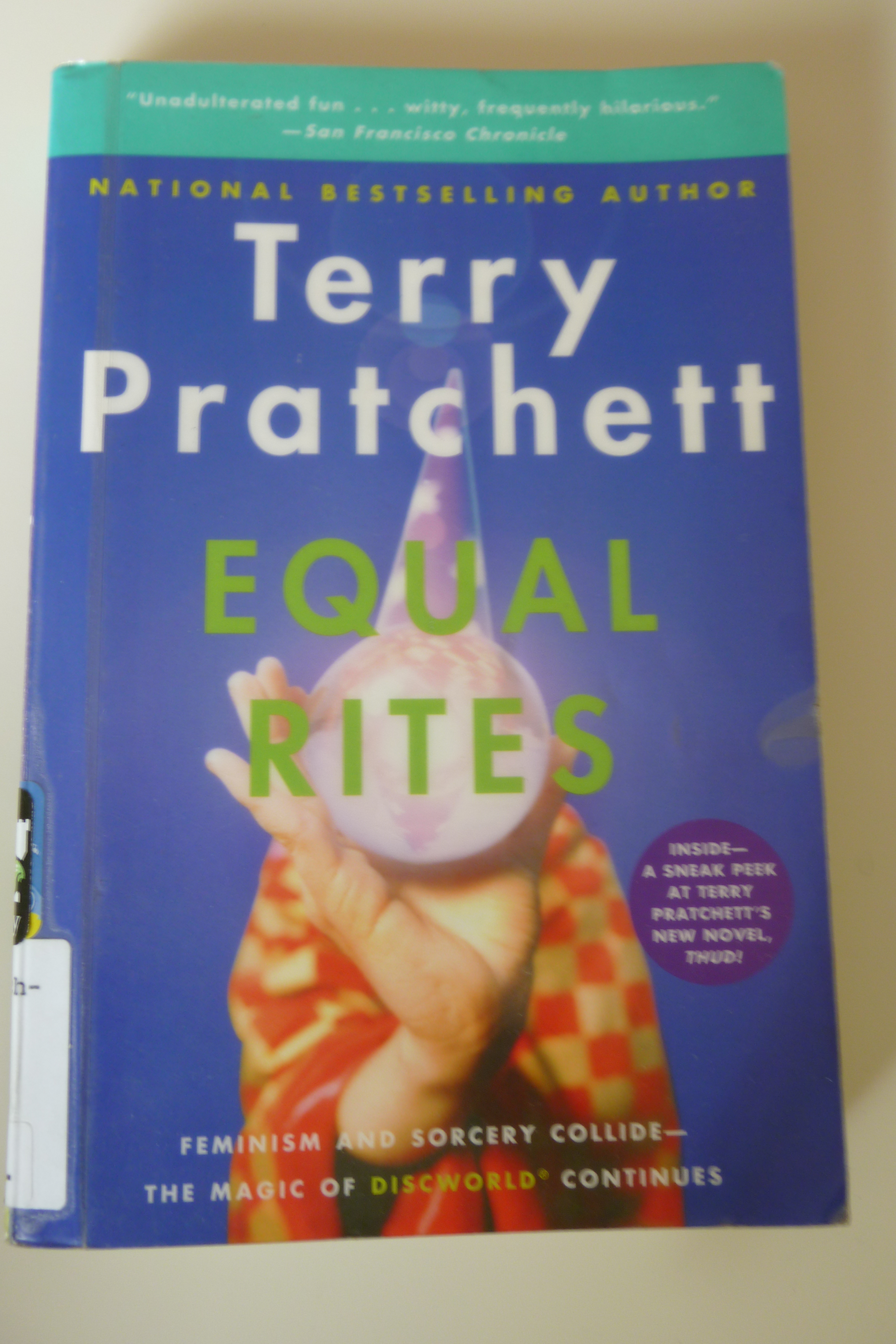 So far, I’ve seen Terry Pratchett be hysterically funny while tackling subjects like racial tension, politically-motivated war, business competition, and murder investigations. In my most recent Discworld read, Equal Rites, he took on gender equality–and if not hysterically funny, he was at the least quite amusing.
This is a new one for me but not for him, as it’s actually the third book in the Discworld series. Unfortunately, it shows. It took a few books for Pratchett to quite work out Discworld, and there seems to be universal agreement that the first couple are simply not as funny. It’s true for the third one too–it’s funny, but something’s off. Timing, style, character…I can’t put my finger on it, but it’s just not AS funny. Don’t get me wrong here–that still makes it one of the funniest books I’ve read this year. It pales only in comparison to the rest of the series.
I read this one because it’s the first book focusing on the Witches, one of the groups of major recurring characters within Discworld (along with the Wizards, the City Guard, and Death). I read Maskerade, another Witches book, long before I read any other Discworld (it’s that Phantom connection), and I hadn’t read any Witches books since, so I couldn’t quite put Maskerade in context. This helped a bit, though there’s much more to read.
As to the actual plot…a dying wizard passes his power on to what he thinks is a newborn boy–but turns out to be a girl. This is a problem because girls never become wizards. When Esk gets older, strange occurrences start happening around her–as when she turns her brother into a frog. Her family sends her to the local witch, Granny Weatherwax, who starts teaching her witchcraft. But Esk still has all this wizard power hovering around her, and eventually they set off for Unseen University, where all the wizards are trained, to see what can be done about a girl wizard.
There are certainly funny moments. Granny is an excellent character, although she’s not quite there yet. She’s a major character in Maskerade too, and she’s funnier then–but she’s funny here. There’s chaos and there’s mayhem and there’s at least a bit of commentary on gender rights.
It’s a good book–but I only recommend it if you’re really interested in reading as much Discworld as possible. If you want a fantasy novel about gender equality, read Tamora Pierce’s Song of the Lioness quartet. If you want to read one book in Discworld, read Going Postal (and if you want to read a few more, check out my post here). As for me, I’ve got my eye on another Witches novel, Lords and Ladies, which I’ve been told is a retelling of A Midsummer Night’s Dream…
Author’s Site: http://www.terrypratchett.co.uk/
Other reviews:
Confessions of an English Literature Eater
Eyrie
Cubilone’s Dimension
Yours?
Pirates!
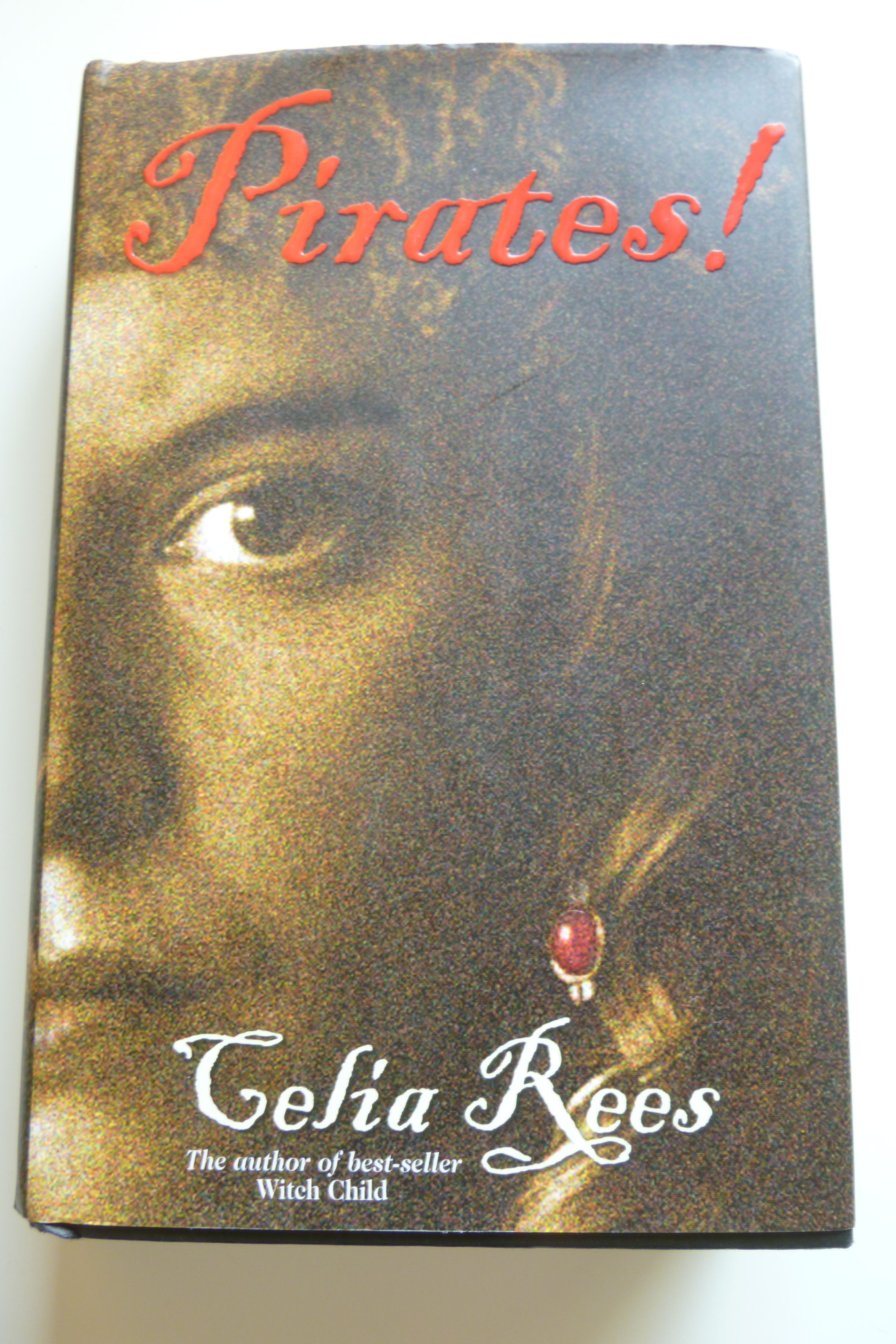 Rarely can my interest in a book be so perfectly expressed by its title as in the case of Pirates! by Celia Rees. I mean, why was I interested? Pirates! It’s all rather self-evident.
But this is also a Dusty Bookshelf book, so despite the pirates(!) it took me some time to get to it somehow. Backstory:
How did I get it? Bookswap with my book club. I’d been seeing it at bookstores and the library for ages but somehow never got to it, so when it wandered past me available for free, I thought…pirates! And took it home.
How long was it on the shelf? Since February 2011…I read it in April, so 14 months. Ouch.
Am I keeping it? No…I enjoyed it, and I enjoy the title way too much, but I didn’t quite love it enough to keep it.
What, you ask, is the book about? Besides pirates, of course. It’s about Nancy, the tom-boyish daughter of a wealthy English merchant, who after her father’s death finds herself packed off to the family plantation in Jamaica. There she bonds with Minerva, a slave who becomes like a sister to her. The two girls flee into the wilderness when Nancy realizes she’s being forced towards a marriage with the terrifyingly cruel Bartholome, another merchant and plantation owner. Nancy and Minerva find a friendly band of pirates and join the crew, though Nancy is still dreaming about her childhood sweetheart–who just happens to have joined the British Navy.
It’s a fun story and an exciting premise, and I loved reading a novel about female pirates in the Caribbean during the Golden Age of Piracy. I mean, I wrote a novel with that premise–it’s kind of an area of interest for me! I may be too familiar with it, though, because I kept feeling sort of like I’d already read this. I’m reasonably sure I haven’t actually read it, but I can think of several books with similar elements.
There were some things a bit more unusual. I liked the bond between Nancy and Minerva. I liked the twin focus on both piracy and slavery. I’ve read books about one or the other, but rarely seen them together, even though they were both going on in the same time and place, and even in the same shipping lanes. I studied Jamaican history for a class in college and was fascinated by the Maroons, a group of escaped slaves and other society outcasts who lived inland in Jamaica. I was also shocked that I’d done a lot of research on piracy (same time and place!) and never heard about them. Somehow the stories don’t usually overlap–but they did here, as Nancy and Minerva got in with both groups, and I enjoyed seeing that.
I loved the references to historical pirates. None of them showed up, even in cameos, but they were talked about, including Anne Bonney and Mary Read, the only two real life female pirates from the Golden Age. This is actually set a few years after most of the greats had died, in the last year or two of the Golden Age (so that’s about 1724).
This was mostly historical fiction, not fantasy. Bartholome has an uncanny ability to track Nancy after she runs away, and Nancy has some oddly prescient dreams about him, but I wouldn’t really define this as fantasy. It’s more a suggestion that some of the native folklore has a little bit of truth in it.
This was an enjoyable book, good characters and an excellent setting…and I really don’t know why I liked it without loving it. But at least now I know more about that tantalizing title–Pirates!
Author’s Site: http://www.celiarees.com/
Other reviews:
Curvy Writer
Em’s Bookshelf
Mommy Brain
Anyone else?
Saturday Snapshot: Bookish Places
One of my favorite things to do on trips is to visit places I’ve read about in books. Somehow, having a fictional event set in a real place makes that place so much more interesting! Maybe it’s because I read about so many fantasy or sci fi places I’m obviously never going to go 🙂 so it’s especially fun when I can go somewhere real.
Everywhere I turned on my trip to New York, I seemed to be seeing something I knew from a book or a movie or just the cultural consciousness. Naturally I took pictures of everything! But I’ll just share a couple today. 🙂
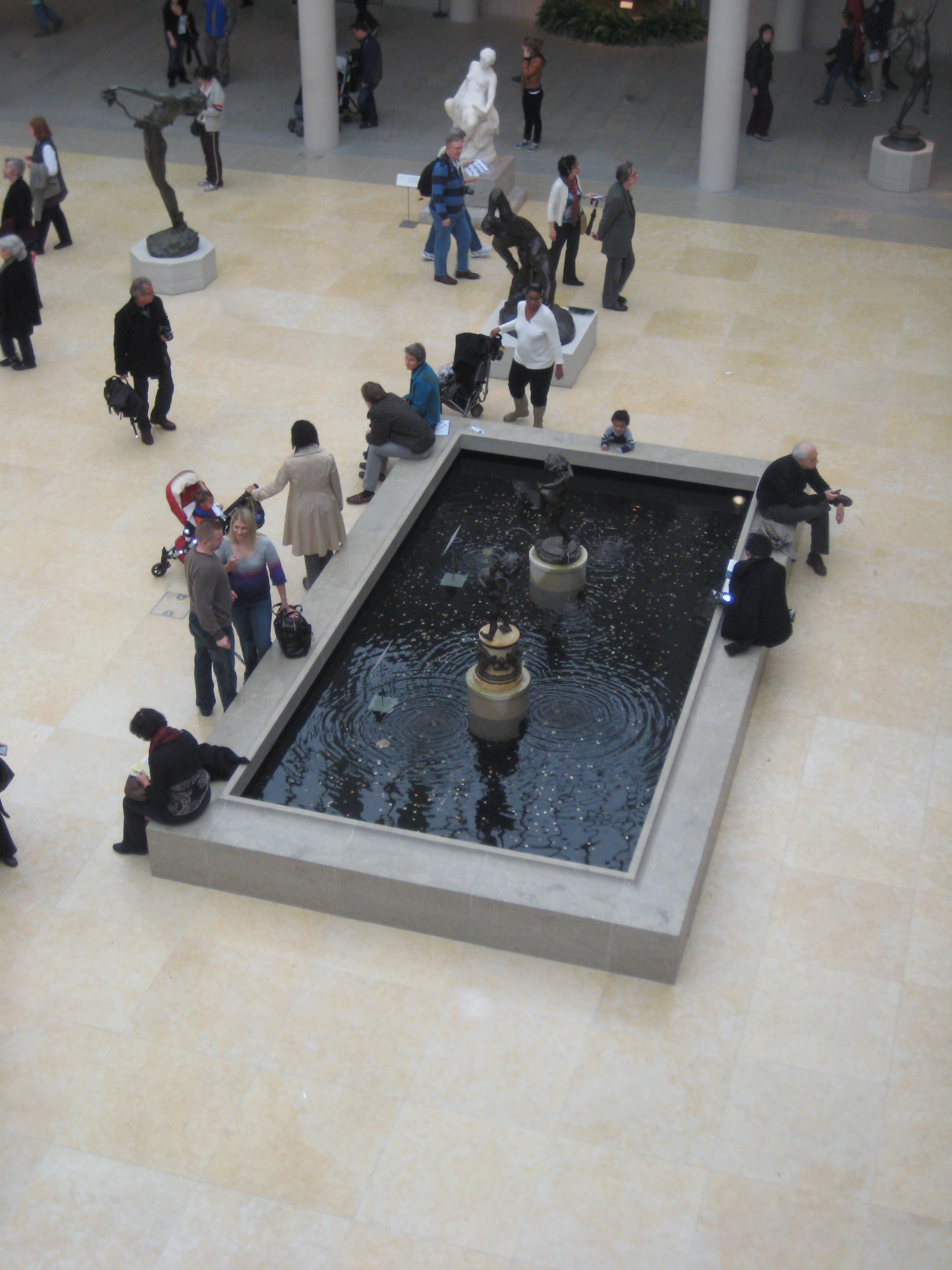
First, the fountain in the Metropolitan Museum of Art. It’s lovely in its own right, and all the more interesting because Claudia and Jamie took a bath in it while they were hiding out at the Met, in From the Mixed-up Files of Mrs. Basil E. Frankweiler by E. L. Konigsburg.
Next on the museum tour, the Natural History Museum. It’s featured in The Night at the Museum, but personally I was more interested in it as Caroline’s museum.

In The One Hundredth Thing About Caroline by Lois Lowry, Caroline is an eleven-year-old girl and aspiring paleontologist who goes to the Natural History Museum every week. She knows all the exhibits and everyone who works there. It’s clearly a second home for her, and I felt that a bit vicariously, even though it was my first trip. And anyway, who doesn’t love seeing dinosaurs?

I’ll save some other places for another week… In the meantime, check out more Saturday Snapshots on At Home with Books!
Fairy Tale Round-Up: The Twelve Dancing Princesses
I focus on fairy tale retellings often, and right now it’s the season for them, since I’m participating in the Once Upon a Time challenge. I thought it would be fun–and maybe useful to someone–to spend a few Fridays gathering together lists of the retellings I’ve read.
I decided to start with a relatively minor fairy tale that has been getting a lot of press lately, “The Twelve Dancing Princesses or The Shoes That Were Danced to Pieces.” It’s certainly not on a level with Cinderella as a cultural touch-point, but I stumbled on a number of retellings in the past few years, and then when I decided to write my own version, I started seeking them out. It seems to be a popular story at the moment.
The Brothers Grimm story is “The Shoes That Were Danced to Pieces,” and is about twelve princesses who are wearing out their dancing slippers every night, even though they’re locked in their bedroom. Their father the king puts out a call for champions, who will each be allowed to spend three nights in the princesses’ chamber. If they can solve the mystery, they get to marry a princess. If they fail, they lose their heads. After a number of champions fail, an old soldier comes to try. With the help of an invisibility cloak, he’s able to follow the princesses through a magic forest of silver, gold and diamonds, across a lake to a castle where they’re dancing with twelve princes. By telling the king what’s happening, the soldier breaks the spell and marries the oldest princess.
It’s fascinating to see what is and isn’t in the original story, compared to the retellings. There are definite trends in how the story has been retold. The original is entirely the soldier’s point of view, but most of the retellings are from the princesses’ perspective, or from a new, female character who’s seeking to help them. In the retellings, the king is well-meaning and at worst a bit stern; I’ve yet to read a retelling where heads are actually being chopped off. The princes in the castle are usually cast as demons or monsters, although I personally don’t think that’s clear in the original. And almost everyone struggles to develop twelve princesses as characters, which really is a remarkably large number to deal with.
So let’s see what’s been done more specifically…

Wildwood Dancing by Juliet Marillier was one of my first retellings, and a very loose one. Only five girls, they’re not princesses, and they go dancing at a fairy court that is not as terrible as in most versions. This story combines with a retelling of The Frog Prince, so that brings in some significant different elements.
Princess of the Midnight Ball by Jessica Day George is a much closer retelling, and one of the few that gives at least part of the story from the soldier’s point of view. It does better than most at developing the relationship between the soldier and the oldest princess–and I rather love that the hero is brave and strong and also knows how to knit (soldiers have to get socks from somewhere!) It also has some of the best-depicted princesses.
 The Twelve Dancing Princesses by Marianna Meyer and illustrated by Kinuko Craft is a very beautiful picture book. It doesn’t do anything too exciting with the story (though it is another one from the champion’s point of view) but the illustrations are exquisite.
“The Twelve Dancing Princesses” by Robin McKinley is a longish short story in her book, The Door in the Hedge. I had such high hopes for this one (I mean, Robin McKinley!) and they were only partially met. It’s a beautifully-written retelling with vivid imagery and all the details of description and character emotion that the Grimms always leave out. But…there’s really nothing innovative about it either. It’s pretty much precisely the original story (minus the head-chopping).
 The Thirteenth Princess by Diana Zahler supposes that the princesses have a thirteenth sister, Zita. Their mother died when she was born and their father banished her to be a servant in his grief. She evades the spell that captures the rest. It’s a cute version in some ways, although the twelve princesses are unusually undeveloped as characters. The focus on Zita’s story means less focus on the twelve princesses’ adventure.
The Phoenix Dance by Dia Calhoun is another one that brings in a new heroine, this time the royal shoemaker’s apprentice. Her master’s reputation is being ruined by the constantly worn-out dancing slippers–which, by the way, is a fantastic idea! The original fairy tales never address that kind of detail. I loved that premise, but then I didn’t love the heroine as well. This is also a fantasy look at bipolar disease, and while I respect what Calhoun was trying to do, I actually had difficulty getting a sense of the character through the mood swings.
 Entwined by Heather Dixon is one of the latest retellings, which made the rounds of all the blogs I follow. This one more than any other I’ve read emphasized the beauty of the dancing, and played with the princesses’ love of dancing. There are twelve princesses named in alphabetical order, which was very helpful for keeping track of the relatively bland younger nine.
The Night Dance by Suzanne Weyn meshes the dancing princesses with Arthurian legends. It’s a clever idea, but the book is hampered by some very slight characters. They served their roles, but I can’t remember a single character’s name anymore.
 Troll’s Eye View has “The Shoes that Were Danced to Pieces,” a short story by Ellen Kushner. Mostly pretty light and silly, this captured better than any other version how annoying it could actually be to have eleven younger sisters. The princesses are universally devoted to each other in other versions, and it was fun to see an oldest princess who finds her clamoring crowd of sisters overwhelming.
There you have probably more versions than you could ever actually want. 🙂 Recommendations…if you want a close retelling, go for McKinley’s short story. If you want something close but more elaborated upon, read Princess of the Midnight Ball. If you want to look at beautiful pictures, definitely get Craft’s picture book. And if you just want to know which book is overall the best read…it’s only a loose retelling but a wonderful book…Wildwood Dancing.
And if I’ve missed a version–let me know!

