When Princesses Take Over the Fairy Tale

I’ve read many (many) fairy tale retellings, but rarely have I come across fairy tale crossovers, mixing characters from more than one tale.  That’s exactly the premise of Jim C. Hines’ Princess Series, of which I just read the second one for the Once Upon a Time Challenge.  This also goes towards my Finishing the Series challenge (two more books in this series to go!)  Since I hate to start out by reviewing Book Two, I’ll just tell you a bit about both, and try for a minimum of spoilers for the first one.

The Princess series books (so far, at least) are about adventures after the traditional fairy tale ends.  The main character is Danielle, also known as Cinderella.  The first book, The Stepsister Scheme, opens with Danielle recently married to her handsome prince, Armand.  Her stepfamily, however, is not ready to accept defeat, as becomes clear when stepsister Charlotte attacks Danielle, and kidnaps Armand.  Fortunately, Danielle finds valuable allies ready to help her rescue her prince.  Her new mother-in-law, Queen Beatrice, likes to take princesses-in-need under her wing, and has a kind of secret service made up of Snow White, a powerful sorceress (she doesn’t like the term witch) and Talia (Sleeping Beauty), who has used her fairy-given gift of grace to become a skilled fighter.  Together, the princessess set off for the realm of fairies to rescue the prince.

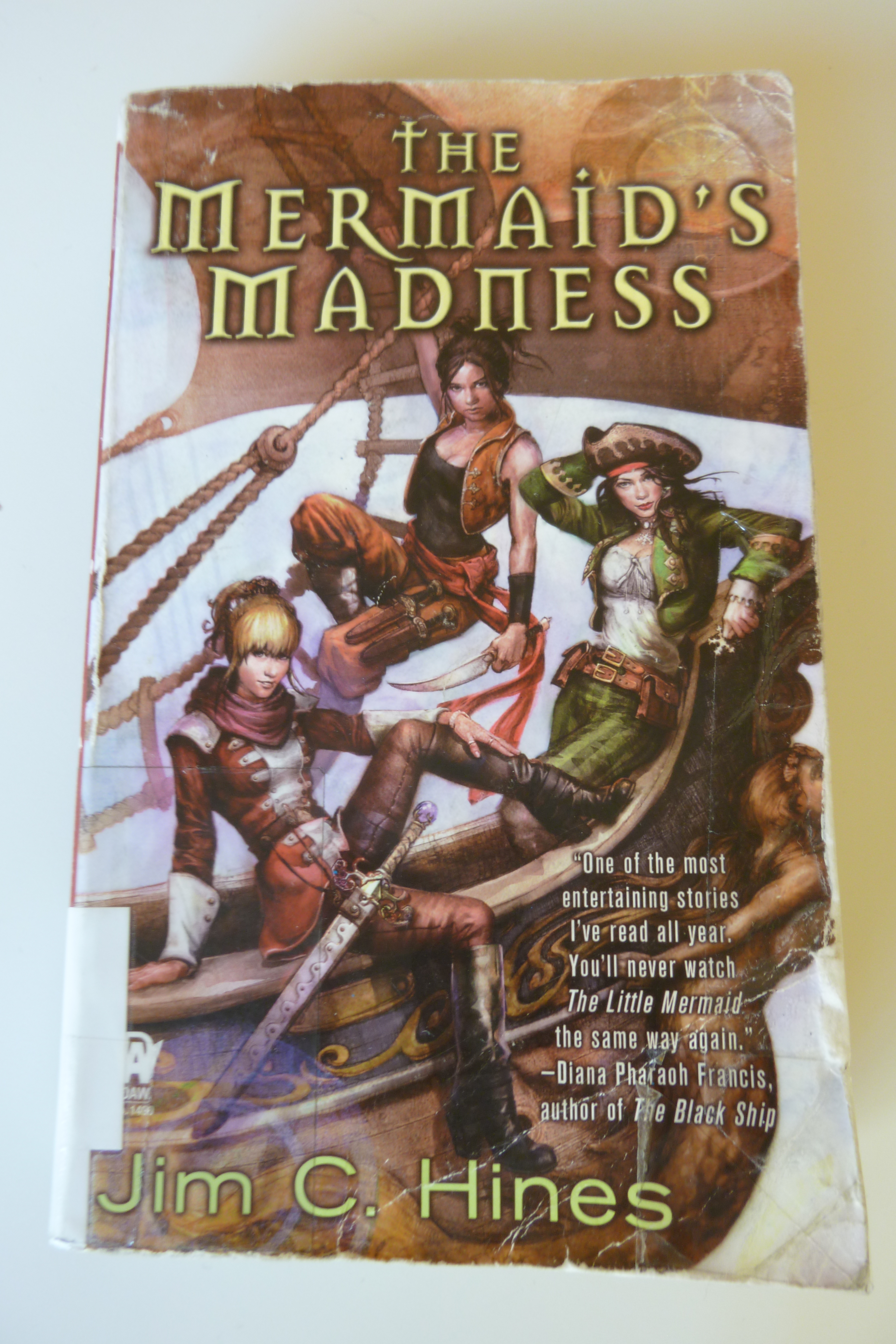
Book Two, The Mermaid’s Madness, brings in another fairy tale–and this is definitely not Disney’s version.  In the original story, the little mermaid can’t marry her prince, and instead sacrifices herself to save him.  Hines’ mermaid killed her prince, and went mad as a consequence.  With Queen Beatrice mortally wounded and a war brewing between humans and merfolk, the princesses have to find a way to capture the mermaid, the only one with power to save the queen.

There’s so much to enjoy about these books.  I love the interpretation on the princesses.  Their abilities are grounded in the original fairy tales (Talia gets skills from her fairy gifts, Snow White’s magic revolves around mirrors), but reinterpreted to make the girls so much stronger and more powerful than they ever were in the originals.  I love the gender reversal of the first book–not only are these princesses not sitting around waiting to be rescued, they’re setting out to rescue the prince!  When I was around ten, I started writing a short story about a knight who was rescued by a girl.  The story never went very far, but I feel like it was motivated by some of the same impulses that make me love this series.

The girls are complex characters as well.  We get bits and pieces of backstory for them all, and it becomes clear that these girls didn’t live Disney movies, and maybe not even the Brothers Grimm stories.  Talia, at least, is coming from an even older and much darker version of Sleeping Beauty.  They have tragedies and they have complexities.  But there’s also humor in here too.  The relationship between the three girls is often a lot of fun, and it’s nice to see a story focusing on female friendship.

Much as I enjoy that, it also brings me to the one thing I don’t like as well.  I feel like Armand is under-developed as a character.  With Danielle as the lead (though occasionally Snow or Talia will narrate as well), I feel like her husband should have a bigger part!  He’s in it just enough for me to notice that he’s not in it enough, if that makes sense.  I love the focus on the girls, but I’d like a little more balance to give Armand and Danielle’s relationship some time too.

That’s a minor complaint about an excellent series, though.  If you like fairy tales and strong heroines, these are the books to read.  They’re from the grown-up section (is there a proper term for that?) and I’d probably classify them as appropriate for older YA, because of some of the darker themes.  I’d recommend starting with the first book, as a better way to get to know the characters, though the plots are independent.  I think I enjoyed the second one a bit more, but more because I was getting to know the characters better than because it was an inherently better book.  They’re both great!

Author’s Site: http://www.jimchines.com/

Other reviews:
Shiny Book Review
Bookshop Talk
Bookish
Yours?
A Pratchett Proposal

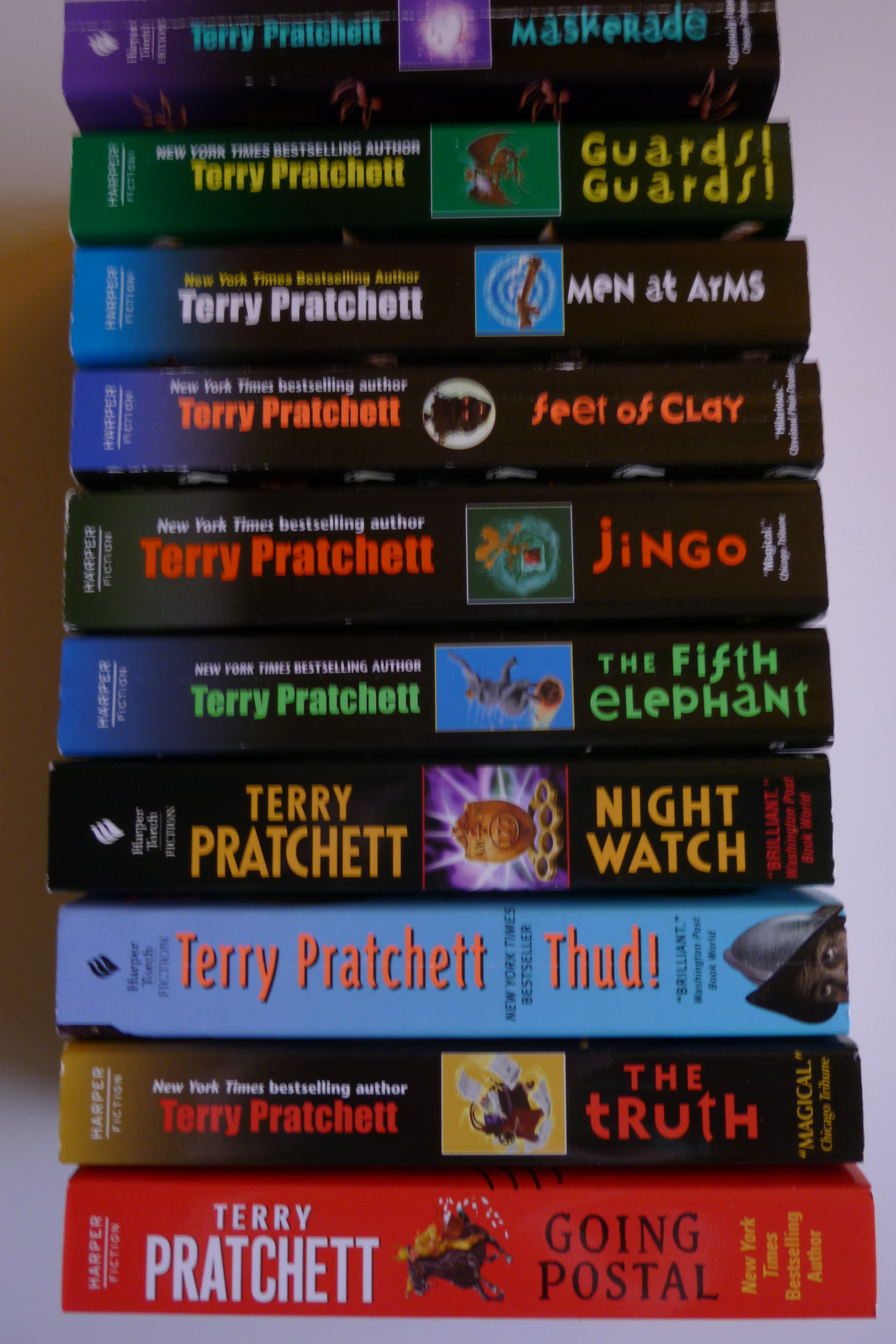
In my recent posts about Terry Pratchett’s Discworld series (here and here), I noticed a smattering of comments along the lines of “I’d really like to read more/start reading Discworld.”  Now, I’m always up for reading more Discworld myself, so I thought…what if we made it a group effort?  I’ve also been thinking for a while that there’s going to be a hole in my book-life when the Once Upon a Time challenge ends June 20th, and this could be the perfect solution!

So here’s the proposal: how about spending part of the summer with Terry Pratchett?  I’m thinking this would run June 1st to August 31st (so you could even do a two-for-one in June, with the OUaT challenge).  It would be totally low pressure, low requirement, high fun…all you have to do is read something from Discworld (and if you really want to read a different Pratchett book, that’s cool too) and then tell us about it.  If you have a blog and want to share a review, great–if not, you could just leave a comment (I’ll set up a post for that).

I thought we could do a group-read if there was interest in a particular book.  And of course you’re welcome to dive in absolutely anywhere you want with Discworld (though I don’t recommend starting with any of the first three).

This post is really just to gauge interest, and see if enough people want to jump in for it to make sense to hold a Pratchett Experience (that “challenge” word is far too intimidating for such fun books!)  So…if you’re interested, leave a comment and let me know!  Vote in the poll below if you’d like to get into a group read.  And if it turns out some people are interested in reading Pratchett this summer, I’ll post something official at the beginning of June.

Another Day, Another Monster

I felt terribly clever putting Rick Riordan’s newest book, The Serpent’s Shadow, on reserve at the library a month before it was coming out.  That meant I was only #23 in line! 🙂 They bought enough copies that I actually got mine quickly–and I already returned it for the 150 people now waiting.

If you don’t recognize the name, Rick Riordan is the author of the very popular Percy Jackson series.  The Serpent’s Shadow is the final book in The Kane Chronicles, his Egyptian mythology trilogy.  (Read my review of the first one.)  The trilogy follows Carter and Sadie Kane, a brother and sister who are learning their powers as Egyptian magicians, and practicing forbidden magic by engaging with the Egyptian gods (who are far more metaphysical than their Greek counterparts).  In the third book, Sadie and Carter have to face Apophis, a monster serpent determined to destroy the world and return it to pre-creation-type chaos.

As is typical for Riordan, the book is set in a compressed time period (I think only two or three days), there’s a clear deadline for the end of the world, and the characters have to pursue quests to get the pieces they need to fight the monster.  It’s a structure that I think works well–sometimes he can be a little episodic, but mostly I thought this was tied together well, had a good drive and focus, and both the looming deadline and the present crises kept the tension level high.

The story is told through alternating first-person narration.  The frame story is that an audio recording was mysteriously sent to Mr. Riordan, and throughout the recording Sadie and Carter have been passing the microphone back and forth.  I really enjoyed Carter in this book.  Throughout the trilogy, circumstances have been forcing him to take on more and more responsibility, and by the third book he’s coming into his role as a leader.  He’s still unsure of himself though, and that made him very human and relatable.

If Carter had been the only narrator, I would have loved this book.  I still liked it…but Sadie just irritated me completely.  She’s conceited, obnoxious, and has this incredibly aggravating tendency to view her personal life as of equal importance to the end of the world.  There are two guys she has crushes on, I have no idea what either sees in her, and I can’t help feeling that deciding between them is just not as important as the imminent destruction of the universe.  Especially when I wasn’t that drawn into her relationship with either guy.  (To give Riordan credit, I liked the romance in Percy Jackson better, and Carter also has romantic troubles that are better balanced with the larger looming threat.)  Some of Sadie’s most conceited, most relationship-drama lines are perhaps meant sarcastically or tongue-in-cheek, but it doesn’t come across that way enough for me.  I remember Sadie bugging me a bit in the previous books, but it was much more so this time.

However–it’s a problem but not an insurmountable one.  I did enjoy the book.  I sighed a little whenever I turned a chapter to see Sadie was narrating the next one, but even her sections had good aspects to them.  And it’s a good book, lots of excitement and lots of irreverent mythology humor, which Riordan is so good at.

This winds up the Kane Chronicles trilogy, but there were some very blatant hints at the end about new problems with “other gods.”  I’m seeing a Greek/Egyptian crossover coming, which seems like it would be enormous fun!  I’d definitely read that…even if Sadie is one of the narrators.

Author’s Site: http://www.rickriordan.com/

Other reviews:
Lost in a Book
21st Century Once Upon a Time
Knight Reader
Anyone else?

Saturday Snapshot: My Literary Cat-Friend

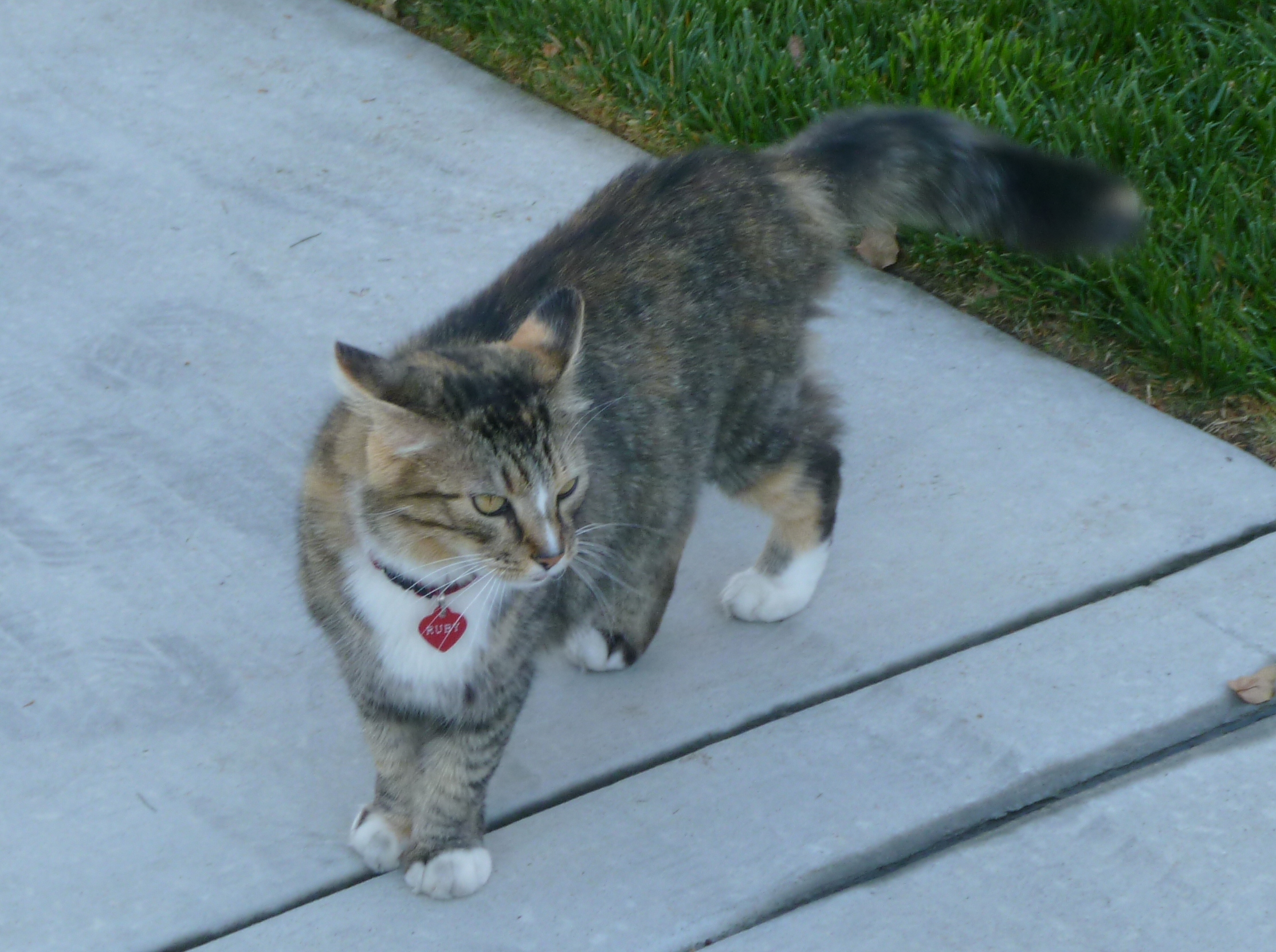
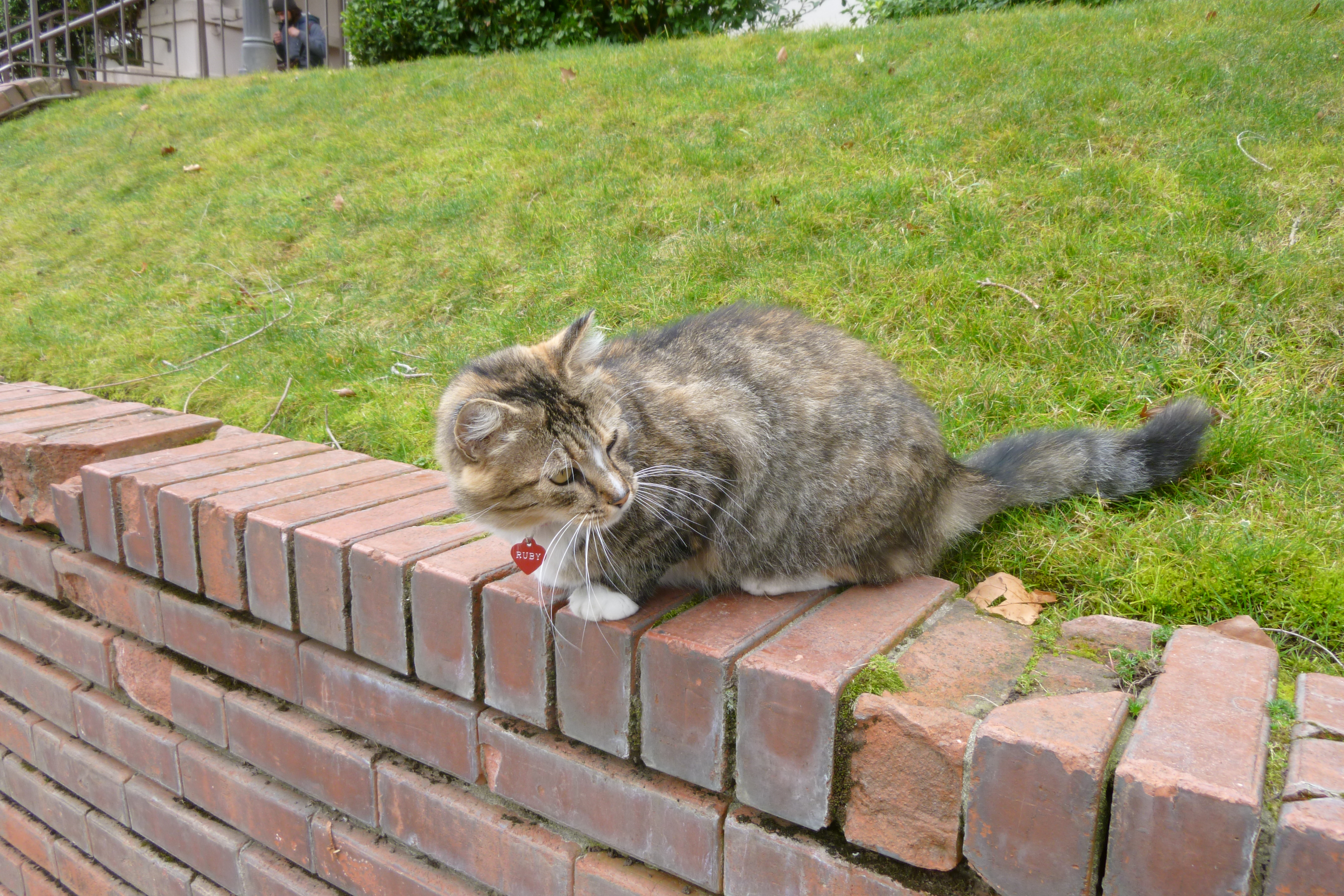
I try to make a habit of walking around my neighborhood every day, and along the way I’ve met lots of neighborhood cats.  My favorite is Ruby, a very friendly adventurer who plainly has a literary interest.

There’s a small library only about six blocks from my apartment, and most of the time that’s where I see Ruby.  She likes to hang out on the brick wall or the front steps.  She’s a smart cat, and has realized that this is the place to go to meet people–or perhaps she likes to read.

I had always assumed she lived nearby, but then one day I actually took a look at the address on her tag–it turns out she lives a block and half away from the library.  By that point I’d been seeing her there for months, so I knew she wasn’t lost.  She just likes to travel.  In practical terms, I know I probably should worry about her crossing (quiet) streets, but if you actually meet Ruby–well, that is the most sure-of-herself cat I’ve ever seen, and it’s hard not to believe that she knows exactly what she’s doing.

Just once I did worry a little–I was walking a block on past the library, and Ruby seemed inclined to go the same way, the exact opposite direction from her house.  She ignored my suggestions that she ought to go back, and I don’t really think she was trying to follow me at all.  I think she was just going about her own business.  She trotted off down a sidepath with no hesitation, and sure enough, I saw her back at the library a day or two later.

I must admit, there are days when I feel somewhat envious.  I’d rather like to spend the day hanging out at the library too!

Visit At Home with Books for more Saturday Snapshots!

Friday Fairy Tale Round-Up: Cinderella

Last week I looked at a list of “Twelve Dancing Princesses” retellings, and this week I thought I’d look at what might be the best-known fairy tale in this culture–Cinderella.  I suspect if I really tried to gather up every version I’ve read, this would become completely unmanagable!  So, I’m highlighting the major ones and recent reads instead.  🙂

One thing I found interesting in searching out the “originals” (with due acknowledgement to earlier oral tradition) is that “Cinderella” is one of the few stories that’s in both Charles Perrault and the Brothers Grimm.  Between the two of them, they seem to account for almost every major fairy tale in Western culture, so maybe both of them presenting “Cinderella” is part of the key to its popularity.  And, of course, it plays right into the dream that life can be better–that no matter how dreadful your circumstances, everything can change (and the cynic in me says, without you even needing to do anything!)

Later versions have mostly been pretty consistent with the older ones, in the major strokes at least.  Cinderella is a kind, beautiful girl who is downtrodden by her nasty, ugly stepmother and stepsisters.  When the prince throws a ball to find a bride, Cinderella desperately wants to go.  And she does, aided by some kind of magic–either a fairy godmother, or the spirit of her deceased mother.  Cinderella charms the prince but has to leave early, and the prince uses her dropped slipper to identify her–which is a truly bizarre way to find anyone.

I have a lot of problems with the original Cinderella–the incredibly passive main character, the absentee fairy godmother, the prince who apparently can’t recognize his “true love,” and the really weird slipper element.  But often the strange bits of the story are exactly what new authors can use to spin off a brilliant retelling…

Ella Enchanted by Gail Carson Levine tackles Cinderella’s passiveness head-on.  Levine’s Ella is brave and determined, but cursed by an obedience spell.  She has to find her own strength to overcome it, and the story is more about her quest to take control of her life than it is to win the prince–who is a childhood friend, not a stranger at a ball.  There’s a movie version too, but don’t see it.  It bears very little resemblance to Levine’s wonderful book.

Just Ella by Margaret Peterson Haddix plays with how hard it would be to go from scullery maid to princess.  This is another smart and determined Ella, who made her own way to the ball, only to realize afterwards that the life of a princess is not what she expected–and that the prince isn’t either.

The Stepsister Scheme by Jim C. Hines is another one that looks at the story after the ball.  This Cinderella (Danielle, actually) got her prince and he is charming–but then he’s abducted by her evil stepsister.  Fortunately, a couple other fairy tale princesses are on hand to help get him back.  This is a great twist on the usual themes of fairy tales, with some truly awesome princesses.  I just read the sequel, so stay tuned for a review of both soon!

Princess of Glass by Jessica Day George tells the story from a very different point of view–a princess visiting the court, who notices how really creepy it is when everyone, especially the prince, are suddenly enamored of this mysterious woman in the glass slippers.  Because really–why exactly is everyone so blown away?

Disney’s Cinderella is probably the version everyone knows best, and it’s pretty close to Perrault.  It’s a cute fluff of a cartoon, although the mice are the best part.  Cinderella and her prince are pretty bland, and I just can’t take them seriously when they start singing, “So This Is Love.”  No, it’s attraction.  I can’t believe you got all that far exploring the depths of human emotion in just one dance.

Silver Woven in My Hair by Shirley Rousseau Murphy is, with Ella Enchanted, my other favorite retelling.  It somehow creates a very real, very practical world, tells about it with gossamer-beautiful writing, and even without magic is utterly enchanting.  Thursey has dreams, but they’re real ones.  Her friends are real people and she falls in love with a real man, not a shining prince out of a daydream.

There must be more Cinderellas out there–any recommendations?