A Camera-Eye View of the Hunger Games

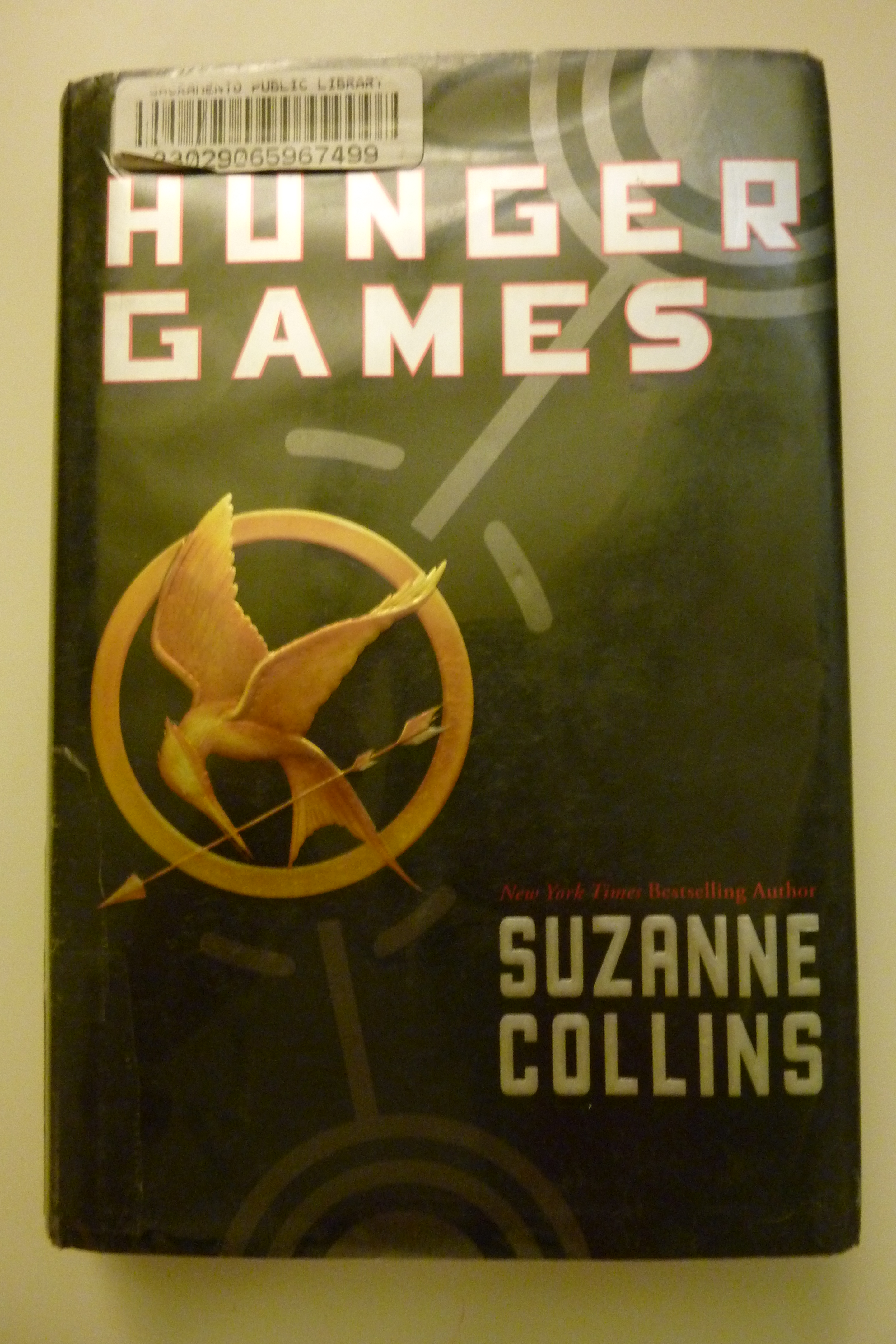
If you’ve been paying attention to entertainment news at all (and maybe if you haven’t), then you know that the Hunger Games movie came out this past weekend.  Having read the trilogy, I was eager to see it!

If you’d like, you can read my reviews of the three books, Hunger Games, Catching Fire and Mockingjay.  The short version is that I LOVED The Hunger Games, enjoyed Catching Fire but had some issues, and was ultimately disappointed by Mockingjay.  Fortunately, I was not disappointed by the movie!

If you’ve really not been paying attention to entertainment news, here’s the quick plot: in a future dystopian society, one wealthy Capital rules over twelve impoverished districts.  As punishment for a past rebellion, the districts must each offer up two tributes, male and female, between the ages of 12 and 18, every year for the Hunger Games.  The tributes fight to the death in an elaborate arena: 23 will die, one will survive and receive riches.  It’s all filmed; in the Capital it’s an exciting sporting event, and in the districts watching is part of the punishment.

The heroine, sixteen-year-old Katniss Everdeen, has been taking care of her little sister, Prim, ever since their father died and their mother had a breakdown.  When Prim’s name is drawn to be sent to the Hunger Games, Katniss desperately volunteers.  She’s whisked away to the terrifyingly flamboyant capital, and then thrust into the terrifyingly brutal arena, where everything is further complicated by uncertain feelings about Peeta, the boy sent from her district.

I felt in my book review and I feel again that it’s hard to give a good plot summary of this story!  It’s too complicated with too many layers.

The first question everyone has about this movie is how intense it is.  I was a little hesitant at first about seeing it (but then the trailers drew me in).  I thought some moments were more intense in the book–others were harder in the movie.  The gore was not too bad–it’s there, definitely, but I have a low threshold for gore and I wasn’t too disturbed.  The worst is probably when Katniss burns her leg.  People die swiftly, and the filmmakers weren’t too graphic about the battles.  I’m trying to avoid spoilers, but I will say they seriously toned-down the last tribute’s death, which I found to be far and away the most disturbing part of the book; it’s accurate to the book, but the creepiest parts are taken out.  It was still a very heavy, very intense movie, though.  If you read the book and were okay, I think you’ll be okay with the movie.  But if you’re doubtful, don’t say I didn’t warn you!

The first question for me on adaptations is how faithful they were to the original, and I thought The Hunger Games did very well.  Minor changes here and there to fit into the movie format, and they did change how Katniss got her mockingjay pin, but that was really the biggest change I noticed (and I understand why they did that, as it involved a very minor character).

The characters were excellent, especially Katniss (Jennifer Lawrence).  She was wonderful in the first book, and it all carried onto the screen.  She has some issues (well-justified mistrust, for one), but if I had a teenage daughter I’d rather she read about Katniss Everdeen than Bella Swan (actually, I’d want her to read about Alanna, but that’s another review).  Suffice to say Katniss is tough and courageous without being unfeeling or without sentiment.  Her kindness to Rue, another tribute who’s only twelve, is one of my favorite things about the story.  Katniss’ relationships with Prim and her best friend Gale were beautifully handled.  Like in the book, they’re out of it very quickly, but it was still very well-established in those few scenes.  Peeta (Josh Hutcherson) was good too–he just radiated sincerity and good intentions, in the middle of horrible situations.  Apart from Rue, who was lovely, the other tributes didn’t get the same development they did in the book, but in a compressed movie I can’t really fault the filmmakers for that.  And there was enough.  It worked.

With the possible exception of Katniss, my favorite on-screen portrayal was Stanley Tucci as Caesar Flickerman, the announcer for the Hunger Games.  He was incredible, hitting just the right note of delight but not sadism.  It’s hard to explain, except that he talks about kids killing each other in the same voice every sports announcer uses, makes some of the same kinds of comments and it was brilliant.  I thought in the book it was a little more clear that he had some kind of sympathy for the tributes, at least to the extent of trying to make them all look their best when he interviews them.  That wasn’t so clear, but it was still absolutely wonderful.  Awful, of course, but wonderfully done.

The only portrayal I was disappointed by was Haymitch, Katniss and Peeta’s mentor.  In the book I pictured him as a scraggly, overweight alcoholic with deep-seated problems; in the movie he was a reasonably-together man, somewhat cynical and liking to drink.  Not really the same thing, although they may have felt they needed to change him to make some of the narrative clearer.

There were points when I thought this would have benefited from a voiceover from Katniss.  Her relationship with Peeta is very complicated in the book and I don’t think it all showed.  On the other hand, I thought they completely conveyed her relationship with Rue, even though it was brief.

After all this about what was good, I do have to mention my one big problem–and it was one I can’t remember having with any other movie.  I didn’t like the cinematography.  I think that’s the right term–the camera angles, and the way the camera moved.  Particularly at the beginning of the movie, the camera wouldn’t focus on anything for more than a second before it swooped off.  And it didn’t blink to something else, it actually moved, and it moved too fast.  So suddenly everything goes blurry as it moves and my eyes are struggling to make sense of everything.

People keep telling me that this was a deliberate choice to express Katniss’ confusion, the chaos of the arena, and to avoid being too graphic with the battles.  I’ll buy all of that, except that they were doing this in the first ten minutes of the movie, long before she got to the arena; they actually stopped doing it as much (or I got used to it) once she was in the actual games.  It did seem like a good choice during one battle in the arena, but in most moments it didn’t.  I want to see this movie again on DVD, because I think this might actually be a case where a movie looks better on a smaller screen.

That was my one big problem, and it was an annoying one…although it did seem to ease off farther into the movie, and I still really loved the movie overall.  I am having an astonishing string of good movies made from books I love, which normally is so unusual.  But I’d put The Hunger Games in with John Carter and Arrietty–all excellent movies from excellent books.  The books are still better in all three cases…but these were very good movies too.

Movie Site: http://www.thehungergamesmovie.com
Author’s Site: http://www.thehungergames.co.uk

Other reviews:
Book Journey
Tor.com (in comics, with spoilers)
MeReader (also with spoilers)
AbeBooks.com
The Whole Sort of General Mish Mash
The Bookworm Chronicles
Books Without Any Pictures
And I’m sure a Google search will find you HUNDREDS more…  If you want, tell me about yours!

Love Never Dies, Even When It Should

The better Webber musical with the Phantom

I recently saw the filmed version of Love Never Dies, Andrew Lloyd Webber’s sequel to The Phantom of the Opera.  It was showing in a local theater, and two friends and I went. It was everything I had expected–it was terrible, and I had a wonderful time.

The short, quick review is that it is an awful, awful play, flawed on so many levels I can’t count them, funny when it’s not supposed to be, entertaining in much the way that Plan 9 from Outer Space is entertaining.  The long review is going to be complicated and slightly incoherent, because there are so many flaws on so many levels at so many points, it’s hard to get structure into the review.

First, a few notes on biases: I did not come into this with an open mind.  I expected to hate it.  But I also didn’t come into it with an uneducated mind–I had read a lot about Love Never Dies and listened to about half of the soundtrack.  Frankly, I had put plenty of effort into hating it, and I think that’s why I wanted to see it.  I’d built up a vast amount of morbid curiosity.  Another bias: I’ve been invested in my own idea for the last six years about how the Phantom’s life ought to turn out in a sequel (the brief version: he stays at the Opera House, becomes a renowned but never-seen composer, and marries Meg Giry).  Some of my reaction may be based on “but it’s not how I want it to turn out.”  But that’s not all the basis for my reaction.  Love Never Dies really is terrible–on so many levels.

The story is set on Coney Island (already we have a problem), ten years after Phantom.  Actually, it must be ten years and nine months, but more on that later.  The Phantom, now going by the name Mr. Y (why? not a clue, especially when he has a perfectly nice name like Erik) is running a freak show on Coney Island and writing really bad sideshow performances for Meg Giry, while he mopes about Christine.  Christine turns up in New York with Raoul and her son Gustave in tow, here to sing for Oscar Hammerstein in order to pay off Raoul’s gambling debts.  The Phantom quickly finds her, and really, really, really wants her to sing for him on Coney Island.  He offers money, plays on the sentimental past, and if that doesn’t work, threatens to kidnap her son–at least until he has a sudden GASP moment when he realizes how old the kid is.

That takes you about halfway through the play, and so many problems should already be apparent. Continue reading “Love Never Dies, Even When It Should”

Saturday Snapshot: Glories of Daffodils

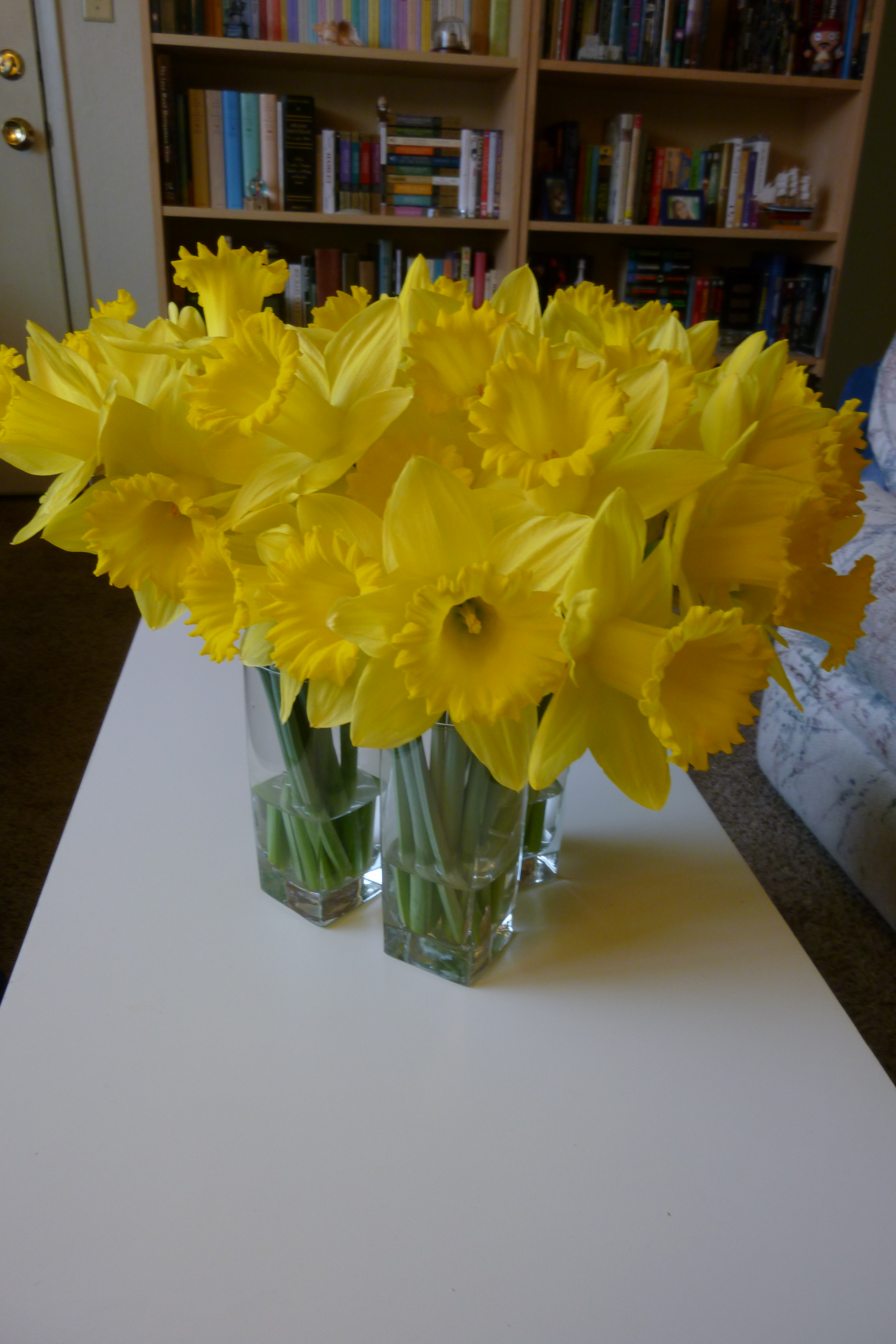
You know that I love daffodils.  Well, I’ve been reveling in daffodils recently!  Safeway was selling daffodils in bunches of ten, three bunches for five dollars–which just seemed to me like an obvious invitation to buy 30 daffodils…  It was a gloomy, rainy week and the perfect time to have some indoor sunshine in flower form.

I couldn’t quite capture the great massed golden glory of them, but here are my best attempts.

Visit At Home with Books for more Saturday Snapshots!

Beauty and the Roses

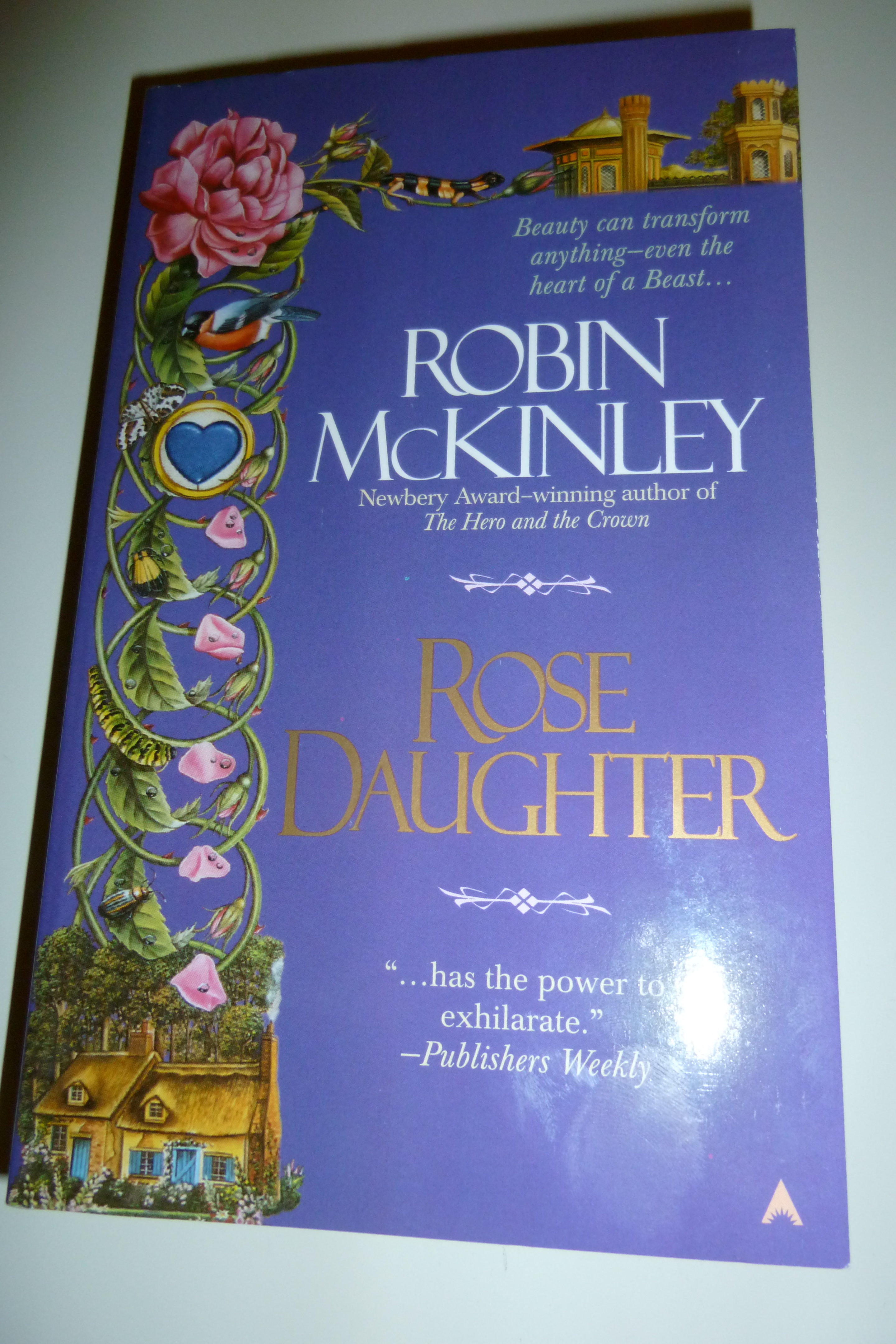
It’s always a joy to come back to a beloved book, and find out you still love it on a reread.  But it’s even better when you find out you love it even more.  That happened to me with Rose Daughter by Robin McKinley.  I’ve read it at least once–maybe twice–and I always liked it.  But this time I really loved it.

Rose Daughter is a retelling of Beauty and the Beast, and my first book for this year’s Once Upon a Time Challenge.  I was excited to jump into the challenge, which is why you’re getting a third book review this week!

I don’t have a lot to say about the plot, because mostly there aren’t surprises here (except when there are, and that’s too far into the book to discuss without ruining it with spoilers!)  There’s a ruined merchant and his three daughters, there’s a mysterious castle with a mysterious Beast, and there are roses.  Lots and lots and LOTS of roses.

You may be thinking–didn’t McKinley write another story with this plot?  A few less roses, but still the same story?  She did–Beauty.  But the amazing thing is how different the books felt to me, even though they are essentially the same plot.

I’ve said before that I am hugely impressed by the different writing style in McKinley’s different books, and that’s very true in these two.  Beauty is practical.  There’s magic, but it’s magic that exists in a very reasonable, understandable world, with real people and commonplace concerns.  Even the magic has a slightly homey feel to it, from winds that scold and candles that whisper “Psst, wake up!” when one of their number forgets to light.

Rose Daughter is surreal.  The Beast lives in a constantly changing castle where laws of time and space simply don’t apply.  The magic is somber and imposing and a deeply serious business, powerful and ominous.  Even the world outside the castle feels more like something wild and strange, a world where everyone’s names reflect who they are (Beauty’s sisters are Jeweltongue and Lionheart), and there are mysteries and magic and curses.

While I always liked Rose Daughter, I also preferred practicality to surrealism.  I’m not sure what happened since my last reading, if it’s just that I got older or if it’s that I read more Brothers Grimm, but I loved the style of Rose Daughter this time.  It really may be that I came to it shortly after writing my own Brothers Grimmesque stories, and this is a Brothers Grimmesque book: the names, and flowery ornateness of the writing, smack of the Brothers Grimm (even though they didn’t write a version of “Beauty and the Beast”).

The writing is just gorgeous.  I love the descriptions, of feelings and flowers and smells.  There are long passages about flowers, but don’t be offput by that.  I’m not even fond of roses, but I never got bored by the book–and it kind of made me want to have a love affair with roses, even though I’ve been in a very happy relationship with daffodils for years.  Based on other reviews, it seems to make many people want to go out and plant rose bushes.

I think, in my heart of hearts, I do still love Beauty better.  I like that Beauty a bit better than this one, and I definitely like her romance better.  Much as I love Rose Daughter, the relationship with the Beast just didn’t appeal to me as much.  But I do love Rose Daughter, and it is a truly, truly beautiful book.

McKinley wrote an Author’s Note about the inspiration that led to Rose Daughter, and mentions that it came twenty years after Beauty–so maybe the story will come back to her in a new form in another twenty years.  That was in 1996, so if that prediction comes true, we only have four years to wait!  If I could, I’d put in my preorder today.

Author’s Site: http://www.robinmckinley.com/

Other reviews:
Angieville
Dodging Commas
Fyrefly’s Book Blog
Others?

Persuaded to Read More Austen

Somehow–and I don’t really know how–I went all the way through a BA in English without being assigned any Jane Austen.  I’ve been trying to rectify that gap in my reading history, first with Pride and Prejudice and then Sense and Sensibility.  I picked up S&S because it was the most familiar title after P&P, and I did like it well enough though I wasn’t enamored.  Then several more Austen-familiar friends told me I had to read Persuasion–so I recently gave it a go.

Persuasion came in for me somewhere in between, not as good as Pride and Prejudice but better than Sense and Sensibility.  I learned my lesson from S&S and watched a movie version (1995) first, to help me get some grounding on who all the characters were.  This may have slanted my impressions somewhat, although mostly I think it was helpful.  Austen employs a large cast of characters related to each other in complicated ways, and it helped coming into it with some idea of how everyone fit together.

I had a little trouble with Austen’s language–some of her sentences are extraordinarily convoluted, so that I had to go back to the beginning and try again to follow their thread.  Like I’ve found with other authors, though, the more I read the easier it gets, so this was mostly only a difficulty in the beginning of the book.

This is largely a character-driven story, making it a little hard to give a plot description.  In a way, it’s a Cinderella story, about a Cinderella who mislaid her prince.  When Anne Elliot was 19, she was engaged to Captain Wentworth, splendid in every way except for a lack of fortune.  Lady Russell, a dear family friend, persuaded Anne to break off the match.  Eight years later, Anne is still single, disregarded and a bit downtrodden by her horrid father and two sisters.  You can even cast Lady Russell as the Fairy Godmother (if a slightly misguided one) who sees Anne’s value and wants to help her.  Such is the situation when Captain Wentworth comes back into Anne’s life and social circle, and then the question becomes whether she still loves him and, even more in doubt, whether he still loves her.

That sounds fairly straight-forward, but there are subplot romances, a couple other suitors for Anne, and a lot of going about making social calls in one place or another.

I enjoyed the characters–Anne is a complex, sympathetic heroine.  She’s under less societal threats than Elizabeth Bennett, whose whole family would collapse if the daughters didn’t marry well (or at least, her mother thought so).  Anne has Lady Russell as her refuge, and maybe that’s just as well.  Her desire to marry Captain Wentworth really seems to be about him, not societal pressures (which is not at all to criticize Lizzie’s attachment to Mr. Darcy, just observing context!)

And while I don’t want to give too much away–let’s just say that there is a final romantic conclusion, as seems to be usual in Austen, and she actually gave us more dialogue for a change!  Instead of narration along the lines of “and he expressed himself on the occasion as sensibly and as warmly as a man violently in love can be supposed to do” (which has me wishing to know what Mr. Darcy said), we actually get a quite beautiful declaration-of-love letter, and some real talking.  Probably still less than most authors would have done (sigh) but more than seems to be Austen’s norm.

One thing that struck me in this book was the question of servants.  I came to this book directly after watching Downton Abbey, which shows the life upstairs and the life downstairs with equal care and interest (and my favorite character is Anna, the head housemaid).  Persuasion is strictly the life upstairs.

Anne’s father is a baron of some sort.  He’s fallen on financially difficult times, but he is still determined to keep up the proper status.  He must have servants.  Anne’s snobbish elder sister cannot possibly be cooking or cleaning or probably even doing her own hair.  But servants aren’t mentioned at all!  They’re not even walk-on characters.  Finally halfway through the book, that snob sister decides not to hold a dinner party in Bath, because they have less servants at their lodgings than they used to have at their manor house, and that would be embarrassing.

Coming right off of Downton Abbey, I wondered a great deal about these completely disregarded people who really must be there but aren’t noticed by anyone.  It almost feels like a modern book where you wouldn’t bother to mention that a character has a refrigerator.  Of course they have one.  Of course Austen’s characters have servants.  Why say more about them?

That was my own particular quirky reaction to the novel.  On the whole, I did enjoy it, and it was nice to meet another cast of Austen characters–once I worked out who was who!

Other reviews:
Fyrefly’s Book Blog
It’s All About Books
Becky’s Book Reviews
And no doubt many, many others.  Suggestions?