Book Review: The Strange Case of the Alchemist’s Daughter

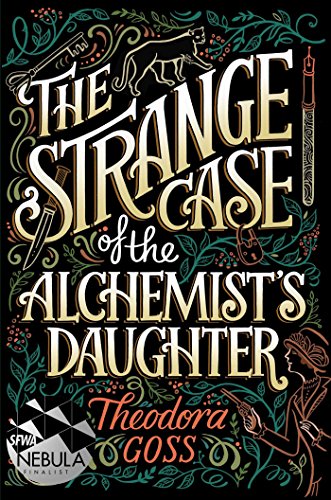
A good friend recently gave me a book for Christmas–always a chancy endeavor, as it can be hard to find just the right one.  She hit the mark beautifully though, as I loved The Strange Case of the Alchemist’s Daughter by Theodora Goss.

The story begins as Mary Jekyll buries her mother.  Clearing up her mother’s affairs, Mary finds a regular payment being made for the care and keeping of “Hyde.”  Baffled by this apparent connection to her deceased father’s hideous, long-missing assistant, she follows the clues.  She finds Diana Hyde, and in the process winds up assisting Sherlock Holmes and Dr. Watson as they investigate the Whitehall Murders.  Tracing clues to a secret alchemists’ society, Mary and Diana find Beatrice Rappaccini, Catherine Moreau and Justine Frankenstein, all a different shade of monster.

This is one of those books that has such a wonderful premise it’s hard to dare hope it will live up to it–but it does!  This is a wonderful exploration into the world of Gothic, Victorian literature, but turned sideways and much more feminist.  Each woman (including Mary, though we don’t have full answers about her yet) has been shaped by her alchemist father (or creator), but this is very much the women’s story.  Each one is a fully-formed individual with agency, and the story is about them, not their fathers.

In some ways this reminds me of Catherynne Valente’s Fairyland series, drawing greatly from classics of literature, while putting an entirely new angle on them–with an active, realistic heroine (or five). Continue reading “Book Review: The Strange Case of the Alchemist’s Daughter”

Classic Review: The Princess Bride

Valentine’s Day was last week, so perhaps it’s an appropriate day to revisit a favorite movie with a lovely romance.  I just finished saying I don’t revise Classic Posts, but this one does require mentioning one changing view.  I think I was too hard on Buttercup–she has her moments of strength as a heroine.  She actually has two different problems–she’s oddly impassive in some key moments and, as Cary Elwes pointed out in his memoir, in a movie full of funny lines, Buttercup gets none of them.

I rewatched this movie just recently at a Fathom Events showing, and I really tried to have a different view of Buttercup.  It was maybe a little better?  But I still don’t love her.  Ah well.  It’s still a nearly perfect movie.

**************

I love fairy tales, and retold fairy tales, and fairy tale-inspired stories.  I have great success reading books like that, and sometimes I try a movie too.  More often those turn out to be very cheesy…but sometimes it works, as with one of my favorites, The Princess Bride.  It can be cheesy at times too, but in a good way, and all in all it’s a very nearly perfect movie.

There’s a book too, which I have read, and which is also truly excellent.  It’s been a long time since I read it, though, so that review will have to wait until I get a chance to re-read it.  In the meantime, let’s talk about the movie.  It’s at its twenty-fifth anniversary, so I’d like to assume everyone’s seen it…but I’ve learned not to assume that about any movie.  And I do have a friend who just saw it for the first time a month ago.

The Princess Bride starts with an adorable frame-story, about a grandfather reading the book The Princess Bride to his grandson, who had been ill.  The boy pretends indifference, but is drawn into the story.  It’s about the beautiful Buttercup, who is going to marry her beloved farmboy, Westley.  But Westley goes off to seek his fortune, is reportedly killed by the Dread Pirate Roberts, and Buttercup ends up unwillingly engaged to the nasty Prince Humperdinck.  She’s kidnapped shortly before her wedding, carried off by mastermind Vizzini, slow-witted and good-natured giant Fezzik, and brilliant swordsman Inigo Montoya.  They’re pursued by a mysterious man in black (whose identity will probably not turn out to be all that much of a shock). Continue reading “Classic Review: The Princess Bride”

Book Review: Hitty: Her First Hundred Years

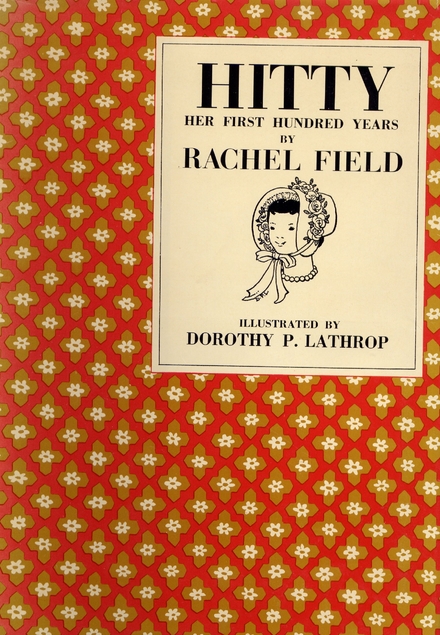
I recently put several more Newbery Medal winners on reserve at the library at once—basically, searching for the ones whose names I could remember, since I didn’t have my list with me!  One of those was Hitty: Her First Hundred Years by Rachel Field, because that second part sounded so intriguing.
It turns out that Hitty is a doll.  First carved in Maine in, I think, the early 1800s, Hitty passes through a number of different families and goes on a series of adventures, including sailing the high seas, becoming a castaway and traveling to India.  Over her century of life, up to the 1920s, she belongs to people at every stage of society, experiencing many different owners and many different kinds of life.

This book achieved a nice trick, sending Hitty through some very exciting experiences, while making their occurrence plausible.  The life of a doll could be a rather staid one, but there’s nothing dull about Hitty’s life—and while the excitement may be extreme, each development follows reasonably and believably. Continue reading “Book Review: Hitty: Her First Hundred Years”

Book Review: The Girl Who Drank the Moon

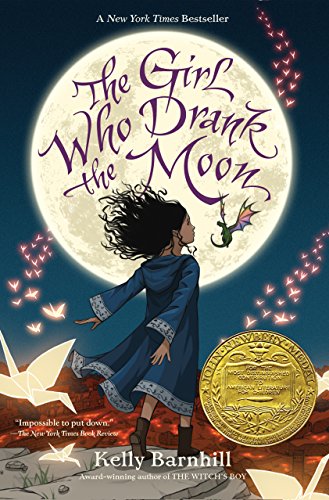
I’m continuing a strong push with the Newbery Medal winners in my reading, and I recently read the most recent winner, 2017’s The Girl Who Drank the Moon by Kelly Barnhill.  And we have a serious contender for favorite Newbery–at least of the ones I’ve been reading for this challenge!
The story starts in a very sad village in the Bog, where every year on a certain day, the youngest baby is left in the forest for the Witch, so that she won’t destroy everyone else.  We swiftly meet the Witch, Xan, 500 years old and quite unaware that anyone thinks she wants to harm them.  She rescues the babies every year, taking them through the forest to happier towns where they are adopted and cherished.  She feeds them starlight on the journey and they grow favored.  But one year she is especially taken by a baby, and mistakenly feeds her moonlight instead.  The baby grows full of magic, and Xan decides she must adopt Luna herself, adding her to a little family including Fyrian, a Perfectly Tiny Dragon, and Glerk, a grumpy, poetical bog monster.

This is a delightful story, full of fantasy, whimsy, humor and heart-tugging moments.  I knew this was going to be good as soon as Glerk and Xan appear, Xan scolding him about apologizing to Fyrian.  I love fantasy that takes the tropes (swamp monster, dragon, witch) and turns them upside down in a funny, human way. Continue reading “Book Review: The Girl Who Drank the Moon”

Book Review: What She Ate

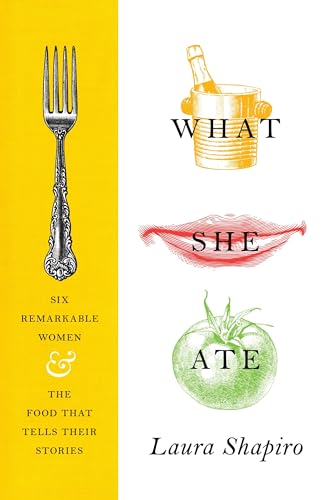
I have a friendly coworker who reads a lot of nonfiction—not usually my style of books, but she recently had one that sounded fascinating.  Happily, the audiobook wait list at the library was short (apparently the physical book list was long…) and I got to enjoy listening to What She Ate by Laura Shapiro, six essays on six women in history, their stories told through the food they ate.

Of the six women, the only two I recognized were Eva Braun (Hitler’s mistress) and Eleanor Roosevelt (no introduction needed, surely!)  The other four are Dorothy Wordsworth (the famous poet’s sister), Rosa Lewis (Edwardian-era caterer), Barbara Pym (novelist) and Helen Gurley Brown (Cosmopolitan editor).  Their lives vary wildly, in circumstance, era and character, the essays tied together by the focus on food and each women’s relationship to it.

I like history and I like psychology, and this combined a bit of both, while putting the focus squarely on one of my other favorite narrative elements: an engaging heroine.  While three (two and a half?) of these women are best known for the primary man in their life (Eleanor is the half), these essays are still squarely on the women in a way I found very satisfying.  Obviously Hitler, William Wordsworth and Franklin Roosevelt figure largely, but it’s still about the women and what they’re doing, thinking and eating.  I started reading Ladies of Liberty and found it was so focused on the men (!) that I stopped.  That wasn’t a problem here.  And three out of six were clearly independent women getting things done (though Helen Gurley Brown might deny it). Continue reading “Book Review: What She Ate”