Challenge Update: Bad Reviews and the Pulitzer Prize

We’re getting down to the end of the year!  I’ll have a final update on my 2015 reading challenge at the end of the month, but I wanted to look briefly at a few of the books, in a lead-up to the final update.  As you may recall, I’ve been working on a kind of grab-bag challenge, with 50 different criteria.  I’ve been doing the more unusual ones here at the end of the year, and those are the ones I’ll be looking at in more depth–to discuss how meeting these particular criteria turned out.

Two today, which could be taken as opposite criteria (commendation vs. condemnation), but which actually have more in common, for me, than you might think…because it was hard to find a Pulitzer Prize-winning book that looked remotely to my taste!

Pulitzer Prize-winning book: Tales of the South Pacific by James Michener

I read through the entire list of Pulitzer-winning fiction, and was very nearly stumped.  Because everything looked so unbearably dark and depressing and grim!  But I finally settled on South Pacific, because I know the musical–and more specifically, I have troubles with the musical.  I wanted to see how the two compared.

It turned out to be a fairly dark and grim book, actually.  It is, after all, about war.  And it really is tales, more a collection of related short stories than a true novel.  The musical picked up some of the major plot points and characters, but changed the tone pretty dramatically–and interwove things that were originally unrelated.  I might be biased, but Nurse Nellie, Lt. Cable and Luther Billis really did seem to be the most significant characters in here, but there stories were much less intertwined.  Despite the grimness, it was overall a pretty good read.

Mostly I wanted to see if there was any redemption in the book for Lt. Cable or for the Frenchman.  Because really…Lt. Cable should not be sleeping with the very young native girl who gives very questionable consent.  And the Frenchman may be a great patriot, but he’s a lousy father–he wasn’t willing to go on a suicide mission when he could be with Nellie, but he didn’t mind abandoning his children?

As it turns out, there’s not much redemption for Lt. Cable in the book (although we get enough from Liat’s point of view to conclude she really is willing–I’m not sure how he knows that), though he does come across as less racist–just conscious that he and Liat live in very different worlds.  And the Frenchman’s story ends up being so different that it doesn’t really compare accurately with the musical’s story.

And I also decided that Luther Billis is my favorite character in both the play and the book.

A Book with Bad Reviews: Rejection Proof by Jia Jiang

This was a rather odd criteria–because in the wonderful world of crowd-sourcing reviews, every book has bad reviews somewhere.  And I honestly don’t know how to search for one that received a more broadly negative response.  So I decided to count for this one a book that I feel should have negative reviews–and it does, although I was disheartened by the overall high number of stars it was receiving on Amazon and Goodreads.

So my bad review is that this promises far more insight than it actually offers, and the author’s supposed expertise on rejection is based on a series of extremely flimsy experiments that took all the stakes out of rejection, to the point of being, well, pointless.  It made me deeply appreciate Brene Brown and her honest examination of vulnerability (not a topic covered in Rejection Proof), and authors like Jon Ronson and A. J. Jacobs, who fill their books with both serious research and conversations with genuine experts on the topics they discuss (neither of which Jiang offered).


So much for two of the less promising criteria!  More to follow soon.
Book Review: Emily of Deep Valley

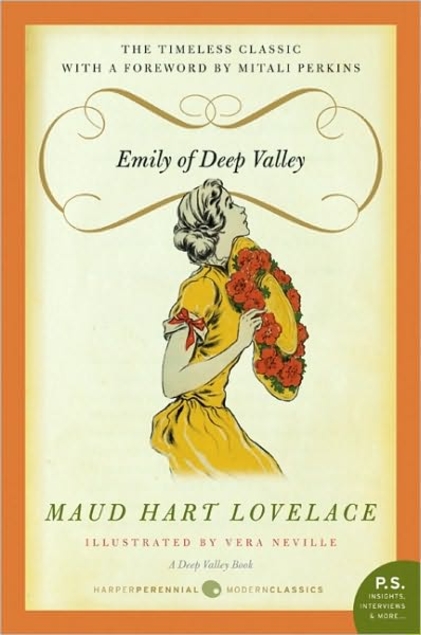
I’ve been rereading my way through the Betsy-Tacy series by Maud Hart Lovelace lately, starting with Betsy-Tacy when they’re five years old and on up to Betsy’s Wedding. I might write about the whole series some other time, but right now I want to write about one of the companion books. Ten of the books focus on Betsy (and friend Tacy), two focus on close friends of Betsy, and just one focuses on an entirely separate character who happens to live in the same small town and share a few acquaintances. And that one, oddly enough, may be my favorite.
Emily of Deep Valley starts when Emily graduates from high school (a few years behind Betsy, for those who are keeping track at home). She has always been a bit separate from her peers, an orphan living out near the slough with her grandfather. Now all her acquaintances are setting off for college while she has to remain in Deep Valley, feeling adrift with no purpose or future.

Deep Valley is the most charming of small towns. The series is set in the early 1900s, with a distinctly nostalgic and idyllic view of the time. Other books can explore class and gender and social issues of the time, but the Betsy-Tacy books are just an innocent delight. And fairly progressive in their way, as Betsy dreams of a career as a writer, and Emily feels that she needs a purpose beyond caring for her grandfather.

Of course the book ends up being about Emily finding her purpose, her confidence and a belief in herself. She’s not like Emily of New Moon (or Betsy) with her sure flame of belief in what she’s meant to do in life. This Emily has to find her way, an ordinary girl who sets out simply to help some people in her community, and to explore a few interests

That’s what I love about this book. It’s a coming of age story without trauma, a quest for meaning without traveling anywhere, a story about finding oneself without needing to find out that one is anything unusually gifted or extraordinary. And it’s just lovely.

There is a romantic element in this book, but it felt very secondary to Emily’s personal growth. Her love interest doesn’t come in until very late in the book, and her romance is an effect of her growth more than it is a cause.  Which feels perfect, although it is a quite sweet romance too.

It’s actually a very sweet series overall. But this particular installment has a little more depth to it, a little more character exploration…while being a lovely delight of a book too.

Author’s Site: http://www.maudhartlovelace.org/

Other reviews:
Live, Learn, Love
The Captive Reader
Forever Young Adult
Anyone else?

Buy it here: Emily of Deep Valley


December NaNo Update

As I mentioned in my NaNoWriMo wrap-up post, I am spending December continuing to write my NaNo novel.  My goal is to write 834 words a day (for a 25,000 word total month).  After official NaNo, this feels much, much easier!  And that’s a good thing because I’ve been sick a couple times and slipped behind on my goal–although right now I’m just about on track.

I’m also not too worried about the possibility of getting behind because I really don’t think the novel is going to take a full 25,000 words to finish.  I’ve done a little over 8,000 words so far this month, and I’d be surprised if it takes a full 10,000 more to finish.  Although it could happen!  Stories do often surprise me…

I realized somewhere near the end of NaNo that this story is bigger and more complex and frankly beyond the scope of what I’m achieving in this first draft–so at this point I almost feel like I’m writing an extremely detailed outline which will be changing and expanding as I revise.  I’m rather looking forward to finishing this draft and letting it percolate in my backbrain while I go on to another project.  And I am figuring out some things in the process of this writing, so it feels worth it to finish the outline-ish draft.

And it means I can give you another excerpt!

Aza rubbed her hands together, then pressed one palm against a blank space between the handprints.

Immediately the sound of rock sliding over rock filled the cavern. Aza and I looked at each other with mirrored excitement, looked towards the ravine blocking our path—and realized that the ledge we were standing on had just shrunk significantly.

“Maybe that wasn’t the right spot?” Aza said just above a whisper.

“Just how angry was this woman?” I demanded, staring at the now much closer ravine. “It was not enough to scatter clues across the entire galaxy, she had to put death traps in the final approach?”

Book Review: Daring Greatly by Brené Brown

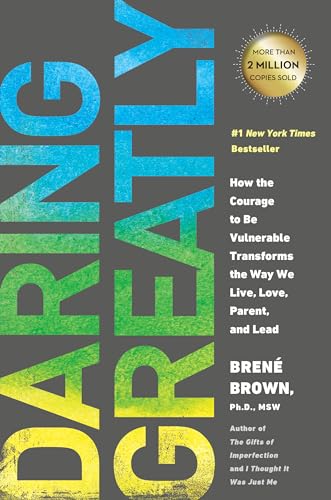
It’s rare for me to read a book that makes me want to rush out and tell everyone I know to read it—and even rarer with nonfiction. But that happened with Daring Greatly by Brené Brown.

How I came to this book is a story in itself. You may have heard of Brené Brown, and if you have, it’s probably because she has a wildly successful TED talk on vulnerability, with a follow-up talk on shame. Her first one is, I believe, in the top ten most popular talks on TED (which is saying a lot) with over 22 million views. I watched the talk (for the first time) years ago, and vaguely meant to check out her books some time.

And then my book club chose to read a book on rejection: Rejection Proof: How I Beat Fear and Became Invincible Through 100 Days of Rejection. Suffice to say, the author became a supposed “rejection expert” through a series of self-devised experiments setting himself up for rejection. Except. All of these experiments involved no investment, had nothing at stake, did not involve anyone he cared about, and didn’t even put any of his identity on the line. In other words, he managed to take all the vulnerability out of rejection, which seems to rather defeat the point. I got Rejection Proof from the library and did not choose to buy it. But I went out and bought Daring Greatly.

To put it briefly, everyone experiences vulnerability, no one likes it, and yet it’s a prerequisite for connection and whole-hearted living. Brené explores what vulnerability is, how it plays into our relationships, and all the ways we try to avoid vulnerability—and why that doesn’t work. She also discusses shame and worthiness, and how essential it is to believe that we are worthy.

I’ve found that I like philosophical books from type-A perfectionist women who do too much (and are now trying to learn something different). I also appreciate books from people like Thich Nhat Hanh, but the fact is—he’s a monk living in a prayer community. Brené Brown, on the other hand, is coming from where I am.

My favorite section (also one of the longest) was on Vulnerability Armor. One of the major ones? Perfectionism. If we’re perfect enough, it’s supposed to protect us from vulnerability and make us worthy. That doesn’t actually work. But do you know how many years I never missed a scheduled blog post? (Three posts a week, for over four years.)

Another major armor is Numbing. My first thought was that this would be less relevant to me—I don’t drink or smoke or do drugs. But the biggest form of numbing? Busyness. Staying so busy we never have time to stop and think about our lives. That was the point when I decided that this book could be helpful to just about everyone I knew. I don’t mean that everyone I know is desperately avoiding vulnerability—but most people I know are too busy (and me too—again, three posts a week for four years…)

And I think the real point here is that these topics are universal. They relate, more or less and in different ways, to everyone.

So—I’ve been telling people in person and now I’m telling you too. Go read Daring Greatly. Or at the least, go watch Brené Brown’s TED talk. And if it speaks to you at all, then read Daring Greatly.

And if you know me in person, well, I do have a copy…but I’m a little reluctant to loan it out. Partially because it’s one I’d kind of rather keep around. But since we’re talking about vulnerability, I’ll go ahead and admit this—that I’m a little worried about how vulnerable it would make me to let someone see which parts of the book I highlighted!

Author’s Site: http://brenebrown.com/

Other reviews:
The Pioneer Woman
Pop and Banter
Tell Me About It, Sister
Anyone else?

Buy it here (seriously): Daring Greatly

Blog Hop: Friendly Characters and Character Friends

book blogger hopThis week’s Book Blogger Hop question: Which character in a book do you most see yourself as? If none, who would you think would be your best friend in real life?

I’ve always felt some commonality with Emily of New Moon, with her love of books and dreams of writing. And the more I read by, and about, L. M. Montgomery, the more I think I’d love to be friends with her. She’d be my first stop if I had a TARDIS—Cavendish, Prince Edward Island, June of 1908 (I’ve thought about this…)

I’d also love to be friends with September from the Fairyland series, so brave and loyal. I like reading about Jacky Faber, but I think she’d drive me up the wall if I actually knew her (as she says, she is so very hard on her friends), and I’d really rather be friends with her BFF, Amy. I’d also quite like to make friends with the kindly old gentleman of The Little White Bird, which is just another way of saying I’d like to be friends with J. M. Barrie. And I’m very fond of Menolly of the Harper Hall Trilogy and her fire lizards, and Arrietty of the Borrowers books, and oh, so many, many characters! Characters are largely why I read. 🙂