The Last Unicorn Read-Along, Movie Edition

Rounding out The Last Unicorn discussion, today I’m looking at the movie version.  Barring the possibility that I saw it as a kid and remember nothing (unlikely) this was my first experience with the movie, and either way, it was all new!  It was interesting to watch so soon after reading the book, and I really enjoyed the movie overall.  It was fun to compare, and it’s a good movie in its own right…though rather like the book, it’s much more deep and complex than I might have expected (if I hadn’t read the book, that is).

I’m not going to use all of Lynn’s questions this time, because she gets into some details I must admit I didn’t notice.  There are some stories I can discuss that kind of minute detail about (try me on the choreography in Webber’s Phantom) but I don’t know this one well enough!  Here goes some thoughts, though…

The movie is very faithful to the book in a lot of ways, but one of the most noticeable changes to me has always been that it moves the unicorn’s encounter with the butterfly forward. What do you think this does for the narrative? Does it work better or worse for you?

Mixed thoughts here.  I do like that the butterfly gives the unicorn added impetus to leave her forest, and that certainly focuses the plot more by bringing the Red Bull in as an element earlier on.  On the other hand, somehow I like it in the book that she meets the butterfly already out in the world.  Since he’s representative of outside knowledge, I’m not sure I like it that he turns up in the unicorn’s forest in the movie.

On another point, I can’t decide if I like the butterfly’s changing hats.  It’s clever, and it’s a visual for his frantically spinning dialogue, but it also has a kind of Genie-from-Aladdin feel, and seems almost a little too silly for this movie, especially early on when the tone was still being set.

One of the biggest differences between the novel and the movie is that the movie cuts out the storyline of Hagsgate almost entirely. What do you think it does for the plot? Do you think it’s something that the adaptation should have kept or does it work without Hagsgate’s tale?

I quite missed Hagsgate, actually.  That was easily the biggest thing that felt missing to me.  I think the prophecy, especially around Lir, added a really big additional layer of legend, and tied this so much more into traditional tales.  I feel like losing the prophecy means losing two or three layers of meaning!  Additionally, Haggard’s throw-away movie line about picking up Lir as an orphan feels like a total “say what now?” thing with no further context, while the context of the book means it’s just one part of something hugely layered and important.

I also like Hagsgate just to know that there are people in this country.  Of course there are the outlaws and the traveling circus, but those are wanderers on the fringes of society.  Hagsgate (however twisted it may be) is the only actual representative of society, which the others are on the fringes of.  I get stuck on this in Lord of the Rings and Neil Gaiman’s Neverwhere too, trying to figure out where normal people in the magical world live their normal lives…because not everyone can be engaged on magical quests.

The movie has a tendency to condense the passing of time into a song sequence. Do you feel that the songs enhance the storyline or that they don’t fit the narrative?

I didn’t notice the time-condensing aspect of the songs all that much (maybe because songs for travel periods feels normal in movies) but I did really like the songs.  In a way they’re a good example of what makes this story different than might be expected.  I feel like if someone told me there was a movie about a unicorn, with songs, I would have a very clear picture of what those songs would be like–but rather like Schmendrick the “bumbling magician,” the songs aren’t at all what I would have been imagining.  They’re much more reflective, and really fit the style of the story.

The opening song especially was so beautiful, and so effective at showing the unicorn’s earlier life–and it was familiar.  I’m reasonably sure I never saw this movie before (see first paragraph) but I knew the song and I have no idea why or where I might have heard it.  Memory is funny, isn’t it?

What were your favourite moments of the movie? Did the movie leave out any of your favourite bits of the story?

Strangely enough, I most liked and least liked the visual of the movie.  Let me try to unpack that…  The book is in many ways very cerebral.  There’s so much going on and much of it is on (here’s that word again) layers that are below the surface of what we’re actually seeing.  Some things can be conveyed through the visual of the movie, or through character dialogue, but some subtleties and nuances have to be in thoughts, or even in the style of the writing–there’s no way to completely carry that over.  However, at the same time, all those layers in the book sometimes makes it hard to actually see the visual level, because the description (while beautiful) is also hard to pick apart from the abstract.

So I really liked some of the visual of the movie–the best was the image of the unicorns among the waves, because I could never quite see that in the book.  I also liked the movie’s twist of showing things differently to demonstrate what different people were seeing.  Most of the uses of that trick in the carnival were really effective–except for the unicorn’s double horn, which just bothered me somehow.  But I liked the depiction of the Red Bull, and Haggard’s castle.

On the other hand, visually seeing the unicorn, a goofy-looking magician and a handsome prince made that surface-level story feel stronger in the movie.  Which is good and bad, because I had trouble relating to the surface-story in the book, but on the other hand, relating to it in the movie may be at the expense of deeper layers.

So…yes.  The visuals were my favorite part, and least favorite part.  And I feel like that’s an appropriate comment to make about a story that discusses truths, contradictions and, of course, many different layers…

Favorites Friday: Movies for the Fourth of July

I hope you enjoyed some fireworks and barbecuing yesterday!  I may be a little late with this post, but it’s still Fourth of July weekend, so I thought I’d offer up a list of movies in the spirit of the holiday…

Mr. Smith Goes to Washington (review here) is my top pick for Fourth of July, not because it has anything much to do with the revolution (although Mr. Smith’s first name is Jefferson) but because it celebrates, as only Frank Capra and Jimmy Stewart can do, all that is best in American ideals of democracy.  Mr. Smith is the dreamer who believes in honesty and fair play and a government that serves and protects the people, going up against a world that isn’t so straight-forward.

1776 is a close second, a comedic, musical look at the signing of the Declaration of Independence.  It may not always portray the Founding Fathers positively or entirely accurately (apparently the only historical record indicating John Adams was “obnoxious and disliked” is in his own writing, and Richard Henry Lee wasn’t the idiot he’s portrayed as here), but the whole thing is pervaded with a warm affection for the characters–and it’s just so much fun!  With some nice messages about ideals too.

The Sandlot has no revolution or political message, but it does have a scene on the Fourth of July.  More importantly, I think it captures a certain slice of Americana, with its innocent story of boys playing sandlot baseball, eating s’mores, making friends and getting into trouble over one long summer when anything seemed possible.

Newsies (review here) has a kind of revolution, although not the 1776 one.  Set in New York in 1899 and (loosely) based on real history, it tells the story of newsboys going on strike against the powerful newspaper publishers.  It’s a David-and-Goliath story, centers around friendship and fighting for your rights–and features a host of wonderful “rally the troops” songs and adorably enthusiastic newsboys.

National Treasure is no doubt even less historically accurate than 1776, but it’s a fun romp and adventure story based around a mystery/conspiracy theory about the Founding Fathers.  It features all sorts of artifacts and monuments, and like Mr. Smith, the main character, Benjamin Franklin Gates, is named after a Revolutionary figure.

So much for my round-up!  What do you like to watch on the Fourth of July?

Zombieland and Warm Bodies

As a general rule, I’m not much of one for zombie movies.  I’m not much of one for blood and guts in general, so…yeah.  But I had a movie night with friends recently, and watched Warm Bodies, which was really quite a bit of fun.  I watched Zombieland (with the same people) on a different occasion.  Since it’s another funny zombie movie, I thought–why not a joint review?

Zombieland (2009) focuses on the last handful of people left alive in a world overrun with zombies.  Jesse Eisenberg plays (of course) a shy, nerdy college student, who cites his survival to his list of rules–like Rule#1: Cardio, and Rule#4: Don’t be a hero.  The movie turns into a sort of strange, zombie-filled road trip–and of course one of the only other surviving humans happens to be an attractive girl (Emma Stone) the same age as the main character.

On the con side of things, there are some moments of zombie gore and guts (particularly in the first few minutes).  If you’re squeamish, watch with someone who has seen the movie and can warn you (that’s what I did).  As far as zombie movies go, it’s not really a heavily gory one, though (or so I’ve heard).  On the pro and con side, there’s an awesome, super tough girl…who then ultimately does something stupid and has to be rescued by the not-nearly-as-awesome guy.  Sigh.  But the whole thing is something of a geek-guy fantasy, so I suppose it’s just how it goes.

On the pro side–it’s frequently a very funny movie.  And–the Rules!  The Rules are how I ended up watching this to begin with.  I’m writing a novel with a character who has a list of rules for life–and I had never seen this movie.  Everyone in my writing group told me I had to watch Zombieland.

The Rules were awesome…but I feel cheated.  We hear about Rule #30, so there must be thirty rules, but we only actually hear maybe a dozen of them.  For the record, my character has around 35 rules, and they are all in the novel.

Aside from too few rules and too much gore, though, it’s a fun time.

Warm Bodies (2013) tells the story from the point of view of one of the zombies.  His name is R–he can’t remember the rest.  He’s pretty depressed about his non-life, and dreams of being able to connect with another person.  And one day, he does; he meets Julie, a human from a hold-out community of survivors, who R chooses to protect during a zombie attack.  The more time they spend together, the more R begins to change…

On the pro side, R has a fantastic inner monologue going on.  It’s witty and funny, offering commentary on life and on zombie tropes, and giving such an interesting insight into his head.  R has to work so hard to overcome his zombieness, and to connect with Julie–prompting monologue such as “Don’t be creepy, don’t be creepy…”

The gore level is a bit lower than Zombieland, although it does have its moments, so watch out.  On the pro and con sidethey do something really fascinating with the trope of zombies eating brains.  The idea is that eating someone’s brain enables the zombie, at least temporarily, to relive that person’s memories, and remember what it feels like to be alive.  If you can get past the ick factor (eating brains!), I love the concept.

On the con side, well, don’t expect much of this to make any kind of scientific sense.  R doesn’t remember how the zombie infection got started, and pretty much nothing about the nature of the zombies is explained or even seems terribly reasonable.  But honestly, it doesn’t matter that much.  I mean, it’s a surprisingly clever zombie movie with engaging characters.  For me, the science becomes secondary.

I’m still not a fan of zombies in general…but if you want a funny twist on zombies, these were a couple of good ones.

Saturday Snapshot: Lord of the Rings Nostalgia

I’ve been working my way through the Lord of the Rings novels, and as part of the very elaborate process, I’ve also been rewatching the movies.  I saw them all when they originally came out, but never read the books then.  I did, however, collect bookmarks.  I think they were available at my school’s library–the memory has gone a little vague.  But I collected them some ten years ago, and haven’t much thought about them since.

However.  While I had never read the books, my dad had them, so they were in my house.  And in my typical, over-organized fashion, where else would I store LOTR bookmarks…but in copies of LOTR?  So in the course of reading the books (those same copies that were sitting there all along) I’ve also unearthed the bookmarks.

I somehow don’t have the set from Fellowship, but I do have Two Towers and Return of the King

Lord of the Rings Bookmarks (2)Lord of the Rings Bookmarks (3)The bookmarks are two-sided, and I’ve kept them in the same order so you can see which characters were paired.  Some make sense…others don’t.

Lord of the Rings Bookmarks (1)Lord of the Rings Bookmarks (4)My one regret here…no Faramir bookmark.  He gets more screentime in the Extended Edition and…I just love him (this scene!)  Ah well…aside from that, I’ve quite enjoyed rediscovering a collection I all but forgot I had. 🙂

Visit At Home with Books for more Saturday Snapshots!

Star Trek: Into Darkness

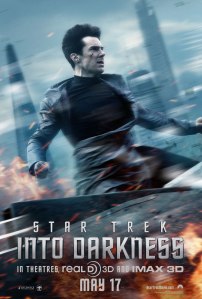
StarTrekIntoDarknessEnterprisePosterI went to see Star Trek: Into Darkness on opening night, and can happily report that I thoroughly enjoyed myself…although in the end, I feel mixed about the movie.  It was a very good time–and yet there are issues.  I feel rather that way about the previous movie too, although the particular issues are different ones.  The first (eleventh) movie had rather a mess of a plot but excellent characters and some fantastic moments.  This one had an engaging plot, made rather a mess of the characters…and had some fantastic moments.

The movie opens with the Enterprise on a routine survey mission that is on the brink of going horribly awry.  This felt a lot like an old-style Trek adventure, and was a very fun way to start the movie.  Kirk breaks regulations to pull a victory out of chaos, but is still smacked-down by Starfleet for breaking the rules.  This is quickly set aside, however, when Starfleet comes under attack from the mysterious John Harrison (Benedict Cumberbatch) and the Enterprise sets out to round up the fugitive.  Beyond that, it’s hard to discuss plot without serious spoilers.

Suffice to say, the plot was at times implausible or convoluted, but also exciting and engaging.  There are some good twists and very good chase sequences, although some of the action parts went on longer than necessary.  And there were far too many flashing lights!

Cumberbatch2But  there was also Benedict Cumberbatch.  Pardon while I gush.  I don’t think I would have enjoyed this movie half as much without Cumberbatch.  Whatever was wrong with the characters (I’ll get to that), the problem was not the villain.  He was completely awesomely amazing  every time he was on screen.  He was one of those villains who is just so damn cool that you want to root for him–while realizing fully that he’s a horrible person who must be stopped.  I’ve only ever seen Cumberbatch before in Sherlock, and this was like the evil Sherlock.  Sherlock if he really was a pyschopath, and not nearly as funny.  So.  Brilliant.

They hold back the reveal on his, shall we say, secret identity for quite a while and I won’t reveal it either.  But I heard a definite exhale go through the audience when it finally came out.  If you’re on the fence about seeing this movie, it’s worth it for Cumberbatch alone.

But he isn’t the only good thing in the movie.  Scotty, McCoy and Chekov are all really delightful every time they’re on screen–which, in the case of McCoy especially, was not often enough.  There are some very funny moments, which was good and bad–and I think that brings me up to why I feel mixed.  Some of the lines made me laugh…except that the characters shouldn’t have been saying them.

I had problems with the portrayal of the characters, and when I say “the characters” I think I mostly mean Kirk, though not exclusively.  Part of the trouble is the whole “prequel” concept that they set up in the last movie.  At the end of that movie, a group of (essentially) college students were put in charge of the top-of-the-line, pride of the fleet Starship Enterprise.  In this movie, the college students are running things–but they’re still behaving like college students.  They flirt, they argue, they have relationship discussions in the middle of a battle sequence, they disregard regulations and blithely expect to get away with it.

Now I’ll grant you, the original series characters always had their moments.  But there was also always a baseline of professionalism.  There was rank, there was protocol, there were regulations and procedures and a rational chain of command.  And they behaved (mostly) like professionals.  They felt like mature adults.  The dynamic and the interactions in this new movie just didn’t feel right to me for Starfleet officers, or for these characters.

I know this sounds like a nitpick, but the continued unprofessionalism was threaded throughout the movie, and when something is just a little bit wrong every third line of dialogue, that’s not a little thing anymore.  It was everything from Kirk making pointed-ear references (which is McCoy’s sole prerogative) to Sulu or Chekov saying things like, “I don’t know if I can do that but I’ll see what I can manage,” when the only appropriate response is “Yes, Captain.”  And then there was Scotty calling Kirk “Jim,” repeatedly.  Only Bones calls him Jim regularly, that’s what makes him special (or maybe I should say, his specialness lets him do it–not that anyone writing this seemed to understand that McCoy is important.  A different issue).  The worst was when Uhura and Spock had a relationship spat mid-landing party.  People: professionalism!  (The fact that they even have a relationship to have a spat about–that’s so wrong I can’t even touch it.)

The lack of maturity was especially a problem for Kirk, because they apparently decided to give him a character arc about needing to grow up into the role of captain.  And yeah, I know, prequel–except that he’s already captain, with the same crew he had on the original series, and the idea in that context that he doesn’t know what he’s doing yet and that, I don’t know, his pre-frontal lobe is still developing or whatever…no, it just felt wrong.  I love Kirk because he is every bit as awesome as he thinks he is, he always knows what he’s doing, and he always bends the rules in exactly the right way to get a victory and stay out of trouble.  Always.  If they want to tell a story about how he became that person, it should have happened before he was sitting in the Chair.

So much for my rant.  Just when I was getting thoroughly frustrated with things, though, we got into the last half-hour or so…which will be a spoiler to discuss.  So I’m putting it in white, highlight the next paragraph if you want to read it.

Loved the last portion of the movie.  I thought the role reversal of Kirk and Spock was mind-bendingly brilliant.  This is by far and away the best example so far of taking the altered timeline and doing something really clever with it.  Loved the chase sequence with Spock and Khan.  Loved that a tribble was part of the key to saving Kirk.  Loved that Khan was shown still alive–and smiling–at the end.  That man’s not going away (I hope).  Loved that Leonard Nimoy had a cameo.  It was a pretty much unnecessary cameo–except that he’s Nimoy, and therefore is necessary unto himself, it doesn’t have to do anything for the plot.

And though it is about the end, it’s not a spoiler to say that using the original music for the end credits gave me the warm fuzzies.  🙂  Suffice to say as a non-spoiler, the last half-hour was brilliant, and while I stand by my issues with the other portions of the movie, it brought me around to a positive on the movie overall.

Next time–because I trust there will be a next time–I’m hoping for more McCoy (please, more McCoy!), less flashing lights and weird reflections, more maturity from the crew and especially Kirk, and with any luck, more Benedict Cumberbatch!

Movie site: http://www.startrekmovie.com/