Spend Some Time with Pat of Silver Bush

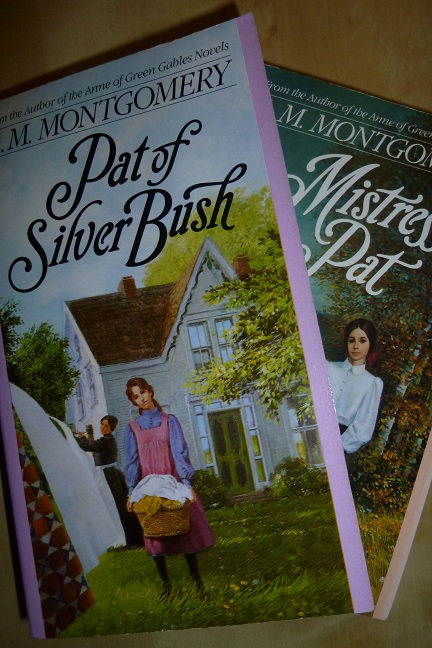
Pat BooksWith the L. M. Montgomery Reading Experience this month, I decided it was the perfect time to revisit the Pat books.  Pat is not as well-known as her literary sisters, Emily and Anne, but she has two charming books, and I was intrigued because Montgomery considered her one of her more autobiographical heroines.

Pat of Silver Bush follows Pat through childhood, from age seven to eighteen, touching on Pat’s small adventures along the way.  I don’t mean “small” as a criticism–part of the charm of Montgomery’s books is that she takes the day-to-day concerns of a girl (and a family) living on a farm on Prince Edward Island, and spins out a beautiful story.

I like Pat, but I think I can see why she hasn’t captured the imagination the way fun-loving Anne or ambitious Emily have.  All Montgomery heroines deeply love nature and a good story, and have at least a glancing appreciation for poetry.  Pat’s interest is more glancing, and though she’s clever, she doesn’t have Emily’s brilliance.  Pat’s chief quality is to love things intensely–often too intensely–and nothing more so than her home of Silver Bush.  Pat worships Silver Bush, and can’t bear the thought of any changes.

It took me a bit to get into the book, and while that may have been a matter of transitioning out of sci fi, I think it also has to do with the particular incidents of Pat’s very early childhood.  Pat can’t bear change–and so she has agonies of emotion over apparently minor things, to the point that it’s hard to sympathize.  This problem is smoothed out as Pat gets older and begins to move in a larger sphere, with larger (and more genuine) concerns.

Pat is one of the few Montgomery heroines to have a large immediate family.  Anne and Emily are both orphans.  Pat has two parents and four siblings.  The funny thing is, I don’t feel properly acquainted with most of Pat’s family.  Her nearest brother, Sid, comes into it a bit, and her younger sister Rae has a significant role in the second book.  The rest, though Pat loves them fiercely, seem to have very little actual presence in the book.

I was particularly struck by the portrayal of Pat’s mother.  She’s lovely and loving and “the heart and soul of Silver Bush”…but she always seems to be off in the other room.  Montgomery’s own mother died when she was a toddler, and she idealized the memory of her mother.  Pat’s mother feels like a living version of this–beautiful, idealized, but not really there.

The one who’s there is Judy, the family cook and house mistress, who understands Pat better than anyone.  Born in Ireland, Judy is an endless source of wonderful, improbable stories, either spooky tales of ghosts and fairies, or funny stories of family history–and of family history for everyone else in town.

The other two characters that shine are Pat’s two best friends: dreamy, ethereal Bets, and practical yet poetic Jingle.  Despite his unfortunate name (and eventually switching to Hilary doesn’t help), Jingle is a delightful childhood sweetheart for Pat–because every Montgomery heroine seems to have one.  Jingle is the mistreated near-orphan of the story, who sees the world clearly and dreams of making a mark in it–but can also join Pat in going in raptures over a bit of woodland.  He has ambitions of becoming an architect, and is forever planning the house he’ll some day build for Pat.

One of my favorite chapters is when Jingle’s long-absent mother comes to visit, and it goes very badly.  It’s a dark crisis for a Montgomery book, not a straight-forward tragedy but a crisis of disillusionment, and very moving.

Mistress Pat follows Pat through eleven years, from twenty to thirty-one, through a series of beaux, new friends and many new changes.  Hired man Tillytuck is a wonderful addition, very colorful and frequently sparring with Judy.  Rae comes into her own as Pat’s dearest friend, and Pat makes new friends out of Suzanne and David Kirk.  They don’t have quite the charm of Bets and Jingle, but they have their moments.

This is a particularly interesting read after reading Montgomery’s journals, because I’m convinced she put so much of her own life into Pat’s.  I’m sure Pat’s brother makes an unwise marriage because Montgomery’s son married a woman she didn’t approve of a year before the book was written.  Pat’s feelings towards David Kirk remind me very much of Montgomery’s feelings towards her husband–though things turn out differently.

I think this is the most heartbreaking Montgomery book (unless you count her journals).  The last third is all but devastating…so at the risk of a slight spoiler, I am glad Montgomery rescued Pat with a happy ending in the last three pages.  I wish there had been a third book–I want to feel Pat’s happy ending, but even though she’s going on to a better life, we don’t get to see it.  Oh well.  It could have been much worse.  It could have ended like Montgomery’s journals!

All in all, Pat doesn’t hold my heart like Anne or Emily, but I still love any Montgomery novel.  Some parts are an absolute delight, especially Judy’s stories, and Montgomery never fails to paint the beauties of Prince Edward Island.  These wouldn’t be the first Montgomery books I’d recommend picking up, but if you’re already acquainted with her other heroines, it’s nice getting to know Pat too.

Other reviews:
This Simple Home
Reading to Know
The Black Sheep
Pages Unbound
And, I am pleased to see, many more–tell me about yours and I’ll link to it!

Buy it here: Pat of Silver Bush and Mistress Pat (It’s weirdly expensive new, but I found some cheap used options!)

Saturday Snapshot: Presidential Statues

With the Inauguration this past week, I thought it would be fun to focus a Saturday Snapshot on past presidents, using photos from my trip to Washington D.C.  I didn’t get pictures of any living presidents, but there were lots of good statues!

Presidents (1)The Lincoln Memorial was the one I most wanted to see, maybe because it shows up the most often in books and movies–and I have this thing about visiting places I’ve read about.  It’s a beautiful monument and, as the inscription says, it feels very much like a temple, despite its essentially secular nature.

Presidents (3)Jefferson is another one with a temple, that beautiful round marble space, and with such a hushed, reverent…well, temple feel.  I’ve been meaning to read a biography of Jefferson ever since I visited…eventually I’ll get on that.

Presidents (2)There’s an outdoor monument for Roosevelt.  I love that he’s shone with his “little dog, Fala.”  Thanks to YouTube, you can see a wonderfully funny speech Roosevelt gave about Fala.

Presidents (4)And speaking of funny, I am probably far too amused by this Roman-style, shirtless George Washington in the Smithsonian.  I just have this general impression that in life, no one saw Washington shirtless, except for Martha–maybe! 😀

Visit At Home with Books for more Saturday Snapshots!

A Concert from the Harper Hall

https://i0.wp.com/opland-freeman.com/pernmusic/images/B000CAFWKQ.MH.jpgIt’s funny the things you can find once it occurs to you to look for them.  I’ve loved Anne McCaffrey’s Pern poetry for years and years, the snatches of verses that, in context, are the songs of the Harper Hall.  In the course of the January Dragonflight group-read, it occurred to me to do a search on Amazon to see if Masterharper Robinton’s harpers have put out any CDs–and they have!

Well, not exactly.  🙂  But Tania Opland and Mike Freeman worked directly with Anne McCaffrey to put together two CDs of music inspired by Pern, much of it using the lyrics described in the book.

Can I just pause for a moment here to say how completely amazing that is?  I mean, Harper Hall songs!  Really!

I admit I was a little nervous on purchasing…this could, after all, go very badly if I didn’t like how the songs were done.  Fortunately, I like the music quite a bit overall.  It has a very acoustic, folk-song style that feels eminently appropriate to the context.  You couldn’t possibly play Menolly’s or Robinton’s songs on an electric guitar.  They need pipes and strings and though I have no musical expertise to recognize exactly what instruments are being used, this feels right.  Amazon tells me it draws from a variety of musical traditions, and I can most clearly hear the Celtic.

Most exciting, unquestionably, is that we get to hear songs I recognize from within the novels. I had to buy both albums because favorite poems/songs were split between them.  The Masterharper of Pern has more of the traditional ballads and, obviously, Robinton-related songs.  Sunset’s Gold has songs from Menolly, heroine and songster of the Harper Hall Trilogy.

Some of the tracks are instrumental, and I must admit those were not as interesting to me, though some do relate to book events.  But that’s me–I almost always prefer words in my music.

The Masterharper of Pern has a number of the songs that figure in Dragonflight.  I particularly love “The Duty Song,” which runs through all the key roles within Pernese society, and how all must come together to serve their unique purpose.  “Fighting Thread” is also excellent, about the dragonmen rising to fight their ancient enemy.  That one sticks in my head somehow.  Most exciting here is “The Question Song” which is suitably spooky, if maybe not quite the soul-capturing mystery described in the book (but what could be?)  I have mixed feelings about “Lessa’s Ride.”  Parts of it are lovely, but I would have liked a melody that was more epic and heroic, considering the subject.  On the other hand, “March of the Wings” gives me that more stirring melody I was looking for.  You can just feel the dragons soaring up in formation.

https://i0.wp.com/opland-freeman.com/pernmusic/images/B001QVJC6A.SG.jpgSunset’s Gold has many of my favorites from the Harper Hall Trilogy, brought to life very satisfactorily.  Menolly’s “Run!” song is suitably toe-tapping, and “Brekke’s Cry” is eerie.  I would have liked “The Little Queen” to be catchier somehow, but it’s been growing on me.  I really enjoy “Gather Day,” which very much captures the festive atmosphere (and the lyrics refer to bubbly pies!)  “Sunset’s Gold” and “Sweet Sea” aren’t ones I particularly remember from the books, but they’re beautiful songs in their own right, and would be even if they weren’t part of the larger context.

So, all my friends who read Dragonflight and especially those who liked the poetry…you really, really have to explore these CDs! 🙂

Musician’s Site: http://opland-freeman.com/pernmusic/index.htm

Buy it here: The Masterharper of Pern and Sunset’s Gold

In Between Star Trek – The Abode of Life

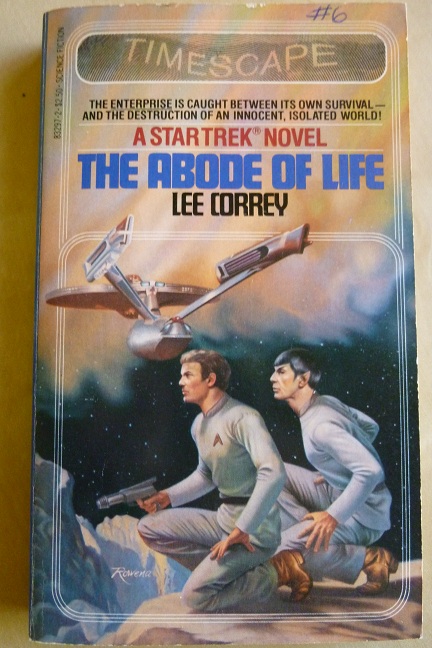
Abode of LifeSo far, my reading for the Science Fiction Experience has taken me to a galaxy far, far away, to the center of the Earth, and to the planet of Pern.  You had to know it would take me to the 23rd century eventually, right?  🙂  That’s where I went for my next book, Star Trek: The Abode of Life by Lee Corey.

I thought this was going to fit in for the Vintage Sci Fi challenge too, only to discover that it misses the cut-off by three years–it was published in 1982.  The best laid plans of mice…

I picked this one up because it promised me a planet with no stars.  The planet turns out to be Mercan, out on a very distant corner of the galaxy, which the Enterprise stumbles on when flung out by a fold in space (I don’t pretend to know what that means).  The Mercanians believe they are the only life in the universe, but the stability of their society is being threatened by new scientific discoveries casting doubt on that idea.  Kirk has his hands full trying to get help to repair the Enterprise, without setting off a civil war at the same time.

There’s a lot that’s fun here, and it met my absolute, cardinal, cannot-be-a-good-Trek-novel-without-this requirement: Spock and McCoy get to snipe at each other.  🙂  Also, Scotty gets to worry about his engines, and Uhura makes jokes about opening hailing frequencies, so I’m saying we’re doing well on the characterization here.

The Mercanians may have been the most interesting part.  They have a complex and unusual society, and I enjoyed seeing how some aspects of it played out.  Most especially, they have vastly advanced transporter technology.  As a result, they have no vehicles (why would you need them?) and no advanced communication (you can just go talk to people in person!)  Considering I was just on Carl’s blog talking about the ramifications of transporter technology, picking this book up shortly later was very well-timed (and not deliberate).

Oddly enough, one of the most fascinating (ahem) things about this book was where it fits in the chronology.  Not the internal chronology (which is somewhere on the five year mission), but the chronology of the Star Trek publishing world.  It’s somewhere between.

First there were some very early novels that I like to refer to as “Star Trek Lives” era, which are not always quite on top of characterization and often inconsistent with later incarnations (understandably), but also have a wonderful earnestness to them, and an obvious passion for telling one more Star Trek adventure.  Time went on, and later we got dozens and dozens of numbered paperbacks and particularly epic hardbacks, which tend to be of a higher quality and have a clearer picture of how they fit into the larger universe.

This one was in between, and it took me most of the book to figure out the distinctions.  The characters are spot-on, and the context all fits the larger universe.  At the same time, the book is a little more cerebral–Kirk spends more time thinking about things than I would expect in later books.

But I finally hit on what I think is the big difference.  This book felt obligated to explain things.  The Prime Directive must have been explained at least three times, and characters’ names, ranks and contexts on the ship are very carefully noted.  In other words, it reads like a Star Trek book that has no confidence people picking it up know about Star Trek.  Maybe it’s the last echo of the earlier era, when the show was canceled and the fanbase was relatively small and the show wasn’t a Thing yet, it was something that had to be saved.  This book wasn’t quite sure the job was done yet.

Or I’m just reading way, way too much into all of this, based on my impressions of different eras in Star Trek fandom.  That could be too.

I’d say the book fits in somewhere in between in a larger sense too.  It was not an epically fantastic adventure, but it was much better than quite a few Star Trek novels I’ve read too.  It was in between, and an in between-quality Star Trek novel is well-worth the read.

Buy it here: The Abode of Life

The Doctor’s Voice

My various posts about Doctor Who have already told you that I haven’t been able to get over David Tennant leaving the show.  I still enjoy the Matt Smith seasons, but…!  One symptom of this unacceptance is that I’ve been seeking out Doctor Who audiobooks.  Not novels–audiobooks.  Specifically, ones narrated by Mr. Tennant himself.

I’ve listened to three so far, and was delighted to find that not only is David Tennant perfect at delivering the voice of the Tenth Doctor (as you might imagine…), he’s quite good at doing other voices too.  Here’s a run-down on all three I’ve explored.

Doctor Who: Pest Control by Peter Anghelides

The Doctor and Donna land on a dark, muddy planet in the midst of a war between human colonists and centaur-like natives.  No, really–centaurs!  The Doctor and Donna get pulled into the conflict, especially when, in a Kafkaesque twist, humans start turning into giant insects.  Obviously, this is a bizarre one in some ways, and it has some dark (and gross) moments.  But there also some good moments between the Doctor and Donna (she does not appreciate the mud, or what it’s doing to her clothes), and even some Star Trek humor.  The Doctor initially introduces himself as Dr. McCoy, and Donna as Captain Kirk.

Doctor Who: The Last Voyage by Dan Abnett

This one is set in between seasons, possibly after Donna’s season, as the Doctor is without a regular companion.  As happens in the specials, he adopts a companion for the day.  In this case, it’s Sugar MacAuley, a flight attendant on the maiden voyage of an experimental new space craft traveling across the galaxy (in 90 minutes!)  When the engines go amok, most of the passengers vanish, and strange creatures start appearing, the Doctor and Sugar have to find answers, or be lost drifting between dimensions forever.

I particularly like the plot of this one.  It’s a good mystery with some neat details.  There’s just one drawback–first, Sugar suffers from a really dumb name, and Tennant compounds the problem by trying hard to make her sound distinctive and winding up giving her an annoying voice.  If you can look (listen?) past that, Sugar is actually a pretty solid character.  I would recommend reading this in book form, except–it’s worth it on audio to hear the Doctor’s voice.  He gets some really wonderful Doctorish lines that I loved hearing Tennant say.  There’s even an “allons-y!” at one point (and if that doesn’t excite you, you must watch this clip).

Doctor Who: The Stone Rose by Jacqueline Rayner

This is my favorite of the audiobooks so far.  As you might guess, it’s a Doctor and Rose story.  Mickey finds a stone statue of Rose in the British Museum, and when he shows it to the Doctor and Rose, they’re off to ancient Rome.  They meet an old man looking for his lost son, a young girl claiming to know the future, and a quite creepy sculptor…and the Doctor becomes convinced that the stone Rose is not a statue at all.

The-Doctor-and-Rose interaction here is brilliant, and I enjoyed the trip to Rome.  Tennant’s voice talents really shone here–he does great voices for Mickey and especially for Jackie.  His Rose voice was less distinct, but worked fine.  There’s a wonderful convoluted (but ultimately coherent) crossing of time lines, some good twists, and the last ten minutes is just lovely.  It’s a wonderful funny and sweet scene between Rose and the Doctor that’s adorable and just makes me smile and smile.  I listened to that bit twice.

As a means to an end, I can’t say that more Tenth Doctor adventures have helped me accept Tennant leaving the show…but more Tenth Doctor adventures are an end in themselves!