A Visit to Discworld to Finish the Story of Tiffany Aching

I found myself with a slight crisis recently, short on books and still waiting on holds, wandering the shelves of my tiny local library looking for something to carry me through the week…and was delighted to stumble upon I Shall Wear Midnight by Terry Pratchett.  Discworld is the one series I somehow feel no pressure to finish–it’s too big and too rambling and I just dip in at random whenever I feel so inclined.  But the Tiffany Aching subseries as always felt much more self-contained and continuous, so I have been meaning to finish that off.

The final book in the sub-quartet presents Tiffany Aching at sixteen, still new to her role as Witch of the Chalk, but settling into the position.  But Tiffany’s dance with the Wintersmith in the previous book has awoken an ancient evil–one who hates witches.  With hostility towards witches rising throughout the land, Tiffany must find a way to fight through the fear and prejudice to confront its root.  And that while dealing with the upcoming wedding of Roland, her some-time beau, and the sometimes harmful help of her devoted allies, the Nac Mac Feegles.

I love the way Pratchett has presented Tiffany’s growth throughout the quartet.  She has always been someone who does what needs doing, from rescuing her little brother from a Fairy Queen in the first book, to the unglamorous witch work of caring for the ill, elderly and forgotten in this final book.  Tiffany has gained wisdom and confidence all along the way, but like life, it’s often been a few steps forward, a stumble or two back, a redirection and a new leap ahead.  Tiffany’s not only learned how to fulfill her role, she’s very consciously had to figure out what that role is, and how she wants to fulfill it.  Pratchett has done a masterful job of keeping Tiffany always the same person, while growing her throughout the series.

And then there are the Nac Mac Feegles, the Wee Free Men, the drinking, fighting, carousing, honor-bound (but always their own interpretation of honor!) clan who swore loyalty to Tiffany as the Hag o’ the Hills and will stick with her through thick and thin, no matter how many times she tells them to go away.  I love how well Tiffany understands them by now, and her back and forth with them is hilariously brilliant.  For instance, she’s somewhat less than surprised–and remarkably calm–when Daft Wullie sets fire to her broomstick in midair, and staunchly denies responsibility while holding a lit match…

I also appreciated that Rob Anybody, the Nac Mac Feegle chief, did get one moment of more depth.  The Nac Mac Feegles, basically, are never serious…until the humans try to dig up the Nac Mac Feegle hill, and for just a moment we glimpse a very real fear and anger from Rob Anybody about his wife and children.  I’m not sure I really want more than one serious moment from the Nac Mac Feegles, but one was perfect.

Having read other Discworld books, I enjoyed a cameo for Granny Weatherwax and Nanny Ogg.  It’s always fun to see familiar characters from a different perspective, and I liked seeing them through Tiffany’s eyes–still the same characters as when they tell the story themselves, but with maybe a little more awe mixed in.

Pratchett’s books are all the more remarkable for being hilariously funny, while sharply insightful in their satire.  Here he personifies a familiar and particularly ugly side of human nature, the hatred of the Other simply because they’re Other.  Or as was said in another fantasy story, “we don’t like what we don’t understand; in fact, it scares us” (Beauty and the Beast, “The Mob Song”).  There it was against the Beast; here it’s against the witches, and there’s an added subtlety in the sense that part of the hatred comes because people know that the witches do what needs doing–what people guiltily realize they ought to be doing themselves and aren’t.

I already own all the City Guard Discworld books, and I think I need to start collecting the Tiffany Aching books.  They’re both my favorite kind of comedy–we have one stable, complex main character to ground us and guide us through the constant hilarity of everyone else around them.  This book was a wonderful end to the quartet, hilarious, insightful and deeply satisfying.

Author’s Site:

Home

Other reviews:
Tethyan Books
Escape Pod
Book Aunt
Anyone else?

Buy it here: I Shall Wear Midnight

Twice Upon a Time…and Once Upon the End

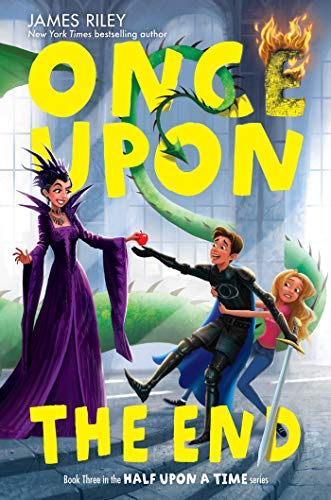
Somewhere earlier during the Once Upon a Time challenge this year, I read Half Upon a Time by James Riley.  I didn’t love it, but it had some intriguing parts to the ending, so I decided to go ahead and plunge into the second and third books in the trilogy.  And I thought I’d better plunge quickly before I forgot the details of the characters and the plot twists!  I didn’t love the later books either, but I do think they improved as they went, and overall I found the trilogy to be a pretty fun ride.

The first book introduced us to Jack, who considers himself more clever than heroic; May, a girl from our world who suddenly landed in Jack’s land of fairy tales; and Philip, a very proper handsome prince.  The second book, Twice Upon a Time, opens with the three of them searching for answers about May’s past, and for a way to defeat the Wicked Queen.  Their quest takes them to the Fairy Homeland (which has fallen under a Sleeping Beauty-style curse, thorns and all), into a slightly twisted Neverland, onto Blackbeard’s ship and under the sea, searching for a little mermaid.
As you can tell, this followed the style of the first book, mashing together familiar fairy tales and classic fantasy.  Riley mostly doesn’t retell stories–instead he takes the characters and gives them a new slant, or explores what might have happened to them after the traditional story ended.  Things get a little convoluted in the process, but there are some clever (and funny!) twists as a result.

The plot was entertaining, although at times I felt we were drifting pretty far from the main conflict, the fight with the Wicked Queen.  However, each individual adventure is pretty cool, so as long as you roll with it a bit, it works!

The third book, Once Upon the End, brings the Wicked Queen back to the center of the story.  There are fewer mashed together fairy tales (though we do get quite a bit of “Jack and the Beanstalk”), with the focus much more on Jack, May and Philip, and some very hard choices they each have to make about if, and how, they’re going to take a stand against the Wicked Queen.

That brings me nicely to why I think these books improved throughout the trilogy–the characters.  My main reservation on the first one was that the characters just didn’t grab me, feeling like basic fairy tale archetypes (even may as the “spunky princess”).  Fortunately, they gained more depth.  Philip was the one I most disappointed by, and he had the most satisfying growth.  He stayed the proper prince–but we got into the conflict of how hard it could be to always be noble and honorable and honest and good.  And what happens when two noble causes conflict, or the greater good requires a dishonorable act.

Jack got more interesting too, as he went on what was essentially a hero’s journey, finding his skills and his strength.  This was particularly apparent in the third book, where circumstances at one point make it very clear how far he’s come.

May, I am sorry to say, got more obnoxious in the second book, or so it felt to me.  However, she reined that back a bit in the third book, and went through some more complex character growth around who she can trust, and how to protect her friends.

The third book also gave us Penelope, also known as Sleeping Beauty.  And she was amazing!  She uses cursed spindle splinters as weapons!  And she gives Philip a stern lecture on how sometimes, he just needs to back off and let her handle things because she has a plan and he is not helping by swinging his sword around.  Penelope was not in this book enough, and I want another one about her.

I think this trilogy rides somewhere in between Middle Grade and Young Adult–the characters are sixteen which seems to imply YA, but the style feels a bit more Middle Grade.  A little lighter and a little simpler–so if you enjoy that, and fairy tale mash-ups, and are willing to ride with a little randomness…then this is just the trilogy for you!

Author’s Site: http://james-riley-author.tumblr.com/

Other reviews:
Best Kids’ Reads
Carstairs Considers
Michelle I. Mason
Anyone else?

Buy it here: Twice Upon a Time and Once Upon the End

Jack the Giant-Killer, in Urban Fantasy

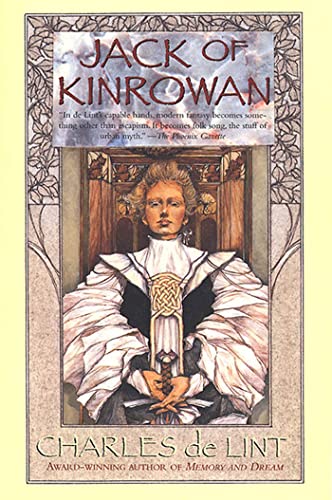
Katy from A Library Mama recently guest posted about her favorite fairy tale retellings, and I was delighted to hear about a Jack the Giant-Killer retelling from Charles de Lint.  That one went straight on my list!  The only copy the library had was an omnibus, Jack of Kinrowan, which combines Jack the Giant-Killer and its sequel, Drink Down the Moon…so naturally I wound up reading them both!  Perfect for Once Upon a Time.  My favorite de Lint tends to be his urban fantasies, and these were classic examples.

Jacky Rowan, midway through a personal crisis, stumbles on a gang of supernatural bikers, the modern-day Wild Hunt.  Jacky finds herself on the fringes of Faerie, a world of hobs and goblins existing invisibly side-by-side with the mortal world.  There are deep troubles in Faerie, with the Unseelie Court growing in strength, fed by mortal man’s belief in the darker side of stories.  Jacky impetuously volunteers to help…and once you’ve seen Faerie–and Faerie has seen you–there’s no turning back.

I have to start by saying how much I love that Jack the Giant-Killer is a girl!  Jacky is promptly accepted by the denizens of Faerie as a Jack, a wily trickster; the designation is part role, part title and part birthright, but gender doesn’t seem to make a bit of difference.  Jacky is believable as someone who is both out of her depth but trying to rise to the occasion–and generally managing, with a lot of luck to help.  Luck, of course, is a classic feature of any fairy tale Jack.

If there’s anything I found less believable, it was Jacky’s initial plunge into the situation.  There were moments early on when she still could have walked away, and I don’t know that I ever quite understood why she didn’t.  She was having a personal crisis and trying to prove something, but all the same…  Still, that was a bump early in the book, and once I accepted she was in the situation, the rest of the book rolled along just fine.

Jacky is joined in her plunge into Faerie by her best friend, Kate Hazel (or Crackernuts, which also has folklore origins).  We saw in Blue Girl that de Lint has a flair for presenting stories of strong friendships, and this is another good one.  There was a little romance around the edges, but the friendships were the central relationships of the story.

I’ve read a few other de Lint urban fantasies, and this has much the same feel–which I mean as a compliment!  He has a real skill for bringing magical creatures into the modern world, fitting them into the crevices and dark shadows of an urban landscape, and still keeping a fascinating otherness to them.  I’ve never been good at defining the difference between folklore and fairy tale, but de Lint seems to be drawing from the folklore side of things.  His magic is tied to nature and the land, to old traditions and ancestral memory.  No sparkles and little pixies here!

Drink Down the Moon follows closely from Jack the Giant-Killer, bringing back Jacky and Kate and introducing a few new characters too.  The threat-level rises admirably, matching Jacky and Kate’s growing ability–but they’re still new enough to Faerie that a fair bit of scrambling goes on to confront the crisis.  The second book also brings in more musical elements, which seem to be common in de Lint’s magical stories.  If you ever meet a fiddler in a de Lint book, they are probably not what they seem!

I would recommend this as a good book(s) for someone not familiar with de Lint.  Neither book taken alone is very long (about 200 pages in my edition, though it was small print), and they feel like a good introduction to de Lint’s world.  Many of his urban fantasies connect together in a loose web, with characters appearing here and there (a bit like Discworld).  These two are pretty much independent; all I spotted was a couple passing references to musicians or folklore experts whose names I recognized from other books.  If you haven’t read de Lint’s other books, I don’t think you’ll ever feel like you’re missing something!

Author’s Site: http://www.sfsite.com/charlesdelint/

Other reviews:
Black Gate
Keifus Writes
Random Reading
Anyone else?

Buy it here: Jack of Kinrowan: Jack the Giant-Killer and Drink Down the Moon

Alchemy and Meggy Swann

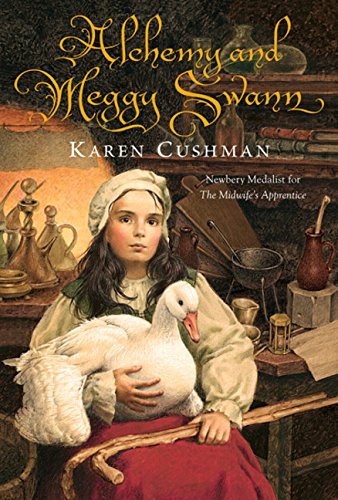
I rarely pick a paper book up randomly anymore, but I do browse for audiobooks sometimes.  That’s how I landed on Alchemy and Meggy Swann, because it’s by Karen Cushman and I thought that was a good indicator.  And then after I had checked it out, I discovered it was being read by Katherine Kellgren–which would have sold me on it anyway!  This also is a nice pick for my largely-ignored goal this year to read more historical fiction.
Meggy comes to London in the mid-1500s, summoned by a father she’s never known.  Master Ambrose is an alchemist, consumed by his “great work,” who had hoped for an able son to help him.  Besides being female, Meggy is crippled from birth, only able to walk with the aid of two sticks.  Ignored by her father, Meggy has to find her own place in the loud, sprawling city of London.

Meggy goes through an excellent evolution throughout the book.  As it begins, she’s sympathetic but not very likable.  No one (except her grandmother) has ever been kind to her, and she meets the world now “with her fists up,” ready to give as good as she gets.  She gradually softens, as small acts of kindness back and forth build up tentative friendships with a few people around her.  She loses her fierce anger, while gaining self-confidence and appreciation for her own worth.

One of Meggy’s first friends is Roger, her father’s former apprentice who has now joined a theatre company.  Meggy is not eager to be friends and he’s perfectly willing to spar back.  The range and creativity of the insults they exchange would make Shakespeare proud!

Meggy’s character arc was the part that really seized me, but there’s also a bit of a conspiracy plotline, and a lot of good historical information too.  This isn’t built around any major historical events, but the atmosphere of 1500s London is very strong, with the crooked streets, the crowds, and of course–the stenches!  Like Cushman’s best-known book, Catherine Called Birdy, this one never skimps on the dirtier side of life in the past.  There’s a lot on alchemy too, and the quest for the Philosopher’s Stone.  I don’t have a lot of scientific knowledge, but I knew enough to know where the alchemist was going wrong in his interpretation of what his experiments told him.  It was interesting to see what learned men of the day thought they knew–and to wonder what people 500 years from now will think of our science!

This was a very engaging book and, almost needless to say, Katherine Kellgren’s reading was as excellent as ever.  I now want to read more Cushman books!  A reread of The Midwife’s Apprentice, I think, and I’ve been meaning to read Will Sparrow’s Road…which should be good for that historical fiction reading goal…

Author’s Site:

home

Other reviews:
Finding Wonderland
Ana Mardoll’s Ramblings
Book Aunt
Anyone else?

Buy it here: Alchemy and Meggy Swann

The Ozma Trilogy

You may remember I was reading my way through L. Frank Baum’s Oz series, reviewing in batches along the way.  You may remember, but I forgot for a few months that I never reviewed the last three!  So today I’m finally returning back to Oz to wrap that up…

I had to think quite a bit to find a common thread between the final three, and finally realized that the connection was Ozma—though not in quite the same way for each. (You would think Ozma of Oz would be part my Ozma Trilogy, but that’s really a Dorothy and the Nome King adventure.)  These three all have Ozma as a driving force of the story, in one way or another…

**************

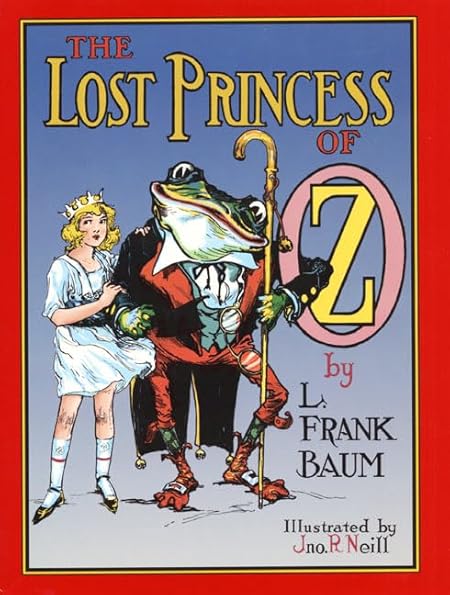
The Lost Princess of Oz has one of the most effective plots for putting something genuine at stake. Ozma has been kidnapped, the same day that many of the most powerful magical objects in Oz have gone missing. Handicapped though they are by their lack of tools, the characters set out in search of their beloved princess. Meanwhile in a far-corner of Oz, Cayke the Cookie Cook has been robbed of her diamond-encrusted dishpan, and sets off with the Frogman in search of it. Naturally all the events eventually tie together…
I’m inclined to think that Baum noticed his characters were growing too powerful (see the conclusion of Rinkitink in Oz), and in this book he takes steps to give them genuine obstacles. As a result, we get a true crisis, with real danger and a villain who could inflict actual harm. It never gets very dark—this is Oz after all—but a plot is more exciting when the characters have something to lose.

The Frogman is also a particularly interesting new character. He’s been ruling the Yips, who believe him to be wonderfully wise. He realizes all the time, however, that his wisdom is just an act.  This becomes a problem for him when he accidentally swims in the Truth Pond, forcing him to always tell the truth in the future. Though it’s treated fairly lightly, it creates an unusually complex problem for the world of Oz.

Ozma’s search party encounters some marvelously whimsical cities along the way, and finally encounters a villain with some real menace to him. This book also features one of the largest roles for Toto, who is here worrying about his missing growl, and wondering if it was stolen with everything else.

****************

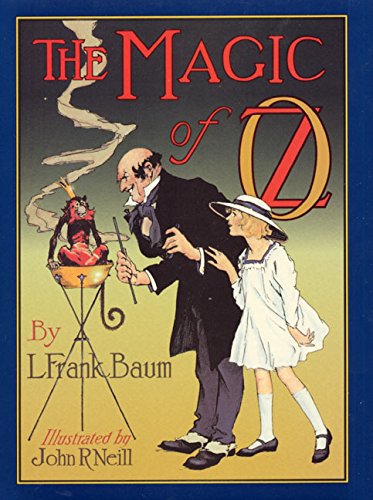
The Magic of Oz ostensibly centers on a search for birthday gifts for Ozma (earning it its spot in my Ozma Trilogy), but swiftly develops into more dramatic crises. Trot and Cap’n Bill’s search for a gift causes them to be trapped on a magic island, slowly shrinking away to nothing. Meanwhile the deposed Nome King is back to stir up trouble, joining forces with Kiki Aru, a Munchkin boy who stumbled on the ability to transform himself and others into creatures of his choice. They attempt to rally the animals to attack the Emerald City, and inflict transformations on many characters.

I enjoyed the return of an old villain with new power, and the Nome King’s attempt to conquer Oz this time is far more interesting than his previous one (where he pretty much gathered an army and marched). I always enjoy Trot and Cap’n Bill, and I think it may be because they actually worry. Dorothy is downright Pollyanna-like in her good cheer, while Trot gets into real danger at times and knows it, giving the reader a reason to care.

This installment also offers one of my favorite pieces of whimsical Baum magic, in the form of the magic flower, which is constantly in bloom in an ever-varying succession of different kinds of flowers.

************

The final book in the series, Glinda of Oz, finally gives a starring role to a significant character usually on the sidelines. Not, as you might expect, Glinda—but rather, Ozma. She’s played an important role in other books, but this one gets her out of her palace and into the active role of heroine.

Ozma and Dorothy go to visit Glinda, and in her magical record book they read about a war happening in a far-off corner of Oz, between the Flatheads and the Skeezers.  As ruler of Oz, Ozma decides it is her duty to make sure all the people of Oz are happy, and therefore she must set off to stop this war. That’s all well and good, though I’m at a bit of a loss to understand why she has to go alone, with only Dorothy to accompany her! (Plot reasons, no doubt.)  The girls first visit the mountain of the Flatheads (who have flat heads, and carry their brains in jars—really!) and then go on to the island city of the Skeezers. When the city’s ruler submerges the island, Dorothy and Ozma are trapped within, and the rest of their friends, led by Glinda, must come to the rescue.

This book gives us more of Baum’s wild and whimsical cities. I suspect that Oz is sparsely populated in sections solely so that he could keep having the characters run across new, strange communities! Between the weirdness of the Flatheads and the fairy tale-like nature of three enchanted fish in the Skeezers’ lake, we get some of Baum’s magic at its most entertaining.

The book also succeeds where others have faltered (I don’t quite like to say “failed”) by giving the characters real dangers. Ozma and Dorothy aren’t likely to die, but they are very seriously inconvenienced by the submerged city, and there’s at least a hint of real danger from the Flatheads too.

If this book falters anywhere, it’s in Ozma herself. She’s so very well-meaning, but there’s still something problematic about her rulership of Oz. The Flatheads and the Skeezers have never heard of her, yet she insists on her right to rule them—insists it sweetly, of course. Baum has unfortunately set Ozma up as a hereditary dictator, as far as I can tell. Because she’s so kind and sweet and concerned for her people, it all works out…but I can’t help being bothered all the same!

***********

Sometimes when it’s been a very long time since I read something, I reach the point where I feel like I can’t really have an opinion on it anymore.  I don’t remember it well enough, or I don’t know how present-day-me’s opinion would compare with long-ago-me’s opinion. I had reached that point with Oz, so I’m glad to have gone through the entire series, so that I can comment on them again!

The 14 books unquestionably vary in quality, and even the best aren’t without flaws (which my younger self probably didn’t notice). But—with that said—these are still, by and large, delightfully whimsical classic fantasy. Baum’s strength is in weird and wonderful magical creatures, and some of his creations stayed with me through all those years I wasn’t reading the books.

Apart from the later books including characters introduced earlier, these books are largely self-contained. They’re fun to read in order, but once you’ve read the first three (which introduce most of the major characters) you could pretty easily get away with jumping around. Just in case you want my opinion on the matter, here’s my ranking of the books by quality… (with series order after the title)

  1. Ozma of Oz (3)
  2. Scarecrow of Oz (9)
  3. Rinkitink in Oz (10)
  4. The Land of Oz (2)
  5. The Magic of Oz (13)
  6. The Lost Princess of Oz (11)
  7. The Wizard of Oz (1)
  8. Tik-Tok of Oz (8)
  9. Patchwork Girl of Oz (7)
  10. Glinda of Oz (14)
  11. The Tin Woodman of Oz (12)
  12. Dorothy and the Wizard in Oz (4)
  13. The Road to Oz (5)
  14. The Emerald City of Oz (6)

This is, of course, highly subjective…so if you’ve read any of the series, I’d love to hear your favorites too!