A Magical Wall, and Magical Books

There are some definite Types of fantasy books–for instance, ordinary kids finding a magical item/creature, and then coping with the inevitable chaos that results.  Having read two books like that recently, I thought a combined review was in order!
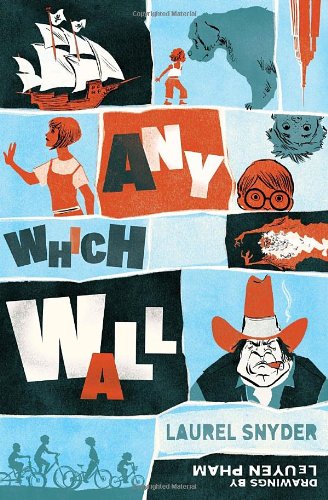
Any Which Wall by Laurel Snyder features one of the odder magical items I’ve seen–a magical wall.  Henry, Emma, Roy and Susan (two sets of siblings) find the Wall out in a cornfield, and discover that they can use it to wish themselves to any other wall.  They find their way into adventures with Merlin, pirates and cowboys, though nothing is ever quite what they expect.

This is a clear descendent of the Edward Eager books–even including some references back (which is particularly fun because Eager always included references to his inspiration, E. Nesbit).  It’s a light book with somewhat low-key adventures, good for a younger reading audience.  Nothing is ever too scary or too big a disaster, though the kids do encounter plenty of things that don’t go as they anticipate.  That may be my favorite part, as they find out that their ideas of history are not carried out by the reality.

I did think there were a couple of lost opportunities where a little more danger and tension could have been pursued.  Their first encounter Guinevere sets her up as seriously creepy…and then that never goes anywhere.  I also thought they took the convenience of the magic a bit for granted.  The first time they use the magic to leave their own town, they don’t have any evidence about how the magic works to get back.  It turns out they can leave by the wall they came by, so to speak, but they hadn’t tested that before landing in Camelot–and the whole thing seemed much riskier to me than it did to any of them!

I have a feeling I would have liked this a lot as a kid.  As an adult, I wanted a little bit more…but maybe that wouldn’t have been right for the book after all!  And for the Type of book it is, it’s excellent.  The kids are likable, the adventures are fun, and they learn some good if not terribly complex lessons in the process of the magic adventures.

There’s also something I like about visiting Anytown in Anytime.  All these magical-item stories seem to be set in the same nice little town where kids ride bikes in the summer (except when they’re set in London), in a vague time period.  This one was more modern than Eager’s books; I think I remember a cell phone or two.  You know what really made it seem modern though?  At one point a father was preparing dinner.  I feel like that wouldn’t have happened in a book fifty years ago… 🙂
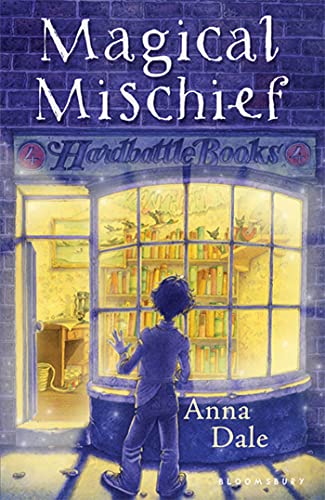
Magical Mischief by Anna Dale takes some twists on the usual Type.  It’s set in a city in England (though not actually London) and centers around a magical bookshop.  Magic takes up residence in Hardbattle Books, and despite the inconvenience (and the smell), Mr. Hardbattle doesn’t have the heart to force it out.  But it’s bad for business and rent is due, so he has to find a new home for it.  He joins forces with Arthur Goodenough, a boy just looking for somewhere quiet to do his homework, and Miss Quint, who’s mostly in search of company.

The magic here has some particularly entertaining features, like bringing a stuffed elephant and the black cat bookends to life, or turning one of the steps on the stairs into custard when it’s feeling rebellious.  Or there’s the pushpins that dance around and occasionally attack…  It also grants wishes in an unpredictable fashion, spurring my favorite thread of the book–Miss Quint gets lonely, and starts wishing characters out of their books.

Now–if you found out you could do that, I bet most of you know exactly what characters you’d bring out for a tea party, right?  I would know!  Miss Quint, on the other hand, picks up books at random and looks for interesting people, which seems like rather a waste of an opportunity.  However, the plot goes in exciting directions because of it, so I’ll forgive her…mostly.  Especially because her random choices brings out Susan, a girl whose only role in her book was to wait by the swings, but in the real world she grows into so much more.  I loved watching her development as a person.

This book has some good humor in it, and a more focused plot.  It’s also unusual to see a kids book with two adults as major characters; Mr. Hardbattle and Miss Quint were both distinctive and engaging.

If you like a particular Type of fantasy book, I would recommend either of these two! 🙂

Authors’ Sites:
http://laurelsnyder.com/
http://annadaleauthor.com/

Other reviews:

Any Which Wall
Charlotte’s Library (where I found out about both books, thank you!)
Jen Robinson’s Book Page
Reading Kids Are Dreaming Kids

Magical Mischief
Charlotte’s Library
Midleton and Fermoy Books

Anyone else?

Buy them here: Any Which Wall and Magical Mischief

The Secret Side of Empty by Maria E. Andreu

Life seems to be perfect for M. T. in her senior year of high school–she’s a straight-A student who enjoys her classes, she has a great best friend she’s known since childhood, and there’s a cute boy interested in her.  But M. T. has a secret.  Her family is from Argentina, and they came into the United States illegally when M. T. was six.  As high school graduation approaches, M. T. feels trapped with no future–unable to go on to college, get a job, or even get a driver’s license.  With well-meaning pressure from friends, trouble at home, and a dearth of options, M. T.’s life begins to unravel.
The Secret Side of Empty by Maria E. Andreu was a departure from my typical fantasy and sci fi, but it’s about a real life situation I’m particularly drawn to.  My mom is an immigration attorney, so while I’m no expert myself, I’ve absorbed a fair bit on the subject.  M. T.’s story felt tragically real to me, a very accurate picture of the situation illegal immigrants can find themselves in.

This book deals with a lot of heavy issues.  The immigration is the core, but there are also boyfriend and academic problems, and the more serious topics of domestic abuse and suicide.  In some ways this is a huge amount for one book, but Andreu balances it very deftly by keeping everything circling around the immigration issue.  M. T.’s trapped feelings prompt her academic problems, and her father’s trapped feelings prompt the domestic abuse.  That escalates in part because M. T. and her mother are afraid to call the police…because they expect they would be deported.

M. T.’s narration of the story provides a strong, natural-sounding voice that contributes to making such a heavy book work so well.  The subject matter is heavy but the writing isn’t dense, and while the topics are hard, the reading itself is easy.  M. T.’s voice propels us through the story.

The immigration issue is clearly the center of this book, but the themes are universal as well.  That feels slightly contradictory, to say it’s all about immigration but it’s not…!  I think I mean that M. T.’s fear of the future, her keeping of secrets, her struggles with family and friends and finding a place in the world, are universal…even if the immigration issue is at the center of her particular struggle.

I wasn’t surprised when I got to the author’s note at the end of the book and Andreu explained that she grew up as an illegal immigrant too.  This is clearly a deeply personal, very real book.  I’m glad to know that her immigration story had a happy ending–and I’m glad she ended M. T.’s story on a hopeful note too!

Author’s Site: http://mariaeandreu.com/

Buy it here: The Secret Side of Empty

Disclaimer: I received an advance copy of this novel in exchange for an honest review.

Chrestomanci as Deus Ex Machina–sort of

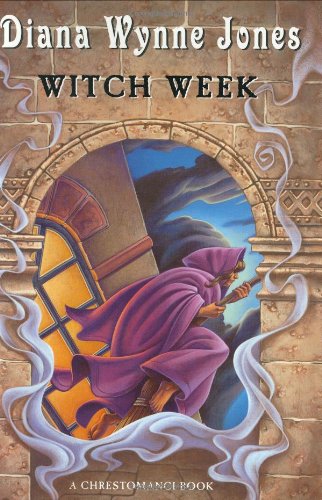
I’ve continued my chronological reread of Diana Wynne Jones’ Chrestomanci series with Witch Week, where the enchanter Chrestomanci plays a supporting (and somewhat deus ex machina) role.  But on the other hand, can his convenient arrival really be considered out of place if he’s the main character of the series?
Witch Week is the most independent book of the series.  Set in an alternate England where witches (with real magic) are hunted, arrested and burned, several children at a rather awful boarding school each come to realize that they have magic.  Their experiments and mishaps create escalating chaos until they’re in real danger of their lives…but fortunately they find a spell to summon Chrestomanci to their aid to unravel a problem of alternate worlds and mistakes in history.

I think this may be the first Diana Wynne Jones book I ever read, long ago before I ever knew it was part of a series.  I also think it was my first encounter with a reference to Guy Fawkes–and incidentally, when you don’t know who he is, you lose some of the impact of finding out that he successfully blew up Parliament in this world!

Witch Week is essentially a boarding school story with a bullying thread and a magical twist.  We get into the heads of several of the children, and Jones paints wonderful portraits of believable, complex individuals.  Charles and Nan stood out the most for me.  Charles is generally disliked in school, but mostly left alone because of the power of his evil eye glare.  Jones successfully makes him sympathetic, even though he really does mean that evil eye glare.  When he finds out he has magic, he’s perfectly willing to turn it on his enemies (with disastrous and often hilarious consequences).  I think I enjoy Charles because, much as I also like Jones’ typical earnest, well-meaning boy-hero, it’s fun to get one who isn’t well-meaning!

Nan is also a victim of the bullies, who are all too willing to accuse her of being a witch.  When she finds out she really does have magic, she’s completely surprised by the jolt of confidence it gives her–not because she does anything with it, but just by knowing that about herself.

Chrestomanci’s arrival towards the end of the book should have deus ex machina written all over it, but Jones manages more skillfully than that.  Chrestomanci does organize things towards their conclusion, but the children still play such an integral role that he doesn’t take over the narrative too badly.  And besides, if he’s really the main character of the series, perhaps he’s just asserting his proper place in things?

A note on the ending in white text to avoid spoilers…  If you’ve read the book, you know that the final conclusion completely alters the children’s lives, pasts and memories.  As far as I can recall, I always accepted the ending on previous reads; this time it struck me as rather an unaddressed tragedy.  Even if their lives are made objectively better, they still had to lose the people they had been through their previous experiences.  It’s like dying to allow another version of yourself to live, which seems like a major existential question that is ignored.  But I suppose we have Doctor Who for that discussion…

I think you could do worse than to start the series here, because it’s so independent of the others.  Although knowing who Guy Fawkes (and Chrestomanci!) are would probably add to the book.  🙂  In any order, this is another fun read, with a more bleak setting but a lot of humor and excitement to set against the gray background.

Author’s Site: http://www.dianawynnejones.com/

Other reviews:
Reading the End
Readers By Night
Just Book Reading
Anyone else?

Buy it here: Witch Week

If History Was Different…

I read The Explosionist by Jenny Davidson so long ago that pretty much all I remembered was that it was set in an alternate history, and there was a sequel I always meant to read.  Clearly a reread was in order before going to that sequel!

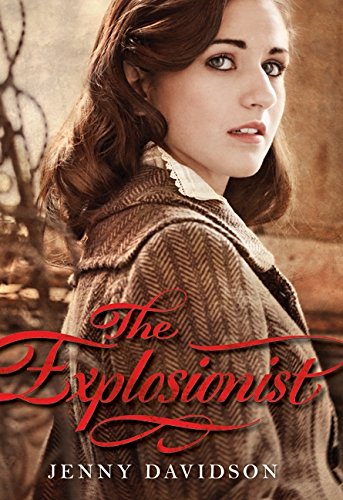
The Explosionist is set in Scotland in 1938–but this is an alternate history, where Napoleon won at Waterloo.  The Northern countries of Scotland, Scandinavia and Russia have united in the New Hanseatic League, in uneasy peace with a united but oppressive Europe.  Sophie Hunter is 15, an orphan raised by her Great-Aunt Tabitha after her parents died in an explosion at a dynamite factory.  Her world begins to unravel with terrorist bombs near her school, an unsettling encounter with a ghost through a medium who is later murdered, and hints of something sinister about IRLYNs (pronounced “Irons”), a patriotic training program for young women.

Sophie is a wonderful portrait of a very intelligent, slightly naive girl who is well-meaning yet often conflicted about what’s best.  She felt very fifteen somehow, just old enough to grasp the magnitude of the conspiracy she begins to uncover, but young enough to still think she can somehow handle it herself–with her best friend, Mikael.  There’s an intriguing thread through the book about the benefit or harm of strong emotions.  Sophie herself is a committed rationalist, who believes that doing away with extreme emotions would be all to the best…though she can’t quite manage it!

This book is part boarding school story, part murder mystery, part conspiracy theory, and part ghost story as Sophie discovers an ability to speak with the recently-dead.  All those pieces somehow balance together, creating an intriguing mystery with a series of surprises and turns.

The alternate history of it all creates some fascinating touches.  The overarching changes to history and government are intriguing, though the small details may be even more fun (if a little silly!)  Many people famous in our own history are famous in Sophie’s world–but for very different reasons, like Freud the radio host, or Einstein the poet…

By the way, I hate this cover–it has none of the character of the first one!

The Explosionist ends with a big shift and a lot of questions still wide open, which is how it stuck in my mind that I needed to read the sequel, Invisible Things.  (Some minor spoilers for the first book to follow.)  The sequel sees Sophie in Denmark with her friend Mikael’s family, volunteering at a scientific facility headed by Niels Bohr where nuclear fission is a hot new topic.  Europe and the New Hanseatic League are rushing ever closer towards open war, while Sophie begins to uncover new truths about her family’s past.  Halfway through the book, we see an abrupt shift with a terrorist attack (using a gas that alters Mikael’s personality), a new villain, and a quest for Sophie.

I enjoyed The Explosionist a lot, but I’m not sure how to feel about Invisible Things.  Sophie, Mikael and all the rest are still likable and compelling characters.  The premise and the alternate history are still fascinating.  But while the first book had a busy and carefully balanced plot, this book feels like it lost its balance somehow.

Sophie has a very passive role for the first half of the book; there are revelations a-plenty, but Sophie herself doesn’t actually do much.  The stakes get higher and so does the interest level in the second half of the book…but that part also seems like a big departure from everything that came before, and begins to strain credulity a bit in certain ways.  The last portion of the book is a “Snow Queen” retelling, which is a cool idea–yet feels forced in places.

It’s unfortunate, because there are a lot of great pieces in here…they just fit together a little awkwardly.  Still, it was worth the read to find out the answers to some of the mysteries left by the first book, and to see the continuing development of Sophie’s story.  If you like historical fiction with a little fantasy thrown in, or enjoy slightly spooky conspiracies, these books are a fun read!

Other reviews:
Bib-Laura-graphy
Bookshelves of Doom
Frenetic Reader
Anyone else?

Buy them here: The Explosionist and Invisible Things

The Last Battle for Narnia

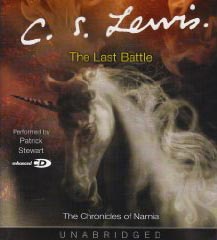
Last BattleI recently finished my voyage through Narnia on audiobook by listening to The Last Battle.  I began with an exciting narrator, Kenneth Branagh reading The Magician’s Nephew, and finished with another exciting one–Patrick Stewart!  And he was excellent, especially in some of the more exciting moments.

The Last Battle is a decidedly odd installment in the series.  It opens many generations after Caspian and Rillian of the previous book, with King Tirian, “the last king of Narnia.”  In the North, a crafty ape and misguided donkey set up a false Aslan to control the Narnians.  They form an alliance with the foreign Calormens, fell the trees and make plans to enslave Narnia’s people and talking animals.  Tirian tries to stand against them, and is soon joined by Eustace and Jill, sent from our world to help.

The book is much grimmer than the previous ones.  That’s not immediately apparent, but as the book goes on it becomes an increasingly desperate struggle against lengthening odds.  There is ultimately a victory, of a sort, but only on a cosmic level.

And that’s why I’m not sure how to feel about this one.  The end ultimately has a very positive feel to it…but it also renders the struggles of the first half of the book somewhat pointless.  The whole world of Narnia is highly symbolic, of course; I think this may be the one installment where Lewis’ symbolism overwhelmed the adventure aspect of the book.  I didn’t dislike the symbolic, cosmic-level side of the book, and Lewis actually did quite nicely with making eternity seem rather homey–and grand and immense at the same time.  All the same, it sits a little awkwardly next to the adventure side.

I am not entirely sure I’m making sense here, so on to other aspects!

The portrayal of the Calormen is a bit complicated here.  They weren’t exactly nice in The Horse and His Boy, but they somehow become worse here, maybe because there’s a new sense that they’re inherently villainous in some way.  Which is all well and good if Lewis wants inherently villainous Calormen; it becomes more troubling when you figure that, symbolically, Calormen are not really Calormen.  However–Lewis does something to redeem that aspect by giving us one Calormen soldier, who is a devoted servant of wicked Tash but still a good person and still comes into Aslan’s Country.  Aslan ends up telling him, essentially, that good is still good and evil is still evil, no matter whose name you’re doing it in.  It’s a simple message on a complex subject, but as a simple message it’s a nice, open-minded touch.

The question of Susan is another troubling one.  Even if she is a bit of a wet blanket, I’ve always felt bad for her in this book!  Here’s a case where Lewis’ symbolism is probably too vague; I find it hard to know exactly what barred Susan in the end (is it really a love of make-up, or is that symbolic?) so I don’t know quite how bothered to be.  I like to think, though, that the tragedy she experiences (rather off-stage) inspires some new depths of character, and that she eventually comes to Aslan’s Country too.

Enough deep and grim discussion, so I’ll wind up with three more amusing notes.

All the discussion of places within places in this book, many of them bigger on the inside, led me to wonder if Lewis’ wardrobe (a wooden box, you know) with an entire world inside of it might have been an inspiration for a police box that is also bigger on the inside.

I recently rewatched the Lord of the Rings trilogy, and that juxtaposition has made me want to mix things together a bit…and after all, who’s to say that the Undying Lands aren’t an offshoot of Aslan’s Country?  (Well, Tolkien and Lewis could say they aren’t, but I rather like the idea!)

And finally, my favorite moment from the very end of The Last Battle (a bit of a spoiler), is when all the long-dead characters of the series reunite (including my favorite, Mr. Tumnus!) and laugh over old jokes together.  Because really–what good is a heaven if you can’t enjoy old jokes there?

Having now finished the entire Narnia series, I can definitely say that The Magician’s Nephew and The Voyage of the Dawn Treader are my particular favorites, probably because they have the most appealing characters and visit the most interesting places.  All the books are good and the entire series is well-worth exploring.  Even if The Last Battle is more grim, it does serve to put a nice punctuation on the series.

Author’s Site: https://www.cslewis.com

Other reviews:
The Bookworm Chronicles
Life with Books & Movies
Stray Thoughts
My Head Is Full of Books
Anyone else?

Buy it here: The Last Battle