Returning from Ventures in Fairylands…

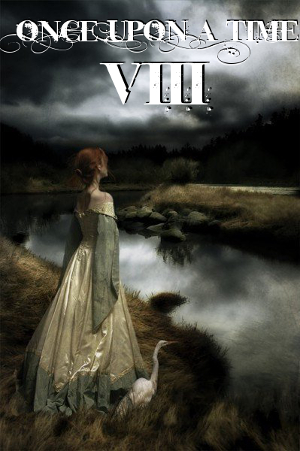
onceup8300Already the end of spring is here…and that means the end of the delightful reading challenge, Once Upon a Time, hosted by Carl at Stainless Steel Droppings.  At least, the end for this year!

I had very vague goals this time around, hoping only to read more fairy tale retellings and to clear out some of the fantasy books that have languished on my To Be Read list for the longest.

So how did things go? Continue reading “Returning from Ventures in Fairylands…”

Classics Club June Meme: Racism in Classics

June Meme


I’m not actually a member of The Classics Club (whose members pledge to read 50 classics in 5 years), but I saw the June Meme question recently on Jessica’s blog.  I started to comment…and realized I had so much to say that I had better write my own post!

For an example of a classic with racism in it, Tarzan of the Apes by Edgar Rice Burroughs came pretty immediately to mind.  The first book is a classic, though I’ll talk about the rest of the series in the discussion as well.   Throughout the series, the overall portrayal of the African natives is both negative and stereotyped (and probably contributed to later stereotypes…), and there are overt comments describing them as inferior to the white man.

Interestingly, Burroughs does make an exception for one African tribe, the Waziri, who Tarzan allies himself with.  It’s still troubling in that they make the lone white man, Tarzan, into their chief, but they are at least portrayed as intelligent, valiant and strong warriors.  (And just to make things more complicated, in Burroughs’ Mars books, the black Martians are secretly controlling all the other races, and John Carter, while remarking that it’s a strange thing for him to say as a Virginian, comments on the beauty of their dark skin.)

But the positive potrayals really don’t do much besides complicating matters, and the negative portrayals are clear, abundant and deeply unfortunate.  There are two reasons that I personally feel like I can still enjoy these books in spite of that.

First, I think that in general, books have to be taken for their time period.  That’s not to say that the racism is acceptable, but we also can’t reasonably expect a past author to have modern values.  I tend to say this about Shakespeare too (usually while discussing The Taming of the Shrew!)  The people and the books are a product of their times, and have to be taken as such.  For that matter, our reactions are a product of our time too!

Second, and this is equally crucial or more so, I don’t feel like the racism is a core part of the Tarzan books.  The racism is fully apparent, but it always felt to me like a sidenote.  The focus of the series is on Tarzan, the struggles in the jungle, his efforts to rescue the frequently-kidnapped Jane, or to explore one of Burroughs’ many lost cities (which seem to crop up all over Burroughs’ Africa).  The strengths of the book carry through into the present and are just as appealing now.

I want to talk about two of the later books in the series as different examples (and together they make quite a good story too…)  Book Seven, Tarzan the Untamed, was written during World War I and is very anti-German. Burroughs planned to have a German officer kill Jane (although his publishers saved her life by talking him out of it!)  After the war, some of the Tarzan books were translated into German and became wildly popular…until someone, without authorization, translated Tarzan the Untamed.  Burroughs wound up completely blacklisted in Germany, to the point that booksellers were afraid to stock even his other books.

But Burroughs apparently learned nothing from this, because during World War II he wrote Tarzan and the Foreign Legion, which is virulantly anti-Japanese…

Tarzan and the Foreign Legion is an example where I can’t get past the racism and just accept it as a product of the time.  It’s so overt and so integral to the plot that it’s actively uncomfortable to read.  So while in principle I don’t think I can extend morals into the past, there are incidents where, as a modern reader, on an emotional level I can’t enjoy a book with objectionable morals.  It also doesn’t help that, by Book Twenty-two in the Tarzan series, Burroughs was getting formulaic to an extreme, and the book has very little to recommend it anyway.

All of this is, of course, highly subjective.  I can probably get past the racism in one book that someone else would find too uncomfortable, and another person might be bothered less by a different example I can’t handle.

Have you read any Classics with racism in them, and how did it feel to you?

And maybe some other time I’ll do a post about sexism in the Tarzan books…because that could be a whole discussion on its own!

Twice Upon a Time…and Once Upon the End

Somewhere earlier during the Once Upon a Time challenge this year, I read Half Upon a Time by James Riley.  I didn’t love it, but it had some intriguing parts to the ending, so I decided to go ahead and plunge into the second and third books in the trilogy.  And I thought I’d better plunge quickly before I forgot the details of the characters and the plot twists!  I didn’t love the later books either, but I do think they improved as they went, and overall I found the trilogy to be a pretty fun ride.

The first book introduced us to Jack, who considers himself more clever than heroic; May, a girl from our world who suddenly landed in Jack’s land of fairy tales; and Philip, a very proper handsome prince.  The second book, Twice Upon a Time, opens with the three of them searching for answers about May’s past, and for a way to defeat the Wicked Queen.  Their quest takes them to the Fairy Homeland (which has fallen under a Sleeping Beauty-style curse, thorns and all), into a slightly twisted Neverland, onto Blackbeard’s ship and under the sea, searching for a little mermaid.

As you can tell, this followed the style of the first book, mashing together familiar fairy tales and classic fantasy.  Riley mostly doesn’t retell stories–instead he takes the characters and gives them a new slant, or explores what might have happened to them after the traditional story ended.  Things get a little convoluted in the process, but there are some clever (and funny!) twists as a result.

The plot was entertaining, although at times I felt we were drifting pretty far from the main conflict, the fight with the Wicked Queen.  However, each individual adventure is pretty cool, so as long as you roll with it a bit, it works!
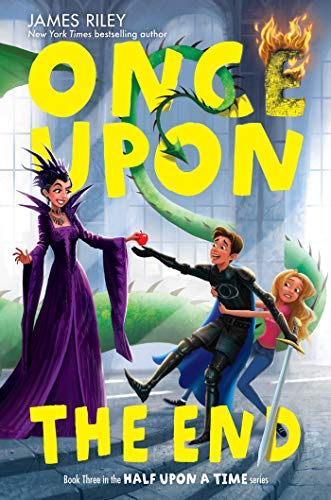
The third book, Once Upon the End, brings the Wicked Queen back to the center of the story.  There are fewer mashed together fairy tales (though we do get quite a bit of “Jack and the Beanstalk”), with the focus much more on Jack, May and Philip, and some very hard choices they each have to make about if, and how, they’re going to take a stand against the Wicked Queen.

That brings me nicely to why I think these books improved throughout the trilogy–the characters.  My main reservation on the first one was that the characters just didn’t grab me, feeling like basic fairy tale archetypes (even may as the “spunky princess”).  Fortunately, they gained more depth.  Philip was the one I most disappointed by, and he had the most satisfying growth.  He stayed the proper prince–but we got into the conflict of how hard it could be to always be noble and honorable and honest and good.  And what happens when two noble causes conflict, or the greater good requires a dishonorable act.

Jack got more interesting too, as he went on what was essentially a hero’s journey, finding his skills and his strength.  This was particularly apparent in the third book, where circumstances at one point make it very clear how far he’s come.

May, I am sorry to say, got more obnoxious in the second book, or so it felt to me.  However, she reined that back a bit in the third book, and went through some more complex character growth around who she can trust, and how to protect her friends.

The third book also gave us Penelope, also known as Sleeping Beauty.  And she was amazing!  She uses cursed spindle splinters as weapons!  And she gives Philip a stern lecture on how sometimes, he just needs to back off and let her handle things because she has a plan and he is not helping by swinging his sword around.  Penelope was not in this book enough, and I want another one about her.

I think this trilogy rides somewhere in between Middle Grade and Young Adult–the characters are sixteen which seems to imply YA, but the style feels a bit more Middle Grade.  A little lighter and a little simpler–so if you enjoy that, and fairy tale mash-ups, and are willing to ride with a little randomness…then this is just the trilogy for you!

Author’s Site: http://james-riley-author.tumblr.com/

Other reviews:
Best Kids’ Reads
Carstairs Considers
Michelle I. Mason
Anyone else?

Buy it here: Twice Upon a Time and Once Upon the End

Blog Hop: What I Want To Know When I “Meet” Your Blog

book blogger hopThis week’s Book Blogger Hop question: When you view someone’s profile, what information do you like to see?

I presume this means blogger profiles… 😉  I would say that when I’m visiting a new blog and clicking over to the About page, I want to see something to tell me what to expect on the blog.  That includes a little sense of the blogger’s personality and perspective, and what kind of posts they typically put up (book reviews, reflections, fiction pieces…?  Oh look, I do all of those!)  For book bloggers specifically, I want to know something about what they like to read, so that I can decide if they’re likely to cover books I’ll be interested in.

I also look for something that may be a little less obvious…I want the story of the blog.  What is this a blog about?  It’s kind of contained in the stuff listed above, but not exactly.  Book blogs are usually straight-forward (it’s about books!), but could be complicated if there’s a more specific focus.  If you’re reading your way through the Newbery winners in alphabetical order, say, it would be nice to have that mentioned!

More often I run into this exploring other kinds of blogs.  I get frustrated when I click onto a random post midway through the life of the blog, find it interesting and get intrigued by vague references that are clearly part of the ongoing discussion…and then can’t find anything on the About page to explain!

For a positive example, I follow a blogger who writes about her adventures as an aspiring actress in New York, with (some) emphasis on dating.  That’s basically the story of her blog, and she makes it really clear in her header and her sidebar.  Without that explanation, I suspect I could easily click on a random post about either an odd job or a bad date, and feel lost on the context.

With an example that does it well, it seems so easy and obvious!  But it is surprising how many blogs will have no About page, or one that really doesn’t explain…well, anything!  And then I don’t know whether to read more posts, because I can’t figure out the story and whether it’s one I want to follow.

And yeah, of course I think of blogs as having a story rather than a topic or a focus or an area.  🙂  I’m a writer–life is a story!

What do you look for in a blogger profile?

Alchemy and Meggy Swann

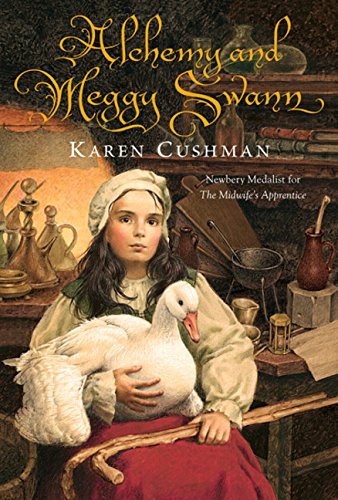
I rarely pick a paper book up randomly anymore, but I do browse for audiobooks sometimes.  That’s how I landed on Alchemy and Meggy Swann, because it’s by Karen Cushman and I thought that was a good indicator.  And then after I had checked it out, I discovered it was being read by Katherine Kellgren–which would have sold me on it anyway!  This also is a nice pick for my largely-ignored goal this year to read more historical fiction.

Meggy comes to London in the mid-1500s, summoned by a father she’s never known.  Master Ambrose is an alchemist, consumed by his “great work,” who had hoped for an able son to help him.  Besides being female, Meggy is crippled from birth, only able to walk with the aid of two sticks.  Ignored by her father, Meggy has to find her own place in the loud, sprawling city of London.

Meggy goes through an excellent evolution throughout the book.  As it begins, she’s sympathetic but not very likable.  No one (except her grandmother) has ever been kind to her, and she meets the world now “with her fists up,” ready to give as good as she gets.  She gradually softens, as small acts of kindness back and forth build up tentative friendships with a few people around her.  She loses her fierce anger, while gaining self-confidence and appreciation for her own worth.

One of Meggy’s first friends is Roger, her father’s former apprentice who has now joined a theatre company.  Meggy is not eager to be friends and he’s perfectly willing to spar back.  The range and creativity of the insults they exchange would make Shakespeare proud!

Meggy’s character arc was the part that really seized me, but there’s also a bit of a conspiracy plotline, and a lot of good historical information too.  This isn’t built around any major historical events, but the atmosphere of 1500s London is very strong, with the crooked streets, the crowds, and of course–the stenches!  Like Cushman’s best-known book, Catherine Called Birdy, this one never skimps on the dirtier side of life in the past.  There’s a lot on alchemy too, and the quest for the Philosopher’s Stone.  I don’t have a lot of scientific knowledge, but I knew enough to know where the alchemist was going wrong in his interpretation of what his experiments told him.  It was interesting to see what learned men of the day thought they knew–and to wonder what people 500 years from now will think of our science!

This was a very engaging book and, almost needless to say, Katherine Kellgren’s reading was as excellent as ever.  I now want to read more Cushman books!  A reread of The Midwife’s Apprentice, I think, and I’ve been meaning to read Will Sparrow’s Road…which should be good for that historical fiction reading goal…

Author’s Site:

home

Other reviews:
Finding Wonderland
Ana Mardoll’s Ramblings
Book Aunt
Anyone else?

Buy it here: Alchemy and Meggy Swann