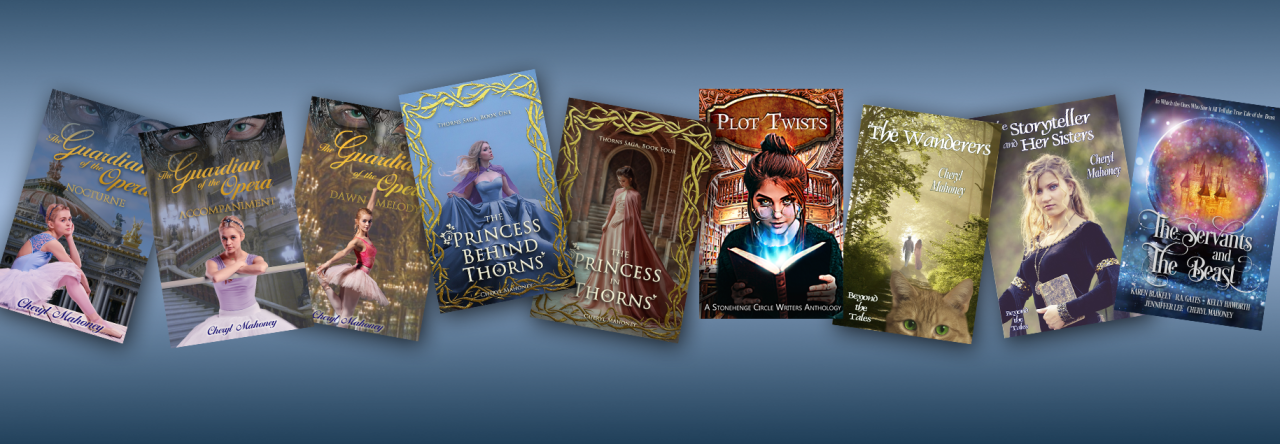
Give Away Results – and Thursday Thoughts on Covers

I’ve mentioned once or twice that I was doing a give away, right?  😉  The period to enter ended yesterday, so today I have results!  And the winner chosen from a metaphorical hat is…

 Emma!

If you didn’t win (or missed entering!) there’s another event coming up later in May to celebrate Children’s Book Week–so stay tuned!

On to the other business of the day…I recently heard about a new-to-me book blogging meme, Thoughtful Thursday, hosted by Reading Is Fun Again.  Similar to the Blog Hop, a book-related discussion question is posted each week.  Here’s today’s question!

Thoughtful Thursday

What features do you like in a book cover? Do you like plain covers? Do you like covers with drawings on them? Do you like covers with photographs on them? Do you like movie-tie in covers?

Well, I gush about pretty covers probably about as much as anyone…Wildwood Dancing and Entwined both come immediately to mind.  But a pretty cover won’t necessarily be right for every book…and mostly this question has led me to think about what I expect from a cover.  Mostly, I use covers to tell me about the genre and the style of the book.  And sure, plot summaries do that too, but as they say, a picture is worth… (I actually don’t think that applies all the time, but that’s a different story!)

I know they say we shouldn’t judge a book by its cover, but I think it works to a point.  Does the cover feature a girl in a Regency-era dress?  (historical fiction!)  Is there a dragon?  Are there pretty fairies?  How about any icons from fairy tales? (fantasy!) Or is there a couple locked in an embrace, possibly with faces obscured but the man’s chest visible?  (and that would be half of the covers in the Romance section…)

So much for genre, which I suppose most books are labeled with anyway–but covers are a fun way to find out!  As to style…if a book has a cartoony cover, I expect it to be lighter than, say, a stark cover with a military symbol (Hunger Games, anyone?)  I will probably expect some romance out of a cover that has a long sweeping skirt somewhere on it, and I definitely expect excitement if there are dragons and swords.  I know covers get it wrong sometimes, especially when it comes to style, but I do think they get it right more often than not.

This is all before I read a book.  After I read the book–then I want accuracy!  In style, of course, but also in the details.  I’m the kind of reader who will notice if the cat’s eyes are the wrong color, or the main character shouldn’t be carrying the sword and the spear at the same time, because of chapter five…and so on.

As to that final question up there, on movie tie-ins–I do have a few books on my shelves with movie tie-in covers, but I’m only willing to buy them if I really liked the movie.  If I disliked the movie, I will always pay more money for the non-tie-in version.

I also tend to be a loyalist about covers.  If I get very attached to a library copy of a book, when I go to buy it sometimes I want that same cover.  Even if I can acknowledge that other covers are more accurate/prettier/etc.  And I can be ruthless about covers.  If I somehow ended up owning a book with a cover I hate, I re-cover paperbacks and get rid of hardback dust jackets.

All right, so much for my rambling cover thoughts!  I’m not sure I exactly answered the question, but I think I covered 😉 the subject.  What do you look for in covers?

And for some cover-related news on my next novel, visit again tomorrow!
Up a Beanstalk and Into a Woods

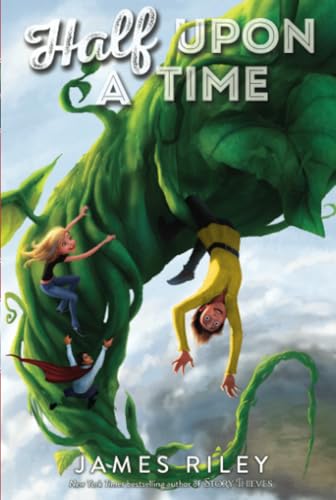
I have been trying to get through my To Be Read List, and trying to believe that I will actually read more fantasy novels than I will add (ha!) during the Once Upon a Time challenge…so I decided to go to the top of the list and read the fantasy novel that had been on there longest.  That turned out to be Half Upon a Time by James Riley, which was on the list since 2010.  On the plus side, the next two books in the trilogy were published in the meantime!

As you can guess from the title, this is a fairy tale-inspired book.  Jack attends a training school for heroes, but his heart isn’t really in it–until a girl falls out of the sky literally at his feet.  May insists she isn’t a princess, but when she’s wearing a t-shirt that says “Punk Princess,” how can there be any doubt?  Soon the two are on a quest to find May’s abducted grandmother, who just might be the long-missing Snow White.  With the Huntsman on their trail, they fight a giant and a witch in a candy cottage, make an alliance with Prince Philip and a more uneasy one with the Wolf King, and try to find the magic mirror that may have a clue to locating Snow White and defeating the Wicked Queen.

This is another “throw lots of fairy tales together!” book, but I thought it worked quite well.  Since Jack and May are traveling on a quest, it felt natural that they keep bumping into new fairy tale elements.  Most are also tied together in some way, through their roles in the Great War between Snow White and the Wicked Queen.  The story is fast-paced between all the new adventures and obstacles, and there are some fun twists.  For instance, the Wolf can change shape from man to beast, and Red Hood has a cloak that makes her invisible.

I liked this book…but I didn’t love it, and I think that was because of the characters.  There’s no real flaw–they just didn’t grab me either.  Jack is clearly a fairy-tale-Jack, the non-royal, relatively ordinary hero without major warrior skills.  He has a good heart and he’s a nice guy, but he didn’t feel particularly unique to me, or as clever as the best of fairy-tale-Jacks.  May is blessedly not a pathetic princess in need of rescuing, but “spunky fairy tale heroine” has also become a Thing, and she’s a pretty generic version of that.  In a way, I think she adjusts too quickly to coming from our world to the fantasy world, losing some opportunities in that area.

Where this book mostly loses an opportunity, though, is with Prince Philip.  I wrote last Friday about Friendship Triangles in stories, and while there’s some romantic hinting, this book pretty much has a Friendship Triangle.  Philip could have redeemed the whole book, by being the show-stealing Third Character that makes the blandness of the leads matter less.  Instead, he was a pretty bland Prince Charming type…

I don’t want to over-emphasize this, though!  I think a younger reader, or someone who has read less fairy tale retellings, would have been bothered much less by slightly flat characters.  And even I wasn’t bothered exactly…I just didn’t become attached to the characters in the way I want to be.

I still plan to go on to the rest of the books in the trilogy.  There were some clever twists near the end of the book, and hints of others coming, and I want to see how it all turns out.  And who knows–maybe I’ll get more insights into the characters and end up liking them more!

Last chance to win a signed copy of my fairy tale retelling, The Wanderers! Just put #WanderersGiveAway in your comment to enter.  Contest closes April 30th!

Author’s Site: http://james-riley-author.tumblr.com/

Other reviews (and they all loved it, so go figure!):
The Book Cellar
Transcribing These Dreams
The Maiden’s Court
Anyone else?

Buy it here: Half Upon a Time

Twenty Mysteries with Dame Christie

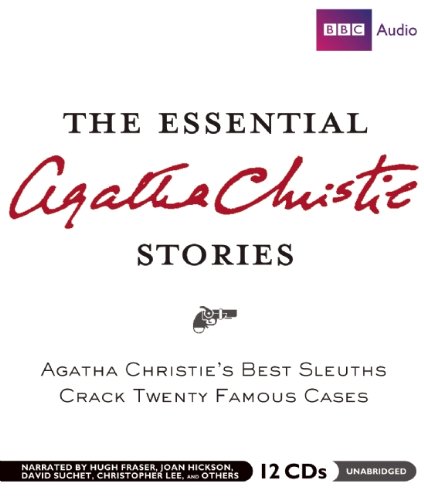
Agatha Christie has been on my “should read” list for a while now, and I did read a couple of her books–but she wrote so many, I didn’t know where to go next.  The Essential Agatha Christie Stories on audio seemed like the perfect solution!

This collection provides 20 stories in 15 hours, with a variety of readers (including Christopher Lee!)  It did exactly what I wanted it to do, giving me a sampling of Christie stories, including three with Miss Marple, quite a few with Hercule Poirot, and a handful of independent ones too.

Overall I enjoyed the stories quite a bit, and I’m impressed that twenty different stories, most of them centering on a murder investigation, held my interest so well.  Christie comes up with clever twists that I usually don’t guess.  Not every story had a satisfying answer to the mystery, but the majority did.

I had been considering picking up a Miss Marple novel next, but now I’m not so sure.  Those three stories were fine, and one, “Murder vs. Opportunity” had a nice twist…but I found I wasn’t that satisfied by how Miss Marple operates.  Poirot claims to base everything on “psychology,” but it seems even more true for Miss Marple…and that doesn’t appeal to me because there’s no answer!  I like mysteries for the sake of the puzzle, and seeing at the end how everything fit together.  Telling me that Miss Marple knew the answer “because she understands human nature” is, for me, dissatisfying.

I think I’m more likely to try a Poirot novel, as I fared much better with him.  My two favorite stories in the collection were both Poirot stories.  The first was “Four and Twenty Blackbirds,” and Poirot combines both an understanding of psychology and physical clues to deduce the answer to a murder, starting from something as simple as a change in the dead man’s habits.

“Murder in the Mews” was my other favorite, one of the longer ones in the collection, focusing on a suspicious suicide.  This one was complex, full of details and a few red herrings, with a satisfying answer in the end.  I listened to this collection on CDs in my car, and this was the only story that got me to take the CD out of the car to listen to the ending after I finished driving for the day.

I also met Captain Hastings in this collection, an apparently regular figure in Poirot stories.  He plays a very Watson-type role, the somewhat blundering friend who narrates the detectives adventures.  He was fun for a few stories, but began to wear on me.  The joke of Hastings thinking he’s being clever when he isn’t only worked a few times, and somehow Poirot seemed to come across as more ridiculous when through Hastings’ eyes.  On the other hand, Hastings did provide the vehicle for a Poirot-narrated mystery, “The Chocolate Box,” told in a nearly story-length flashback.  That was another one with clever details and a good answer to the puzzle.

In the non-Poirot stories, I especially liked “The Girl on the Train.”  It’s full of wild and improbable hijinks, and splendid wit.  Take this paragraph:

“It was true that George embodied a veritable triumph of the tailor’s art.  He was exquisitely and beautifully arrayed.  Solomon and the lilies of the field were simply not in it with George.  But man cannot live by clothes alone–unless he has had some considerable training in the art–and Mr. Rowland was painfully aware of the fact.”

Love it!

On the audio side of things, most of the readers were good, and Christopher Lee was quite good!  The only sour note among the readers was the final story, “Yellow Iris.”  The reader tried a little too hard to do different voices, I think, and it didn’t fly at all…but nineteen out of twenty stories had good reading to back them.

So, Christie fans–have you read any good short stories from her?  And where do I go next with the novels?  Any Poirot ones I should try?  Should I give Miss Marple a chance after all?  Let me know! 🙂

Other reviews:
Bookshelves of Doom
Anyone else?

Buy it here: The Essential Agatha Christie Stories (it’s expensive…try the library, that’s where I found it!)
The Power of Three in Storytelling

A recent read has got me thinking about how three shows up in stories–specifically, stories centered around three lead characters.  There are romantic triangles, of course, but I’m thinking of a different kind of triangle, of three people all connected by friendship, and with no more than one romantic tie.

Anton Chekhov said, “Let two people be the center of gravity in your story: he and she.”  That’s a story that works well too–but sometimes those two people need a third.  And sometimes it’s that third character who really steals the show!  “He and She” are in some ways locked into their roles; they’re on a character-growth journey, or they have to be the moral center of the story, or they’re a reflection of the reader in order for said-reader to relate.  The third character gets to break out of the mold, to be the comic relief, or the dashing rogue, or the morally ambiguous semi-ally.

Rick Riordan’s Percy Jackson series is a perfect example, with Percy, Annabelle, and the comedic Grover (my favorite character!)  Harry Potter probably came to mind for everyone: Harry, Hermione and Ron, although Rowling shifted the romantic pairing away from the lead.  I would argue it even applies to Star Wars, at least in A New Hope: it’s really Luke’s story, with Leia as the heroine and Han as the roguish third character.

Sometimes the third character is an animal sidekick.  In Hero by Alethea Kontis, there’s heroine Saturday, hero Peregrine, and shape-shifting sidekick Betwixt (my favorite!)  Or in my novel (although I didn’t think all of this through when I wrote it), there’s Jasper, Julie, and snarky, talking-cat Tom (who seems to garner the most fans…)

There are variations, of course.  The weight of the story doesn’t always rest quite so neatly on two people, with a third in satellite.  I’m thinking of Catherynne M. Valente’s Fairyland series, with September as heroine and her two friends, A-through-L and Saturday.  Mostly it tends to be male and female leads, with a male third character, but not always: Butch Cassidy and the Sundance Kid focuses on the two title characters, with Etta as the third.

And then sometimes the third character becomes the lead character.  I’m pretty sure Pirates of the Caribbean was supposed to be Will and Elizabeth’s story, but in true pirate fashion, Captain Jack Sparrow stole the movie.

I can’t ignore my favorite triumvirate either, of Kirk, Spock and McCoy.  Some would say (and the recent Star Trek movies suggest) that Kirk and Spock are the leads with McCoy as satellite–and as the irascible, possibly comedic character he has some of those trademarks…but nevertheless, I maintain absolutely that those three all have equal weight, and trends to the contrary represent a serious lack of understanding on the part of those currently running the franchise (not to get all soap-boxy about it or anything…)

Anyway…I find I really like this kind of character set-up.  So now I’m eager to find more examples!  What are some books or movies you’ve enjoyed that feature a Friendship Triangle?  Who are your favorite Third Characters?

And if you’d like to read a book that accidentally followed this set-up, you can win a signed copy of my fairy tale retelling, The Wanderers! Just put #WanderersGiveAway in your comment to enter.  Only open to the end of the month!

A Griffin in a Tower

First of all, happy birthday to Mr. Shakespeare!  Did I ever tell you that I once was in a college Shakespeare class that happened to meet on Shakespeare’s birthday?  I brought cookies.  The professor was (adamantly) not a Stratfordian, but that was actually part of the fun…

Anyway, on to the business of the day!

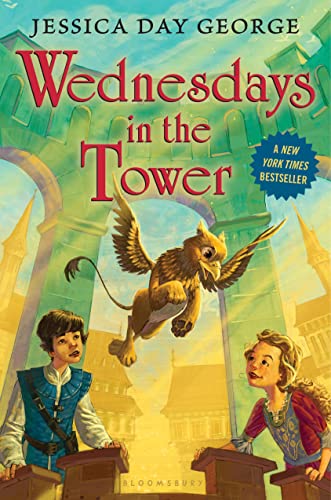
When I read Tuesdays at the Castle by Jessica Day George, I loved the concept of a sentient castle, constantly remaking itself.  So I was excited to revisit Castle Glower in Wednesdays in the Tower (spoilers to follow for the first book in the series).  This fits Once Upon a Time, and my goal to read more sequels.

Princess Celie knows Castle Glower, and its quirks, better than anyone else.  But even she’s not sure what it means when the Castle shows her a new tower, with a mysterious orange egg in it.  The egg hatches into a griffin–and Celie finds herself trying to raise a mythical creature in a castle that won’t let her reveal the griffin’s existence to anyone except her wizard brother Bran, and his friend Pogue.  Celie does manage to enlist her younger brother Rolf in helping her look for any information on griffins, which seem to have mysterious ties to Castle Glower’s history.  Meanwhile, the castle begins behaving increasingly erratically, and a very ominous wizard has arrived to look into matters.

The Castle was my favorite part of the previous book, so I was glad to see it, and its mysteries, take such a prominent role in the sequel…I think! I’m a little worried that finding out too much (in the third book still to come) will ruin some of the mystery…but what answers we have so far are intriguing, so I’m optimistic!

I felt like Celie grew as a character in this book, both through taking care of the griffin (who she names Rufus), and through trying to determine her proper place in the castle. At first she seems to have found that place, as the Castle Cartographer, but it isn’t long before she’s feeling shunted to the side and still looking for her role.

Rufus is great fun as well, and rather adorable! It’s funny that I just read another book (The Pinhoe Egg) about raising a baby griffin, but this felt distinctly different. Rufus has a very different personality (even though, unlike Cat’s griffin, he can’t talk). I loved it when he started learning to fly, and was so eager about it!

Unlike the previous book, this one ends mid-story, with a definite cliffhanger. And now sadly I have to wait for the next one! The disadvantage of catching up with current series…but I get to look forward to Thursdays with the Crown (and to wonder if there will eventually be seven books—one for every day!)

Don’t forget, you can win a signed copy of my fairy tale retelling, The Wanderers! Just put #WanderersGiveAway in your comment to enter.

Author’s Site: http://www.jessicadaygeorge.com/

Other reviews:
Shelah Books It
Batch of Books
Escaping Reality (One Book at a Time)
Charlotte’s Library
Anyone else?

Buy it here: Wednesdays in the Tower