From Beijing to France, with Cyborgs and Lunars

I’m waiting in line at the library for Cress, the third book in the Lunar Chronicles by Marissa Meyer.  Waiting turned out to be a good thing…because it gave me time to reread the first two books, Cinder and Scarlet.  You can click the links for my original reviews, but I thought I’d do a quick re-read review too!  (Some spoilers to follow for Cinder)  These are sci fi, but since they retell fairy tales, I’m still counting them for Once Upon a Time.
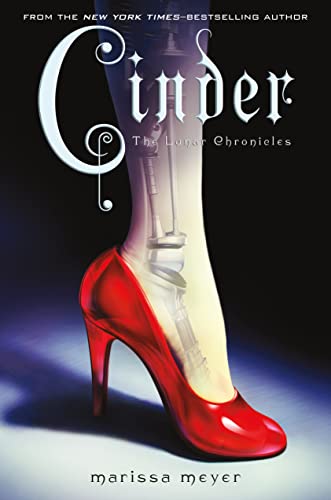
The Lunar Chronicles are set a vague but significant distance in the future. Earth has formed itself into seven countries, all at peace–but in an uneasy truce with the Lunar Colony, ruled by the cruel Queen Levana.  Lunars possess magic-like abilities to manipulate the minds of others, and no one is more powerful than Queen Levana.

Cinder is a teenage girl living in New Beijing, a gifted mechanic–and a cyborg.  Despised by society and her adoptive mother, her best friend is Iko, a robot with an overactive personality chip.  Her path crosses that of Prince Kai, shortly before the annual ball (can we see where this is going?)  At the same time, life begins to spiral out of control for both of them–Cinder’s sister is deathly ill with the letumosis plague, Cinder begins to find out startling revelations about her own past, and the death of Kai’s father forces him to take the lead in dangerous political dealings with Queen Levana.

My favorite thing about Cinder may be that she is just so level-headed.  I never understood Cinderella’s relationships in the original story, but I love how Meyer has reimagined things for Cinder.  She has no choice but to stay with her adoptive mother, because as a cyborg she’s legally property.  Cinder is fiercely loyal to her kind younger sister, and her robot friend, so we know she cares about people…but she doesn’t fall immediately under Kai’s spell.  Oh, there’s a crush going on…but she keeps perspective about it all.  It feels like how someone might legitimately feel about a near-stranger they’re attracted to.

I love a Cinderella who would rather run away and start her own life than go to some ball and dance with a cute prince.  Not that she wouldn’t like to dance with the cute prince, but she has priorities!

Oddly enough, much as I love the not-ridiculously-fast romance, it backfires to a certain extent in that I don’t find myself especially rooting for Cinder and Kai as a romantic couple.  Cinder gave us the very beginning of a romance for them…and I hope subsequent books will give us more so I can get more invested in them as a pair.

My other favorite part is Cinder’s amazing cyborg abilities–from the relatively mundane, like having a cabinet in her calf, to the really awesome like being able to detect lying.  They’re woven throughout the book in a very cool way.
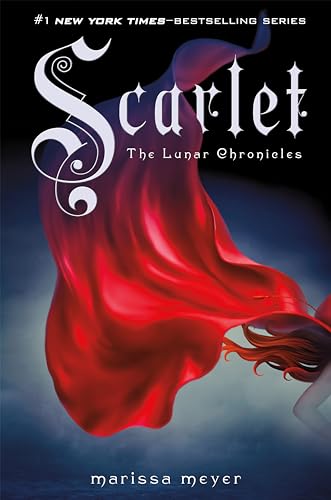
Scarlet picks up right where Cinder left off.  Cinder is now a fugitive from both Queen Levana and the Earth authorities, and winds up joining forces with the dashing Captain Thorne.  In his stolen spaceship, they’re on the trail of information about the missing Lunar heir, Princess Selene.  The trail takes them to France, to intersect with our other heroine of the book, Scarlet.  Scarlet is desperate to find her grandmother, who vanished two weeks previously.  She meets Wolf, a street fighter who fluctuates between gentle and fierce, who may have a clue to her grandmother’s abduction.  Although she doesn’t really trust him, Wolf is her only help, and they set out together for Paris.

I liked Cinder, but I really liked Scarlet.  Scarlet is fiery, impulsive, and even more fiercely loyal than Cinder.  And unlike Cinder and Kai, I definitely got behind this romance.  Yes, it’s fast–yes, it doesn’t always make sense–yes, I know all that…but it just works.  Although I tend to like Brooding Heroes with Hearts of Gold (it’s a thing), so that may be a factor…

And a purely personal aspect that will probably not matter nearly as much to anyone but me–a big chunk of the book takes place in the Opera Garnier!  It’s never identified by name, but trust me, it’s the Opera Garnier, former home of the Phantom of the Opera, and Meyer clearly researched the floor plan.

With broader appeal…much as I enjoyed Scarlet’s storyline, I also enjoyed Cinder’s storyline, which kicked into a higher gear in this installment–and how can I not love Captain Thorne, roguish and charming, if not quite as charming as he thinks he is.  I have this thing about arrogant charmers too, so this book was just hitting all my favorite hero-types.

I have to say, I am even more excited for Cress now, which was kind of the point…that, and making sure I’d actually remember who everyone was when I picked up the new book!  I also snagged on to a possible clue about Cress in the first book that I’m sure I didn’t spot on a first read, and I can’t wait to find out if my guess is right. 🙂

Let’s see…#15 in line, and with 27 copies circulating, that’s not so bad!

Don’t forget, you can win a signed copy of my fairy tale retelling, The Wanderers! Just put #WanderersGiveAway in your comment to enter.  Ten days left!

Author’s Site: http://www.marissameyer.com/

Buy them here: Cinder and Scarlet

Blog Hop: What’s In Your Reviews?

book blogger hopThis week’s Book Blogger Hop question: Are your reviews more of a rehash of the story or do you comment on writing style, characters, and reflection?

Well, I certainly aim to do more than just retell the story!  I generally do include a paragraph or (for very complicated plots!) two of storyline, so readers will have some context when I start talking about characters or other aspects of the book.  However, I feel like plot summaries are what the back of the book, or the Amazon description, are for.  In a sense, that’s the objective part–what happens in the book.

I feel like my job as a reviewer is to provide the subjective part.  Duly noting after our last blog hop discussion that this is just my opinion, my goal is to let you know how well the story was carried out.  Was the interesting premise actually interesting, or did it end up dragging?  Was the awesome-sounding heroine as cool as I hoped?  Did the romance hinted at in the plot summary turn out to be believable, or ridiculous?  Was the book funny, sad, or moving–sometimes the contents of a plot summary will hint at those things, but did it turn out that way?

Knowing what happens in a book does help me decide whether to read it or not–but I’ve read plenty of books that were terrible despite great premises.  Only retelling the plot means only looking at one part of a book, and only one aspect that can make it worth reading–or not.

And now I’m curious what other people are expecting from reviews!  When you read book reviews (not just mine!), are you mainly looking for a description of the story, or do you also want to know the reviewer’s subjective opinions? 🙂

Don’t forget, you can win a signed copy of my fairy tale retelling, The Wanderers! Just put #WanderersGiveAway in your comment to enter.

Hatching a Gryphon, and a Lot of Chaos

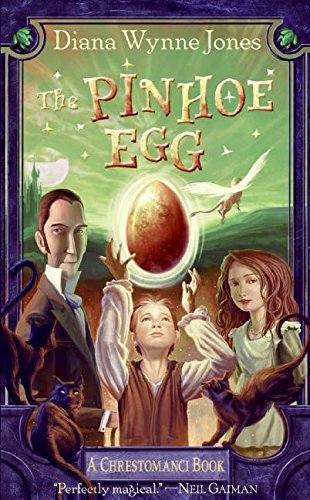
After rereading all of Diana Wynne Jones’ Chrestomanci series, I think I may finally have a favorite–the final book, The Pinhoe Egg.  It’s a perfect blend of new characters, old friends, and high hilarity.  And a great fit for Once Upon a Time!

The Pinhoe family has been practicing their secret magic for generations, avoiding the eye of “the Big Man,” Chrestomanci, who is a kind of magic regulator for the government. The plot beyond that is…complicated.  When Gammer Pinhoe, clan matriarch, goes insane (possibly cursed by a rival magical family), chaos, upheaval, and magical feuds are inevitable.  And there’s a magical egg, long-held by the Pinhoes, which comes into the possession of Cat, ward of Chrestomanci Castle, and hatches into a baby gryphon.

I loved seeing Cat take center-stage again, even more than he did in the first (written, though not chronological) book, Charmed Life.  Cat in this book still struggles with trust and openness, but has also come into more confidence about himself and his abilities.  It’s a nice development from his previous book, while being remarkably consistent for two books written almost 30 years apart!

Centering much of the book around Chrestomanci Castle also meant seeing more of its other residents, and here was where I was especially glad that I’d read the whole series in order pretty quickly.  I’m sure that when I read this before, I’d forgotten who most of the supporting characters were.  This time I still had everyone in mind and could draw all the connections between books.

Along with familiar faces, there were delightful new characters too.  Marianne Pinhoe is our second major character, alongside Cat.  She has some parallels to Cat in the first book, actually, as someone with strong magic who has never fully realized it.  She’s less passive than Cat was, and spends much of the book trying to deal with problems no one else seems to be able to see.

The Pinhoes en masse (and especially Gammer Pinhoe) are a wonderful group, mixing humor deftly with much more sinister undertones.  They form an interesting contrast to the spell families in The Magicians of Caprona.  In both cases we have a busy, clannish family, full of aunts and uncles, fiercely proud of their magic and having an uncanny ability to know what’s going on with family members.  There, however, the Montanas clearly care about their young family members and want to protect, teach and encourage them.  The Pinhoes seem largely bent on stifling Marianne, or at least forcing her into the mold they consider appropriate.  Parents often come off very badly in Jones’ books, and this is a definite case where that happens.

But even with some sinister undertones, there are still hilarious incidents of magical mayhem, including a runaway kitchen table that rampages through town…

If I have one criticism of the book, it’s that I had to suspend disbelief on one of the central plot points.  The Pinhoes are supposed to be practicing magic secretly–and yet they seem to be very bad at hiding anything.  They’re practically on Chrestomanci’s doorstep, they fly around on brooms, and a cursed table runs down Main Street.  I honestly don’t know how Chrestomanci managed to not notice them.  Possibly they were only keeping their particular method of magic secret, not the fact of doing magic in general…but if that was the point, it wasn’t clear to me.  However…the rest of the book is so good that I’m willing to just run with that one idea and not ask too many questions!

So now that I’m at the end of my chronological reread, I do have some thoughts on reading order!  I think there’s actually a lot of room for flexibility, but the books can generally be looked at in pairs.  Charmed Life and The Pinhoe Egg; and The Lives of Christopher Chant and Conrad’s Fate each pair together and should be read in order–although you could make a case for reading either pair first!  Witch Week and The Magicians of Caprona are much more removed from the series and could be read at any point, although probably not first.  And the short stories in Mixed Magics really are best when read in connection to their relative books (see review for details!)

Got all that?  🙂  Maybe the real conclusion here is that it doesn’t matter all that much which order these are read in…because they’re just wonderful books anyway!  My favorites are chronologically at the beginning and the end, The Lives of Christopher Chant and The Pinhoe Egg, but every installment is excellent!

Author’s Site: http://dianawynnejones.com/

Other reviews:
A Journey Through Pages
Charlotte’s Library
Taking a Break
Anyone else?

Buy it here: The Pinhoe Egg

Star Wars: The Hand of Thrawn

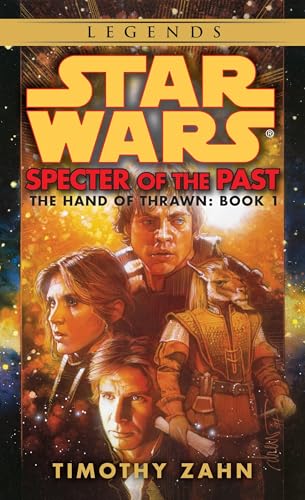
I had an excellent time rereading The Thrawn Trilogy, Timothy Zahn’s landmark Star Wars novels, during the Sci Fi Experience this year.  After that, I decided to finally go on and read his Hand of Thrawn Duet, Specter of the Past and Vision of the Future.  (Warning: some spoilers to follow for the The Thrawn Trilogy.)

So why did I never read these before?  Funny story about that…I actually used to own both of these books.  I had the first one for quite a while but was waiting to read it until the second one came out in paperback.  It finally did, I bought it, I started reading Specter of the Past…and I found out in three chapters or so that they apparently-returned-from-the-dead Thrawn was actually a fake.  I was so disgusted that I stopped reading and gave both books away.  After ten years or so, I felt I may have overreacted…

There was one thing I was right about though–these two books function like one really long book, with what feels like an almost arbitrary break between, so it’s no good reading one without the other, or trying to talk about them separately!

Ten years after The Thrawn Trilogy (and 15 years after Return of the Jedi), the Empire has been beaten back to a tiny fraction of its former strength.  Supreme Commander Admiral Pellaeon believes they have no choice but to surrender to the New Republic.  Unbeknownst to him, Grand Moff Disra has a plan afoot–he’s found a conman who can pose as Grand Admiral Thrawn, the brilliant tactician who nearly reversed the Empire’s fortunes before; and a member of the elite guard with enough tactical genius to support him.

Meanwhile, the New Republic is struggling to hold itself together, especially when revelations come out that an unidentified group of Bothans contributed to a world’s destruction (like Alderaan, but not) some 50 years ago.  With many worlds demanding vengeance be taken on the entire species, and others using it as an excuse to fight their own battles, the New Republic is swiftly on the brink of civil war.  Leia, Han and various friends try to put out fires and find answers at home.  Luke does his own investigating, around the galaxy and using the Force, until he’s eventually drawn into a rescue mission of Mara Jade.

Looong plot!  There’s a LOT happening, and I think that’s both the strength and the weakness of the books.  So many cool things are going on–but so many things are going on!  Zahn moves the point of view around with every different plot thread, so between the two books we spent time with Leia, Han, Luke and Mara (together and separate), Lando, Talon Karrde, two different mercenary female warriors (it’s complicated), Wedge Antilles of Rogue Squadron, General Bel Iblis, and no less than five separate groups of Imperials.

To Zahn’s credit, all of these people had interesting things going on, and I had surprisingly little trouble keeping it all straight.  At the same time, I still felt like I was frequently being sidetracked from the couple of plotlines that I liked best, or from the characters I most wanted to see.  I think I might have liked these two books better as one book with half the subplots.

However…these were still solidly engaging books.  I did overreact about the fake Thrawn all those years ago.  While I am still a little disappointed that it wasn’t the real Thrawn (such a cool villain!), the con turned out to be pretty brilliant too.  I especially liked the way it sent all the other characters into a tailspin, second-guessing themselves because they think Thrawn is manipulating them.  So some of the best aspects of Thrawn-as-villain still came through.

Luke had a particularly good thread here too, especially in the second book when he connects with Mara.  Those two play off each other so nicely, and they both underwent powerful character growth in the second book.  There’s some intriguing examinations of the Force as well, as they each explore their abilities and limitations.

The Thrawn Trilogy are probably the best Star Wars books I’ve ever read, and while The Hand of Thrawn didn’t manage to equal them, they’re still solid installments in the continuing saga.  Now I just have to figure out what to read next!  All the various sites about Star Wars books are surprisingly difficult to decipher, but I think the next one I want is Zahn’s Survivor’s QuestStar Wars fans, feel free to weigh in on the subject! 🙂

Don’t forget, you can win a signed copy of my fairy tale retelling, The Wanderers! Just put #WanderersGiveAway in your comment to enter.

Other reviews:
Speculiction
Mathachew
From the Mind of Tatlock
Anyone else?

Buy them here: Specter of the Past and Vision of the Future

Guest Post: Favorite Fairy Tale Retellings

 You’ve seen me write about my favorite fairy tale retellings many times, but today I’m happy to present someone else’s opinion!  Today we have a guest post from Katy, who writes at A Library Mama.  Some of these are favorites of mine as well, and some are ones I am definitely going to have to explore!  Links go to Katy’s reviews, if you want to find out more.

********************

Fairy tales made into novels are some of my favorite types of books ever, and I promised Cheryl this list oh, months and months ago. I’m finally doing it in honor of the Once Upon a Time challenge (hosted by Stainless Steel Droppings.)

These are not by any means the only fairy tale retellings I have read and loved – but in the interests of keeping it manageable, I’ve limited myself to an even dozen. I hope you enjoy!

Beauty by Robin McKinley. (1978, Middle Grade)

This is the book that started it all, first checked out regularly from the library, then bought with Christmas money so that I could carry it in my suitcase when traveling. This retelling of Beauty and the Beast started both my adoration of Robin McKinley and my search for great fairy tale retellings.

Tam Lin by Pamela Dean. (1991, Adult. “New Adult” might be perfect)

This was the first book I found in the Fairy Tale Series, edited by Terri Windling, though I went on to track down the others as well. I was in college when I discovered it, and despite the marked difference in technology between my college and the college of the story, the college life is so vividly described that it took me quite a while to realize that it was set in the 1960s rather than the present. The magic weaves its way into the story subtly at first, gradually coming to a crescendo.

Jack the Giant Killer by Charles deLint (1987, Adult)

Jacky is stumbling through the streets of Ottawa, reeling from a tough break-up, when she finds that grief and alcohol have blurred the edges of reality so that she can now see its faerie denizens – and the growing conflict between the Seelie and Unseelie courts. This is another Fairy Tales series entry, and my introduction to deLint, as well as a great story in its own right.

Snow White and Rose Red by Patricia Wrede (1989, Adult)

The author of the beloved Enchanted Forest Chronicles doesn’t disappoint in this Elizabethan retelling of the story, featuring a manipulative John Dee. Also part of the Fairy Tale series.

Kate Crackernuts by Katharine Mary Briggs (1963, Middle Grade)

Kate Crackernuts (the original, traditional) is a wonderful story of stepsisters who are loyal to each other even when the stepmother thinks they should be enemies. This lovely retelling moves the whole story to the Scottish Highlands. I got a dusty old copy through interlibrary loan to read it, but it’s now happily available in paperback as well.

Rose Daughter by Robin McKinley (1997, Teen)

It’s Beauty and the Beast again, but different – I’ve read both of these retellings multiple times. Beauty feels more down-to-earth, and has more about Beauty’s love of books and her relationship with her horse. Though of course there’s magic in both stories, the magic here feels more fantastical, and there is a lot more about the magic of roses in particular.

Zel by Donna Jo Napoli (1996, Middle Grade)

A mystical, reflective retelling of Rapunzel, told from the points of view of Rapunzel, the witch, and the prince. I fell in love with it in library school.

Goose Girl by Shannon Hale (2003, Middle Grade/Teen)

The book that first brought Shannon Hale to my attention, the story of Princess Anidori’s struggle to survive and reinvent herself after she’s betrayed grabbed me and wouldn’t let me go.

East by Edith Pattou (2003, Teen)

“East of the Sun, West of the Moon” set in rural Norway. When Rose discovers that, contrary to what she’s been told, she was born facing north, the direction of adventurers, she is both outraged and excited. Then, an enormous white bear offers to save her sister’s life and her family’s fortune if she will come with him. Strong characters and a strong sense of setting make for a wonderful retelling.

Ash by Malinda Lo (2009, Teen)

A Cinderella that puts the chancy Fair Folk back into the fairy tale, and takes the assumptions that a heterosexual romance is the path to happiness out. It’s all done in the context of an utterly compelling story.

Wildwood Dancing by Juliet Marillier (2007, Teen)

A beautiful and terrifying, if not straightforward, “Twelve Dancing Princesses.” This particular fairy tale is one where I tracked down every novel retelling I could find – I’ve picked this one as my favorite for this list, but there were so many other good ones, too!

Breadcrumbs by Anne Ursu (2011, Middle Grade)

Confession: Hans Christian Andersen is not my favorite. It’s greatly to Ursu’s credit that she turned “The Snow Queen,” a quite disturbing story, into a novel that I really enjoyed. Breadcrumbs has a modern-to-magic setting that works very well, and deals well with deep issues of identity and friendship.

***************

Thanks for sharing so many great titles, Katy!  Personally, I’m thrilled by a “Jack the Giant Killer” retelling from Charles deLint!  Anyone else see something they want to pick up?

And don’t forget, you can also enter to win a signed copy of my fairy tale-inspired novel, The Wanderers!  See Katy’s lovely review here, and include #WanderersGiveAway in your comment to enter. Contest open until April 30th, and you can comment around my blog and enter as many times as you like!