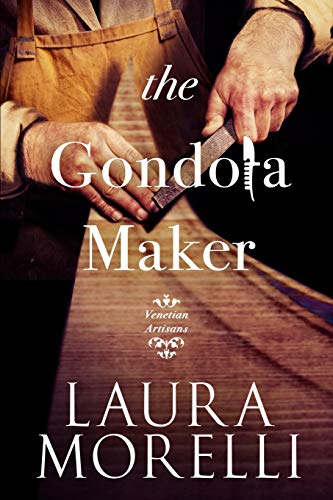
Visit Venice with the Gondola Maker

I have rarely read a book that was driven so much by atmosphere as The Gondola Maker by Laura Morelli.  Set in Venice in 1581, this is historical fiction with the emphasis on the historical, taking us inside the world of the craftsmen and gondoliers of Venice.

Luca’s path in life seems mapped-out and unavoidable, to follow in his father’s footsteps as one of Venice’s finest gondola builders.  But in a moment of rage, Luca makes a terrible mistake.  He flees his old life and his old identity, becoming a boatman on the docks.  He soon becomes private gondolier to Trevisan, a master painter, and there Luca finds two new obsessions: Giuliana, a beautiful girl in a painting; and an old gondola he vows to restore to beauty.

This is a slow book, but not in a bad way.  It’s clearly minutely researched, and Morelli pays great attention to description, especially of craftsmanship.  Many characters are artists, not only the painter but also all the men involved with the different pieces necessary to create a beautiful gondola, Luca included.

I find that I have great respect for Trevisan, mostly because of one observation Luca makes.  Trevisan is a highly successful painter, who takes pains to dress like the nobility (possible through an agreement with a costume-maker’s shop!)  Because of this, he has become accepted among the patricians, even though “he engages in what is, after all, manual labor, little different from how any Venetian glassblower, ironsmith, carver or other artisan spends his day.”

There’s a fascinating double-play here.  Luca lowers Trevisan’s status to the same as all of these professions (including his own), beneath the wealthy in status.  No doubt this was true in the historical social hierarchy!  And yet, the depiction of these other crafts throughout the book raises them, to the level I think a modern reader is likely to place a master painter in, as a genius and great artist.

But mostly I respect Trevisan for finding a way to rise above his ascribed status.  He is a painter, he doesn’t enter a different profession or somehow earn a title, but he’s able to earn respect and privilege above what should be expected for his class.  I love that.  Trevisan is a supporting character, but he may be my favorite anyway.

That may say something about the main character…  I have no dislike of Luca!  Mostly, though, I feel like he was the eyes we used to explore a fascinating world.  His story takes second-place to the world he’s moving through.

And that definitely says something about the romance.  It’s a big plot thread, and it does add some good intrigue and plot twists to the story.  But as a romance it just didn’t grab me.  I mean, Luca fell in love with the painting of the woman.  Even when he begins to interact with Giuliana herself, I never felt sure he appreciated anything about her beyond her beauty.  And that’s a real shame, because there are glimmers that Giuliana is a very intelligent young woman who is determined to chart her own course, beyond the control (none at all) that girls of the nobility typically had.

I would have loved to read this story from Giuliana’s point of view, or perhaps in a split viewpoint.  Giuliana is objectified by every man in the story, some more blatantly than others (normal for the era, I’m sure).  Unfortunately, I was never convinced that Luca wasn’t ultimately doing the same thing.  He acknowledges near the end of the book that he doesn’t really know her at all and that’s true!  There are hints that there’s so much more to her, and I wish we’d had the opportunity to really see that come through.

I actually liked Luca’s “love affair” with the restored gondola much better.  While he takes the living, thinking Giuliana and reduces her largely to a painting, he takes the inert piece of wood and raises it to something that feels almost alive.

So at the end of the day…this is a good book if you like a certain kind of story.  If that story is rich in history and art, and especially if you have an interest in Venice specifically, then I can recommend The Gondola Maker!

Author’s Site: http://lauramorelli.com/

Other reviews:
The YA Lit Chick
Chronicles
Rosie Writes
Anyone else?

Buy it here: The Gondola Maker

Disclosure: I received a copy of this novel from iRead Book Tours in exchange for an honest review.


Top Ten Tuesday: Friendships

Top Ten Tuesday, hosted by the Broke and the Bookish, posts a book-related topic every Tuesday for bloggers to share their top ten lists around.  I wasn’t even planning to participate this week, but I couldn’t resist today’s topic: Books about friendship!  Which I’ve slightly reinterpreted as my favorite book friendships…

toptentuesday1) The Little White Bird by J. M. Barrie – First on the list because it’s one of my very favorite books.  It centers on an unconventional friendship, between the kindly old gentleman (unnamed, so I like to call him that) and a little boy, David.  They each provide the key for the other into a world of wonder and magic (I mean that metaphorically, mostly…)  It’s pretty clearly autobiographical, about J. M. Barrie and the Davies boys.

2) The White Darkness by Geraldine McCaughrean – Another favorite and another unconventional friendship, considering Titus is Sym’s imaginary friend.  But it’s beautiful.

3) Anne of Green Gables, Emily of New Moon and Pat of Silver Bush by L. M. Montgomery – On one line because they’re all in the same mold.  Where would Anne be without Diana, Emily without Ilse, or Pat without Bets?

4) The Bruno and Boots series by Gordon Korman – A hilarious series of books, centering around roommates at boarding school.  Together, Bruno and Boots just can’t seem to avoid chaos, and they usually drag all of their other friends along.

5) Dragonsinger by Anne McCaffrey – Second book in the Masterharper of Pern series, lonely Menolly sets down at the Harper Hall, and for the first time finds friends who accept and value both her and her musical talents.

6) The Jacky Faber series by L. A. Meyer – There’s plenty of romance in this one too, and Jacky sparks with lots of men…but my favorite relationships in the series are her friendships.  Especially Jacky’s friendships with Amy, a Puritan who frequently shakes her head in horror at Jacky’s hijinks but loves her fiercely anyway; and with the ever-faithful Higgins, always ready with clean clothes, a spot of tea and a comb, not to mention well-deserved scolding.

7) Star Trek: Prime Directive by Judith and Garfield Reeves-Stevens – My favorite friendship in all of fiction is the triumvirate of Kirk, Spock and McCoy.  Almost any (well-done) Star Trek book could be here to represent that, but this one is particularly good at depicting the bond, as well as the friendships between the rest of the regular characters.

8) The Squire’s Tale and The Squire, His Knight and His Lady by Gerald Morris – This series is a delightful retelling of Arthurian legends.  The first two books (and some later ones) focus on Squire Terrence and his knight, Sir Gawain.  They start out largely in the traditional, class-based roles, but through adventures together they come to trust and regard each other as equals, friends, and even brothers.

9) The Blue Girl by Charles de Lint – The friendship between Imogene and Maxine is the driving force of this story.  Both girls also have boyfriends by the end of the novel, but those relationships are secondary compared to the friendship story.  This is a nice example too where each girl balances and helps the other–wild child Maxine grows more responsible, while shy Imogene becomes more confident.

10) The Sisterhood of the Traveling Pants by Ann Brashares – I’m listening to the audiobooks of this series, so it’s top-of-mind right now.  I do enjoy the way each girl has her own adventure every summer, involved in drama around boys or family or goals, but the friendship of the four girls (linked together by the pants, of course!) is bedrock of their lives.

I love finding new books with wonderful friendships in them!  There are so many romances in stories, it’s nice to see friendships highlighted.  So–what are your favorites?

Thursday Thoughts on Gender in Books

I recently started following the meme, Thoughtful Thursday, hosted by Reading Is Fun Again.  Similar to the Blog Hop, a book-related discussion question is posted each week.  Here’s today’s question!

Thoughtful Thursday

Do you prefer to read books with a male or female protagonist? Does the author’s gender matter?

This is probably going to sound like a very safe, very PC answer, but I honestly prefer books to have strong characters of both genders.  I tend to get more excited about amazing female characters, but I think that’s largely about there still being some deficit in that regard (aside from the recent surge in dystopian YA…)  Sadly, it still seems like an event to find a capable female character who plays an active role in her own story, all the more so if that story is a retelling of, say, a fairy tale, where that was not the case in the past.

I do feel like, at the end of the day, people are people, and characters should be people too, and whether they are male people or female people is secondary to whether they are complex, interesting, believable people that I want to spend the length of a book with.  The question of gender only becomes a really big thing for me when one gender is notably missing.

I read lots of books with great female characters last year, but my favorite character all year was Samwise Gamgee–but it still bothers me that there are so few women in Middle Earth.

As to the question of the protagonist and author being (or not) the same gender, mostly it doesn’t matter to me.  I’d be rather hypocritical if I did care a lot, considering my novel has a male protagonist!  But see above, people are people.  I’m not the same gender as Jasper, and I’m also not a wandering adventurer, or an orphan, or illiterate–it’s all imagined!

All that said, I am more likely to look sideways at a book if the main focus is the protagonist’s character development, rather than plot or worldbuilding or relationships, and the author is a different gender.  I’m not saying that can’t be done well!  Just that I’m slightly more skeptical because the author has more to overcome to do it well.  But I try to keep an open mind.

Your turn!  Do you strongly prefer to read one gender or the other, or does it not matter that much to you?

Don’t forget you can enter the KidLit Giveaway and win a signed copy of my novel!  Contest ends May 18th.

Reaching Into Books

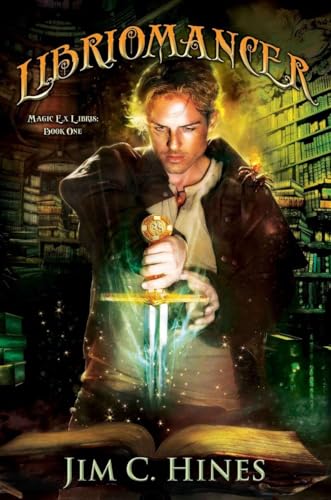
I don’t often finish a book and then start grabbing friends to tell them, “You must read this!”  But I have been having that experience with Libriomancer by Jim C. Hines.  Quick advisory that it’s not my usual YA, but for older readers it’s amazing!
This one has been on my To Be Read list for ages, and I don’t know how it took me so long to get to it.  It has one of the most brilliant premises ever.  The lead, Isaac, is a librarian–but he’s also a libriomancer, part of a secret organization of magicians.  Libriomancers can reach into books and pull out objects–like Excalibur, Lucy’s healing cordial or Tinkerbell’s fairy dust. Libriomancers use their powers to deal with magical threats, from natural magic creatures, or ones created from books (more on that in a bit).

Isaac has been relegated to fieldwork after he lost control on a mission, but when a pack of vampires (the “sparkler” variety) attack him in his library as part of a widespread vampire uprising, Isaac is forced back into the fray.  Isaac, his fire spider pet, and a dryad named Lena soon find themselves at the center of a threat much bigger and more complicated than a simple vampire attack.

So I mentioned the premise is brilliant, right?  The mere concept of pulling objects out of books is amazing, but Hines makes it even better with complex rules around how the magic works.  In some ways I could almost see him deliberately creating limitations, but they’re limitations that make sense. For instance, you can’t grab the One Ring of Power, because certain objects have been deemed too dangerous, and their books were magically locked.  You can’t write your own book with whatever object you need, because it’s the readers’ belief in the story that enables libriomancers to pull objects out–so it only works with widely-read books…and did I mention that Johannes Gutenberg founded the libriomancers’ order?  You can’t do too much magic too quickly, because characters start bleeding into the libriomancer’s mind.  With some of the rules come dangers, giving this rollicking ride some darker undertones and greater depth a well.

So–brilliant premise and plausible, complicated magic, check.  References galore to other books?  Check!  Isaac uses books in his magic, and Hines has mostly drawn from real books–he includes a helpful list at the end.  I recognized most of the books, and I think that will be the case for most readers who enjoy sci fi and fantasy too.  This is a firmly fantasy book, but Isaac deals in sci fi books a lot too, so there are ray guns, and one never-identified-but-unmistakable lightsaber.

References in themselves are great, but Hines manages some hugely entertaining, tongue-in-cheek references.  Remember that mention of “sparklers”?  Many vampires came about because someone accidentally reached into a vampire book at the wrong moment and became infected.  So there are a variety of vampires classed according to what book they spawned from–like Sanguinarius Meyerii vampires, irritatingly superhuman and nicknamed sparkers, or the more traditional Stokerus vampires.  So.  Much.  Fun!

The danger of a really brilliant premise is how disappointing it is when a book falls down some other way.  Fortunately, that’s not the case here.  Isaac is a likable hero, flawed but honorable and well-meaning.  He struggles with some interesting, magical morality questions in a way that made me quite like him.

Lena, as I would expect from the author of The Princess Novels, is tough, take-charge, and very much an equal participant in the adventure.  As a dryad, she has some amazing wooden weapons she can use in very clever ways.  She’s also very much out of the mold of typical characters, considering she’s heavyset and bisexual, two ideas that don’t appear much in fantasy.  Lena has a very complex arc that I won’t try to unpack here, exploring questions of free will, character stereotypes, and power in relationships.  It’s carefully and powerfully handled.

If the book falters at all, it’s that I was just a smidge disappointed by the ultimate reveal on the villain.  Trying not to give spoilers, but essentially I expected the big bad villain to be, well, bigger and badder.  However, this is the first book in a trilogy, so I am optimistic that the threat level will rise with each book, and there were definite hints of something more dangerous lurking.

And the up-side to waiting so long to read this…I can go straight on to Book Two!

Don’t forget you can enter the KidLit Giveaway and win a signed copy of my novel!  Contest ends May 18th so enter now…

Author’s Site: http://www.jimchines.com/

Other reviews:
Making It Up As I Go
The Book Smugglers
Little Red Reviewer
Anyone else?

Buy it here: Libriomancer

Dreamhunter and Dreamquake

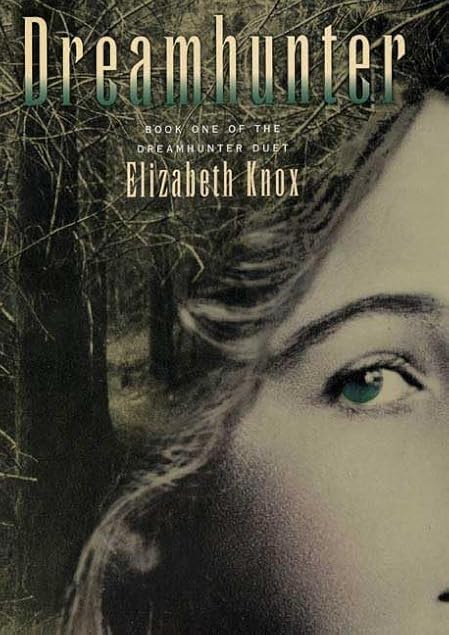
In a happy overlapping of challenges, I recently completed a long-time half-read duet of books, and got another read in for Once Upon a Time!  I first read Dreamhunter by Elizabeth Knox several years ago, and never managed to get to the second book.  So I reread the first one a few months ago, then read Dreamquake during April.
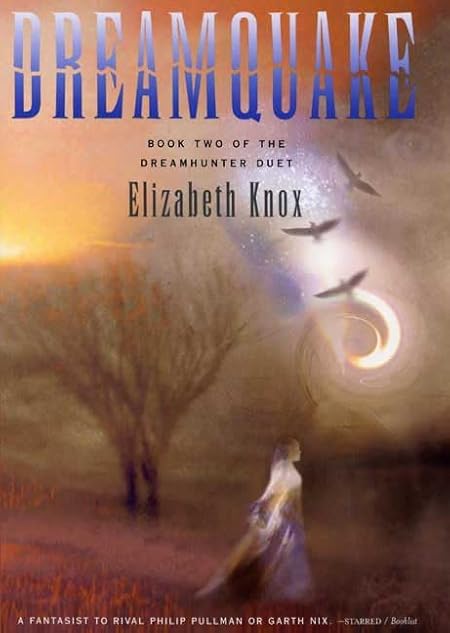
The two books are set in an island country near the beginning of the 20th-century…with a crucial difference from the world we know.  Certain people are able to enter The Place, a barren wasteland overlapping the normal world, and much larger within than its external geography.  Among those who can reach The Place, some have the ability to catch dreams, and then to return to the normal world and share these dreams with others.  Devoted cousins Laura and Rose both expect to become dreamhunters when they turn 15, legally old enough to try.  Laura’s father discovered The Place 20 years earlier, and Rose’s mother is a famous dreamhunter.  But only Laura has the ability to enter The Place, dividing the cousins just as mysteries and intrigues start to build up around them.  Laura’s father disappears, presumed dead, and Laura begins seeing a darker message within the dreams.

The concept of these books is so fascinating!  Knox has created a complex magical system around the dreams and how they work.  Dreams are grounded geographically in The Place, so dreamhunters can sleep in certain places and expect to catch certain dreams.  Dreamhunters have individual talents and abilities, like putting everyone around them to sleep when they sleep, or the ability to alter faces in dream characters.

Layered on the magical system is an economic system.  Dreams have become a business, with dreamhunters utilizing their talents at hospitals to soothe the sick, or in specially built Dream Palaces as entertainment.  On the darker side, dreams can be used for more sordid entertainment, or even as punishment.  I love all the detail around how a society decides to handle this extraordinary magic, turning it into an integrated part of the economy.

The concept was my favorite part, but the characters are solid as well.  Although we get glimpses of many characters, Laura and Rose stand out the strongest.  Rose is a natural leader, fierce, loyal and insightful.  Laura seems to be the more fragile of the two, physically and emotionally, but she’s the one who steps up to undertake an extraordinary task.

After rereading Dreamhunter, it amazes me that I didn’t go on immediately to the second book on my first read.  Dreamhunter ends with a climactic moment, but very little resolution.  Dreamquake picks up in the same moment…and gets hard to discuss without a lot of spoilers!  The tension and the stakes rise throughout the book.  What seemed like a vague social issue in the first book rises to a government conspiracy in the second.  The dreams also grow more and more sinister, with a more urgent message to impart.

Dreamquake becomes a fantastic puzzle.  It grows increasingly clear that some dreams are connected to each other, forming a larger narrative with a message at its heart.  I loved threading together the different pieces of the story, and learning the mystery behind The Place.  There was one important dream that fit in thematically but never fit into the narrative and that disappointed me a bit–but that was a minor flaw.

I originally started reading these because someone recommended Vintner’s Luck to me, but the library didn’t have it so I got a different Elizabeth Knox book.  Now that I’ve finally finished these two, and since they were so good, I think I ought to look into Vintner’s Luck again…

Author’s Site: http://www.elizabethknox.com/

Other reviews:
The Book Smugglers
Gwenda Bond
Please Don’t Read This Book (who despite the name, recommended the books…)
Anyone else?

Buy them here: Dreamhunter and Dreamquake (I should note that Amazon has a blurb from Stephenie Meyer front and center for these books.  If that makes you want to read them, great; but if it doesn’t, don’t hold the quote source against them…)